
Trailer tongue weight is the amount of downward pressure the front of your trailer places on the tow vehicle’s hitch. For most bumper-pull trailers, the ideal tongue weight is usually around 10% to 15% of the trailer’s total loaded weight.
Getting that balance right makes your trailer easier and safer to tow. In this guide, I’ll show you why tongue weight matters, how to calculate and measure it, and what to do when it is too high or too low.
Key Takeaways
- Tongue weight is the downward force placed on the hitch.
- Most bumper-pull trailers need 10% to 15% tongue weight.
- Too little tongue weight can cause trailer sway.
- Too much tongue weight can overload the tow vehicle’s rear end.
- Always calculate tongue weight using the fully loaded trailer weight.
- Water, batteries, propane, and cargo placement can change the measurement.
- Measure again after making major loading or equipment changes.
- Never exceed the lowest rating in your towing setup.
What Does Trailer Tongue Weight Mean?
The tongue is the front part of the trailer that extends toward your tow vehicle. At the end of this section, the coupler connects to the hitch ball.
The weight pressing down at that connection point is called tongue weight. It represents only the portion of the trailer’s weight carried by the hitch, not the trailer’s total weight.
For example, imagine your trailer weighs 5,000 pounds after you load your food, water, equipment, propane, and camping supplies. If the tongue weight is 600 pounds, the trailer is placing 600 pounds of downward force on the hitch.
That would give you a tongue-weight percentage of 12%, which is generally within the normal range for many bumper-pull trailers.
Tongue weight is not fixed forever. It changes when you move cargo, fill a water tank, install batteries, add a generator, or carry equipment on the rear of the trailer.
That is why the number printed on a trailer specification sheet may not match the actual tongue weight once you prepare the trailer for a trip.
Why Is Proper Tongue Weight Important?
Tongue weight affects how the trailer follows your tow vehicle, how the vehicle steers, and how much stress is placed on the towing equipment. A properly balanced trailer should feel stable and predictable instead of nervous or difficult to control.
Trailer Stability
A trailer needs enough downward force at the hitch to keep its front end planted and stable.
When the tongue is properly loaded, the trailer is more likely to follow directly behind the tow vehicle. You should not feel constant side-to-side movement or have to make repeated steering corrections.
Proper balance becomes especially important at highway speeds, where even a small movement can quickly become more noticeable.
Steering and Braking Control
The tongue weight presses down on the rear of your tow vehicle. A reasonable amount is expected, but excessive weight can cause the rear suspension to sag.
When the rear drops too far, some weight may shift away from the front axle. This can make the steering feel lighter and reduce the grip available for turning and braking.
The vehicle may still move forward normally, but it may not respond as confidently during an emergency stop or sudden lane change.
Hitch and Suspension Protection
Excessive tongue weight can place unnecessary stress on several parts of the towing setup, including:
- Hitch receiver
- Ball mount
- Hitch ball
- Rear axle
- Rear suspension
- Tires
- Wheel bearings
- Vehicle frame
A trailer can fall within the recommended percentage range and still overload the tow vehicle. You must compare the actual weight with the ratings of every towing component.
Trailer Sway Prevention
Trailer sway happens when the trailer begins moving from side to side behind the tow vehicle.
Low tongue weight is one of the most common loading-related causes. When too much cargo sits behind the trailer axle, the front becomes lighter and less stable.
Crosswinds, passing trucks, sharp steering, downhill travel, or high speed can then trigger movement that becomes difficult to control.
What Is the Proper Tongue Weight for a Trailer?
The correct tongue-weight range depends on the trailer design and hitch type. The percentages below are useful general guidelines, but your trailer and tow vehicle manuals should always come first.
| Trailer Type | Common Weight Range | What to Remember |
| Bumper-pull trailer | 10%–15% of loaded trailer weight | Common for travel, utility, cargo, and boat trailers |
| Fifth-wheel trailer | 15%–25% of loaded trailer weight | Usually called pin weight |
| Gooseneck trailer | 15%–25% of loaded trailer weight | The load is carried over the truck bed |
| Specialized trailer | Manufacturer-specific | Some trailers require a different balance |
The percentage should be based on the trailer’s actual loaded weight, not its dry or empty weight.
Loaded weight includes everything you plan to carry, such as:
- Water
- Propane
- Batteries
- Food
- Clothing
- Camping equipment
- Tools
- Generator
- Bicycles
- Outdoor furniture
- Aftermarket accessories
Suppose your trailer weighs 4,000 pounds when empty but reaches 5,000 pounds when loaded. You should calculate the target tongue weight using 5,000 pounds.
At 10%, the tongue weight would be 500 pounds. At 15%, it would be 750 pounds.
However, that does not automatically mean your tow vehicle can safely handle 750 pounds. You must also check its payload, rear axle, receiver, ball mount, and hitch-ball ratings.
How Do You Calculate Trailer Tongue Weight?
Calculating the tongue-weight percentage is simple once you know the loaded trailer weight and the actual weight pressing on the hitch. Use the formula below to check whether the trailer is within its recommended range.
Tongue Weight Percentage = Tongue Weight ÷ Loaded Trailer Weight × 100
For example, suppose your loaded trailer weighs 5,000 pounds and the tongue weight is 600 pounds.
600 ÷ 5,000 × 100 = 12%
Your trailer has a 12% tongue-weight percentage.
Example for a 3,500-Pound Trailer
For a fully loaded 3,500-pound bumper-pull trailer:
- 10% tongue weight equals 350 pounds.
- 12% tongue weight equals 420 pounds.
- 15% tongue weight equals 525 pounds.
Your ideal number should fall within the range recommended by the trailer manufacturer.
Example for a 7,000-Pound Trailer
For a fully loaded 7,000-pound bumper-pull trailer:
- 10% tongue weight equals 700 pounds.
- 12% tongue weight equals 840 pounds.
- 15% tongue weight equals 1,050 pounds.
This example also shows why payload capacity matters. A vehicle may have enough towing capacity for a 7,000-pound trailer but not enough remaining payload for the tongue weight, passengers, hitch equipment, and cargo.
Tongue Weight vs. Hitch Weight: Are They the Same?
Tongue weight and hitch weight usually mean the same thing when people discuss standard bumper-pull trailers.
The tongue weight refers specifically to the downward force the trailer coupler places on the hitch ball. Hitch weight is often used as a more general term for the weight supported at the hitch connection.
You may also come across the following terms:
- Pin weight: The downward weight from a fifth-wheel trailer.
- Gooseneck weight: The load applied through a gooseneck connection.
- Receiver load: The total weight carried by the receiver.
A bike rack or cargo carrier installed in the receiver creates additional receiver load. However, it is not part of the trailer’s tongue weight.
What Happens When Tongue Weight Is Too Low?
Low tongue weight usually means too much of the trailer’s load is behind the axle. This creates a rear-heavy trailer that may feel unstable as speed increases.
Trailer Sway or Fishtailing
The most serious sign of low tongue weight is trailer sway.
The trailer may begin moving from side to side instead of following directly behind your vehicle. At first, the movement may feel small, but it can quickly become stronger.
Sudden steering corrections can make the problem worse. If you feel sway, reduce speed gradually, maintain control, and stop somewhere safe to inspect the load.
Poor Highway Handling
A rear-heavy trailer may feel acceptable at a low speed but become unstable on the highway.
Crosswinds, uneven pavement, passing buses, or sudden lane changes can expose the poor balance. You may feel the trailer pushing or pulling the rear of the tow vehicle sideways.
Frequent Steering Corrections
Low tongue weight may also cause the towing combination to wander within the lane.
You may find yourself constantly correcting the steering, even on a straight road. The trailer may feel as though it is floating rather than tracking firmly behind you.
Common Causes of Low Tongue Weight
- Heavy cargo loaded behind the axle
- Motorcycles or equipment stored at the rear
- Bicycles mounted on a rear carrier
- Full water tanks located behind the axle
- Empty front storage compartments
- Heavy rear kitchens or appliances
- Cargo shifting backward during travel
- Poorly positioned trailer axles
What Happens When Tongue Weight Is Too High?
High tongue weight means the front of the trailer is placing too much downward force on the hitch. This can overload the towing equipment and negatively affect the way your vehicle handles.
Rear Suspension Sag
One obvious warning sign is the rear of the tow vehicle sitting unusually low.
A small amount of settling may be normal when you connect a trailer. However, severe sag can indicate excessive load, insufficient payload capacity, or an improperly adjusted hitch.
Suspension airbags or helper springs may raise the rear of the vehicle, but they do not increase the official towing, payload, axle, or hitch ratings.
Light Steering
As the rear of the tow vehicle drops, the front may rise slightly.
This can reduce the pressure on the front tires and make the steering feel lighter than usual. You may notice less precise handling, especially during turns or sudden maneuvers.
Reduced Braking Confidence
Front tires play an important role in stopping and steering. If too much weight has shifted away from the front axle, the vehicle may not brake or respond as confidently.
This becomes particularly concerning during wet weather, emergency stops, or downhill towing.
Overloaded Rear Axle or Hitch
The actual pound measurement matters just as much as the percentage.
Suppose your trailer weighs 8,000 pounds and carries 15% tongue weight. That equals 1,200 pounds on the hitch.
Even though 15% may be within the general range, the setup is unsafe if the receiver, vehicle, or available payload allows only 900 pounds.
Common Causes of Excessive Tongue Weight
- Too much cargo stored at the front
- Multiple batteries mounted near the coupler
- Full propane cylinders on the A-frame
- A front-mounted generator
- Full front water tanks
- Heavy tools stored ahead of the axle
- Cargo shifted too far forward
- Equipment added to the trailer tongue
How to Measure Trailer Tongue Weight
You should measure tongue weight with the trailer loaded exactly as you plan to tow it. Include your normal water level, propane, batteries, food, tools, and camping supplies before taking the measurement.
Method 1: Use a Dedicated Tongue Weight Scale
A dedicated tongue-weight scale is one of the easiest and most direct options.
Park the trailer on firm, level ground and chock the wheels. Position the scale under the coupler where the hitch ball normally supports the trailer.
Slowly lower the coupler onto the scale and record the reading.
Keep the coupler near its normal towing height because raising or lowering it significantly can affect the load distribution.
Before starting, confirm that the scale is rated to support more than the expected tongue weight.
Method 2: Use a Hitch With a Built-In Scale
Some adjustable ball mounts include a built-in scale.
You connect the trailer normally and read the tongue weight directly from the hitch. This can be convenient if you frequently change cargo, tow different trailers, or adjust tank levels.
Make sure the hitch matches your receiver size, ball size, trailer rating, and required drop or rise.
A built-in scale helps you monitor the weight, but it does not increase your vehicle’s towing or payload capacity.
Method 3: Use a Bathroom Scale
A bathroom scale may work for a lightweight trailer when the expected tongue weight is safely below the scale’s maximum capacity.
Follow these safety steps:
- Park on firm, level ground.
- Chock the trailer wheels.
- Check the scale’s capacity.
- Keep the coupler near towing height.
- Use strong and stable supports.
- Lower the coupler slowly.
- Keep hands and feet away from unsupported parts.
Do not try this method if the estimated tongue weight is close to or above the scale’s limit.
Method 4: Use a Bathroom Scale With a Lever
A lever setup allows a bathroom scale to measure a heavier load without placing the entire tongue weight directly on the scale.
The setup generally requires:
- A strong wooden board
- Two round pipes or supports
- A solid block
- A bathroom scale
- A measuring tape
The pipes and coupler support must be positioned at exact distances. You then multiply the scale reading by the correct number for that arrangement.
For example, one setup may require multiplying the reading by three, while another may use a different multiplier.
This method can work, but small spacing errors may create an inaccurate result. Use a clearly labeled diagram and make sure every support is strong enough before lowering the trailer.
Method 5: Visit a Commercial Vehicle Scale
A commercial scale is a useful option for heavier trailers and complete towing-weight checks.
It can help you measure:
- Tow vehicle weight
- Front axle weight
- Rear axle weight
- Trailer axle weight
- Combined vehicle and trailer weight
A simple process is:
- Load the tow vehicle and trailer for travel.
- Weigh the complete connected combination.
- Record the individual axle readings.
- Disconnect the trailer.
- Weigh the loaded tow vehicle by itself.
- Compare the connected and disconnected vehicle weights.
The change in the tow vehicle’s total axle weight gives you useful information about the load added by the trailer connection.
A commercial scale is especially helpful when checking payload, axle limits, total combination weight, and weight-distribution hitch adjustment.
Comparison of Tongue Weight Measuring Methods
Each measuring method has benefits and limitations. The best choice depends on the trailer size, expected tongue weight, available equipment, and how often you need to check it.
| Measurement Method | Best For | Convenience | Typical Cost | Main Limitation |
| Dedicated tongue scale | Small and medium trailers | High | Moderate | Must have enough capacity |
| Built-in hitch scale | Frequent weight checks | Very high | Higher | Requires compatible hitch equipment |
| Bathroom scale | Lightweight trailers | Moderate | Low | Limited scale capacity |
| Bathroom scale with lever | Heavier tongue loads | Low | Low | Requires precise setup |
| Commercial vehicle scale | Large trailers and full weight checks | Moderate | Low per visit | Requires travel and several readings |
No matter which method you use, measure again after changing the cargo layout, installing equipment, or traveling with different tank levels.
How to Adjust Trailer Tongue Weight
You can usually correct tongue weight by changing where the cargo sits in relation to the trailer axle. Make small adjustments, secure the load, and measure again after each change.
How to Increase Tongue Weight
When the tongue weight is too low:
- Move heavy cargo forward.
- Place dense items slightly ahead of the axle.
- Remove unnecessary items from rear storage.
- Reduce weight on rear cargo carriers.
- Check the effect of rear-mounted tanks.
- Secure all moved items before towing.
- Measure the tongue weight again.
Avoid placing everything at the extreme front. You want a balanced trailer, not the highest possible hitch load.
How to Reduce Tongue Weight
When the tongue weight is too high:
- Move selected cargo slightly rearward.
- Remove unnecessary items from front storage.
- Position heavy equipment closer to the axle.
- Review the location of batteries and generators.
- Carry less water when practical.
- Check the tow vehicle’s payload and rear axle weight.
- Reweigh after making changes.
Move cargo gradually. Shifting too much weight behind the axle can create a dangerous rear-heavy condition.
Use the 60/40 Loading Rule Carefully
The 60/40 rule suggests placing about 60% of your movable cargo in front of the trailer axle and 40% behind it.
This can provide a helpful starting point, especially when loading an empty cargo or utility trailer.
However, it does not guarantee the correct tongue weight.
Fixed appliances, axle position, water tanks, batteries, propane cylinders, generators, and storage compartments all affect the balance.
Use the 60/40 rule to begin loading, then confirm the result with a scale.
Reweigh After Major Changes
Tongue weight should be checked again after changing:
- Fresh water level
- Waste-tank level
- Battery size or quantity
- Propane cylinders
- Generator location
- Bicycle racks
- Rear cargo carriers
- Motorcycles or ATVs
- Storage layout
- Interior renovations
- Seasonal camping equipment
A trailer that was properly balanced last year may not remain balanced after an upgrade or a different packing arrangement.
Does a Weight-Distribution Hitch Reduce Tongue Weight?
A weight-distribution hitch does not remove the trailer’s tongue weight. Instead, it redistributes some of the load between the tow vehicle’s front axle, rear axle, and trailer axles.
When you connect a heavy trailer without weight distribution, the rear axle gains weight while the front axle may lose some pressure.
A properly adjusted weight-distribution hitch helps restore some of that front-axle load, improving the way the tow vehicle sits and handles.
However, it cannot fix a trailer that is severely rear-heavy or improperly loaded. You should establish the correct tongue weight before adjusting the hitch.
A weight-distribution hitch also does not increase the vehicle’s:
- Payload capacity
- Tow rating
- Rear axle rating
- Receiver rating
- Gross Vehicle Weight Rating
The hitch equipment itself adds weight and must be included when calculating the load carried by the tow vehicle.
How Cargo, Water, and Accessories Affect Tongue Weight
Tongue weight changes according to both the amount of weight and its location. An item placed near the coupler has a different effect than the same item placed behind the axle.
Fresh and Waste Water Tanks
Water is heavy, so tank location can significantly affect trailer balance.
A 40-gallon tank carries more than 300 pounds of water. When that tank sits ahead of the axle, filling it generally increases tongue weight.
When the tank sits behind the axle, filling it may reduce the tongue-weight percentage.
Your trailer may also handle differently at the end of a trip when fresh water has moved into the gray or black tanks.
Batteries and Propane Cylinders
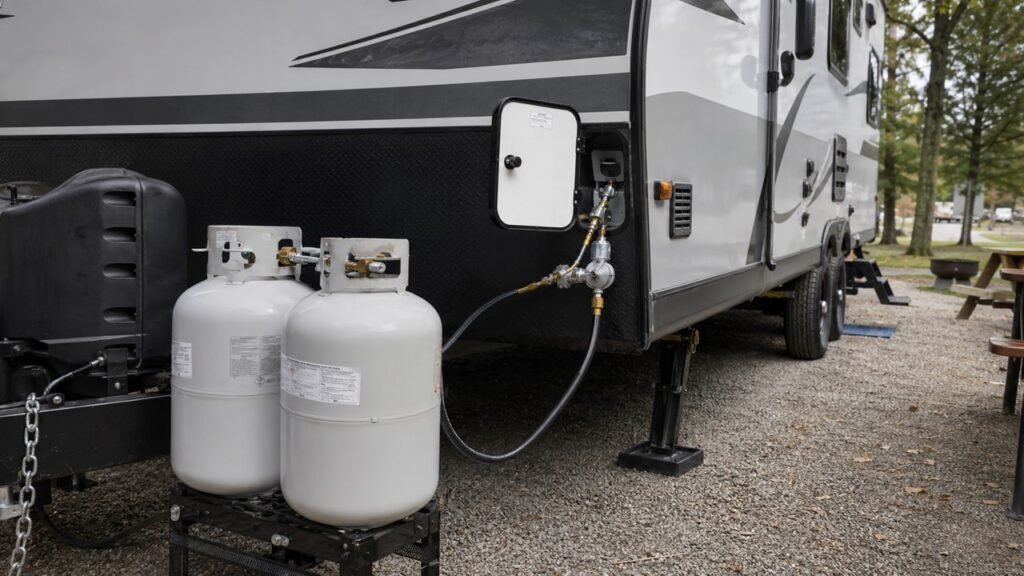
Many travel trailers carry batteries and propane cylinders on the A-frame.
Because these items sit well ahead of the axle, adding larger batteries or extra propane capacity can noticeably increase tongue weight.
Measure again after upgrading from one battery to a larger battery bank or changing the number of propane cylinders.
Rear Cargo Racks and Bike Carriers
Rear-mounted equipment can reduce tongue weight because it sits behind the axle.
The farther back the load sits, the more leverage it creates. This means a rear carrier may have a larger effect on balance than its weight alone suggests.
You should also confirm that the trailer bumper and frame are designed to support the carrier and its cargo.
Toy Haulers and Heavy Equipment
Toy haulers can experience major balance changes when motorcycles, ATVs, golf carts, or other equipment are loaded.
A toy hauler may have suitable tongue weight when empty but a very different percentage once the garage is full.
Follow the trailer manufacturer’s loading guidance and measure the final road-ready setup.
Cargo Movement During Travel
Even a properly loaded trailer can become unbalanced if heavy items move during the trip.
Hard braking, cornering, potholes, and rough roads can shift unsecured cargo forward, backward, or sideways.
Secure heavy items to appropriate anchor points. Do not rely on cabinet doors, lightweight boxes, or furniture to hold equipment in place.
Tongue Weight Ratings You Must Check
A correct tongue-weight percentage does not automatically make the towing setup safe. You also need to compare the actual load with every relevant rating.
- Tow vehicle tongue-weight limit
- Tow vehicle payload capacity
- Receiver hitch rating
- Ball mount rating
- Hitch ball rating
- Trailer coupler rating
- Weight-distribution hitch rating
- Rear axle rating
- Front axle rating
- Tow vehicle Gross Vehicle Weight Rating
- Gross Combination Weight Rating
- Trailer Gross Vehicle Weight Rating
- Trailer axle ratings
- Tow vehicle tire ratings
- Trailer tire ratings
The lowest-rated part determines the maximum safe limit.
For example, a 1,200-pound-rated ball mount does not allow you to carry 1,200 pounds of tongue weight when the receiver is rated for only 900 pounds.
Tongue weight also uses your tow vehicle’s payload capacity.
Suppose your vehicle has 1,500 pounds of available payload. A 700-pound tongue weight and a 100-pound hitch leave only 700 pounds for passengers, luggage, tools, and other cargo.
Common Tongue Weight Mistakes
- Calculating from the trailer’s dry weight
- Relying only on the advertised hitch weight
- Guessing weight by looking at suspension sag
- Measuring before loading travel supplies
- Forgetting the weight of water
- Ignoring batteries and propane cylinders
- Forgetting passengers and tow vehicle cargo
- Assuming suspension upgrades increase payload
- Treating the 60/40 rule as an exact measurement
- Loading heavy equipment at the extreme rear
- Using an undersized scale
- Measuring on uneven ground
- Supporting the coupler at the wrong height
- Measuring only at a jack positioned behind the coupler
- Forgetting the weight of hitch equipment
- Assuming weight distribution removes tongue weight
- Failing to measure after trailer modifications
- Ignoring axle and tire ratings
- Continuing to tow after sway begins
Trailer Tongue Weight Safety Checklist
- Load the trailer as you plan to tow it.
- Include normal water, propane, food, and equipment.
- Secure every movable item.
- Balance the cargo from side to side.
- Park on firm, level ground.
- Chock the trailer wheels.
- Use a scale with enough capacity.
- Keep the coupler near its normal towing height.
- Measure the actual tongue weight.
- Calculate the tongue-weight percentage.
- Follow the trailer manufacturer’s recommendation.
- Check the tow vehicle’s payload.
- Confirm the rear axle weight.
- Check every hitch component’s rating.
- Adjust cargo in small amounts.
- Reweigh after making changes.
- Inspect the towing setup before every trip.
- Stop safely if the trailer begins handling abnormally.
When Should You Get Professional Towing Help?
Some tongue-weight problems cannot be corrected by simply moving cargo. A professional inspection may be necessary when the trailer remains unstable or the towing equipment shows signs of damage.
Get professional help when:
- The trailer continues swaying after proper loading.
- The tow vehicle’s rear axle remains overloaded.
- You cannot reach the recommended percentage.
- The hitch receiver appears bent or cracked.
- The trailer frame shows signs of stress.
- Tire wear is uneven or excessive.
- The trailer has been structurally modified.
- The axle position appears incorrect.
- The weight-distribution hitch cannot be adjusted properly.
- The combination exceeds an important rating.
- Steering or braking still feels unsafe.
A qualified trailer technician or hitch installer can inspect the frame, suspension, axle alignment, hitch setup, and overall weight distribution.
Final Thoughts
Trailer tongue weight is the downward load the front of your trailer places on the tow vehicle’s hitch. For many bumper-pull trailers, the usual target is around 10% to 15% of the fully loaded trailer weight.
Do not depend only on dry specifications, visual sag, or general cargo-loading rules. Load the trailer for travel, measure the actual tongue weight, calculate its percentage, and compare the result with every towing rating.
When the weight is too low or too high, move cargo gradually and measure again. A properly balanced trailer gives you better stability, more predictable steering, and a safer towing experience.
Related FAQs
What Does 500 Pounds of Tongue Weight Mean?
It means the trailer places 500 pounds of downward pressure on the tow vehicle’s hitch. It does not reveal the trailer’s exact total weight by itself.
Is 10% Tongue Weight Enough?
Ten percent is commonly the lower end for a bumper-pull trailer. Follow the trailer manufacturer’s range and confirm the actual weight with a scale.
How Much Tongue Weight Is Too Much?
Tongue weight is too high when it exceeds the recommended percentage or any tow vehicle, hitch, payload, axle, or tire rating.
Can Too Much Tongue Weight Cause Trailer Sway?
Low tongue weight is more commonly linked to sway. Excessive tongue weight usually causes rear sag, overloading, and reduced steering or braking control.
Does Tongue Weight Count Against Payload?
Yes. Tongue weight, hitch equipment, passengers, accessories, and vehicle cargo all use the tow vehicle’s available payload capacity.
Should I Measure Tongue Weight With Water in the Tanks?
Measure with the amount of water you normally carry. Tank location and water level can noticeably change the trailer’s balance.
Can I Estimate Tongue Weight Without a Scale?
You can calculate a target range, but you need a suitable scale or weighing method to know the actual tongue weight.
Does Trailer Tongue Weight Change While Driving?
Yes. It can change when water moves between tanks or unsecured cargo shifts during braking, cornering, or rough-road travel.
Is Tongue Weight the Same as Payload?
No. Tongue weight is the downward trailer load on the hitch, while payload is the total weight the tow vehicle can carry.
Can I Measure Tongue Weight at the Trailer Jack?
A jack positioned behind the coupler may give a different reading because it sits closer to the axle. Measuring at the coupler is generally more accurate.
Does a Weight-Distribution Hitch Increase Payload?
No. It redistributes axle load but does not increase the vehicle’s official payload, axle, receiver, or towing ratings.
Should the Trailer Be Level When Measuring Tongue Weight?
Keep the trailer close to its normal towing position on firm, level ground. A significantly different coupler height may change the reading.

Michael Carter is an experienced RV traveler who focuses on practical outdoor trips across the States. He writes clear, step-by-step guides and realistic reviews based on real travel needs. His aim is to help RV and camper owners plan informed, simpler journeys with confidence.