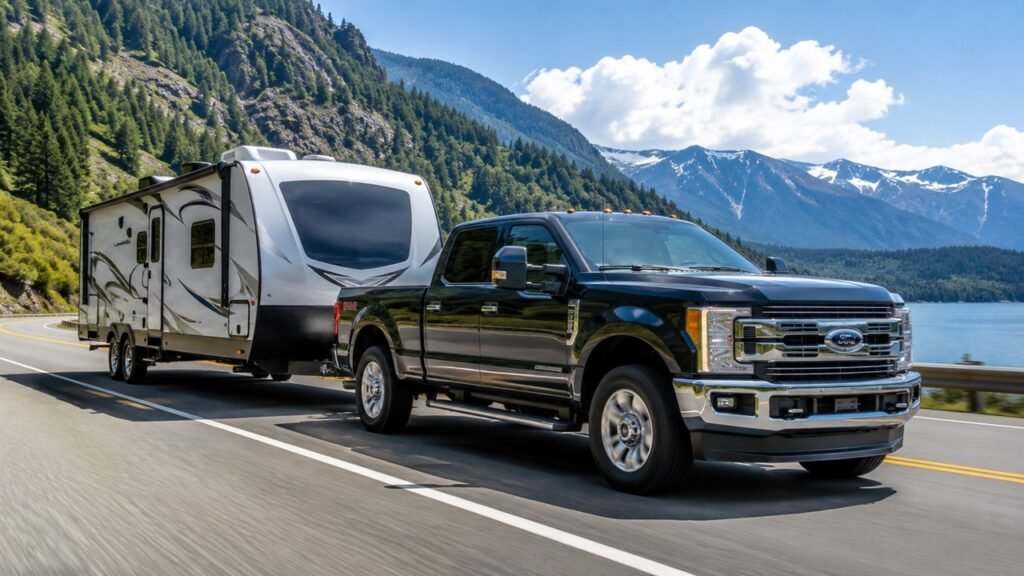
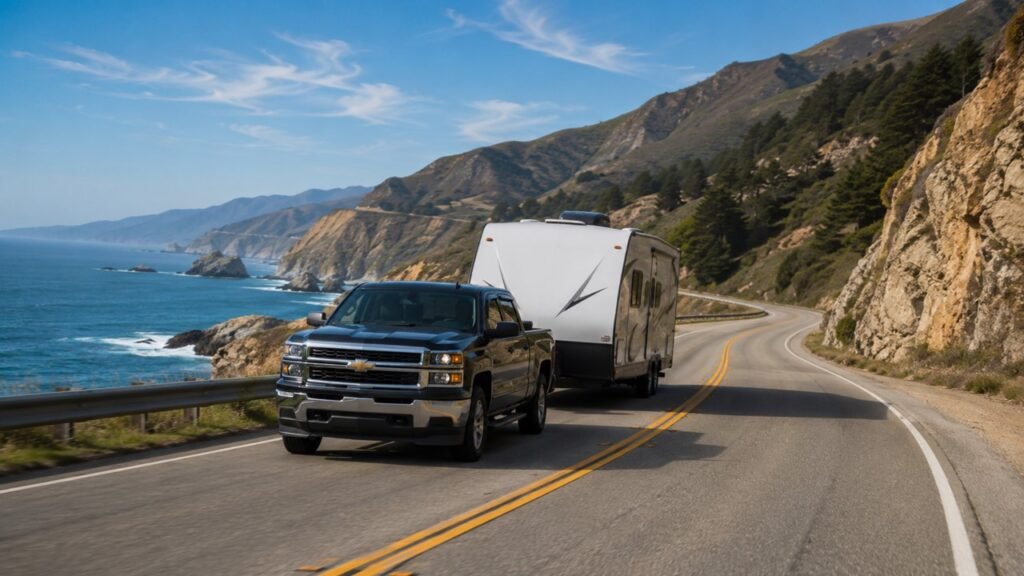
A trailer sways while driving when something causes it to move from side to side and its setup cannot naturally bring it back into line. The most common causes are rear-heavy loading, insufficient tongue weight, excessive speed, crosswinds, passing trucks, incorrect hitch adjustment, and tire or suspension problems.
Below, I’ll explain why trailer sway starts, how cargo placement affects stability, what to do during a sway event, and how you can prevent fishtailing before your next towing trip.
Key Takeaways
- Rear-heavy loading is one of the most common causes of trailer sway.
- Conventional trailers generally need 10% to 15% tongue weight.
- Strong winds, passing trucks, potholes, and sudden steering can trigger sway.
- Driving faster makes small trailer movements more difficult to control.
- Uneven tire pressure, worn suspension, and poor hitch setup can cause instability.
- Ease off the accelerator rather than making sudden steering or braking inputs.
- Apply the trailer brakes manually when appropriate and safe to do so.
- Never rely on sway-control equipment to compensate for unsafe loading.
- Stop and inspect the trailer before continuing after a serious sway event.
What Is Trailer Sway?
Trailer sway, sometimes called fishtailing or whipping, is a repeating side-to-side movement of a trailer behind its tow vehicle. The trailer pivots around the hitch, moving toward one side of the lane and then swinging back toward the other.
A brief movement does not always mean the trailer is dangerously unstable. For example, you may feel a small push when a large truck passes. A properly loaded trailer should settle back into line quickly once that outside force disappears.
The problem becomes dangerous when the movement continues, becomes wider, or increases with every swing. At that point, the trailer can begin pulling the tow vehicle sideways, reducing the driver’s ability to steer and remain inside the lane.
Conventional bumper-pull trailers are particularly vulnerable because their hitch connection sits behind the tow vehicle’s rear axle. This creates a pivot point through which trailer movement can influence the tow vehicle.
Fifth-wheel trailers can also move in strong winds or poor road conditions. However, they are generally less prone to severe sway because their hitch sits over or slightly ahead of the tow vehicle’s rear axle.
Why Does a Trailer Sway While Driving?
Trailer sway usually begins with a push from wind, a road disturbance, or a steering input. Whether that movement stops or becomes dangerous depends on the trailer’s weight distribution, tongue weight, speed, hitch setup, tires, and mechanical condition.
Improper Weight Distribution
Improper weight distribution is one of the biggest reasons a trailer sways.
When too much cargo is placed behind the trailer axles, the center of gravity moves rearward. Instead of naturally following the tow vehicle, the back of the trailer begins acting like the weighted end of a pendulum.
Once the trailer moves sideways, the rear-heavy load keeps carrying it in that direction. It then swings past the centerline and moves toward the opposite side. At higher speeds, each movement may become wider and more forceful.
This is why a trailer can appear manageable around town but become unstable after reaching highway speed.
Insufficient Tongue Weight
Tongue weight is the downward force that the trailer coupler places on the hitch ball.
For most conventional trailers, the loaded tongue weight should generally be around 10% to 15% of the trailer’s total loaded weight. Your trailer, hitch, and tow-vehicle manufacturer limits must still take priority.
When tongue weight is too low, the trailer does not have enough stabilizing pressure at the hitch. It can feel loose, wander behind the vehicle, or begin fishtailing after a small disturbance.
Extremely low or negative tongue weight is especially dangerous. It means the trailer’s rear-heavy load is trying to lift rather than press down on the hitch.
Excessive Towing Speed
Speed does not always start trailer sway, but it can make a small movement much worse.
At higher speeds, the trailer covers more distance during each side-to-side motion. The movement also develops more energy, giving the tires and suspension less time to bring the trailer back into line.
A trailer that feels stable at 45 mph may begin wandering at 60 mph because of a loading, tire, or hitch problem. Increasing speed further can turn that wandering into severe oscillation.
You should never assume the posted speed limit is automatically safe for your towing combination. Wind, traffic, road condition, trailer size, and load placement may require a much lower speed.
Crosswinds and Sudden Wind Gusts
Tall trailers have large, flat sides that catch crosswinds like a sail.
A steady side wind may push the trailer toward one edge of the lane. Sudden gusts are more difficult because they apply an unpredictable force that can quickly start lateral movement.
The effect is usually stronger on exposed bridges, mountain roads, open farmland, and highways without trees or buildings to block the wind.
A properly loaded trailer may recover from a mild gust. However, a rear-heavy or fast-moving trailer can continue swinging after the original gust has passed.
Air Pressure From Passing Trucks
Large trucks create powerful changes in air pressure as they approach and pass.
You may first feel the trailer pushed away from the truck. As the truck moves alongside, the lower-pressure area around it can pull your trailer toward the passing vehicle. Another push may occur as the truck moves ahead.
These pressure changes can make the trailer feel as though it is being pulled and released. Sudden steering corrections can make the movement worse.
Hold a steady lane position, keep both hands on the wheel, and leave as much safe space as possible when large vehicles pass.
Sudden Steering or Braking
Sharp steering inputs can move the trailer sideways faster than it can settle.
Common triggers include:
- Swerving around road debris
- Changing lanes abruptly
- Entering a curve too quickly
- Overcorrecting after a tire touches the shoulder
- Braking hard while the trailer is already moving sideways
The tow vehicle changes direction first, while the trailer continues following its previous path. This difference can start a whip-like motion at the hitch.
Smooth steering and early speed reduction give the entire combination more time to respond.
Downhill Towing
Gravity can make trailer instability more difficult to control on a downhill grade.
If the tow vehicle gains speed, the trailer may begin pushing from behind. A poorly loaded trailer can then start moving from side to side, particularly after a curve, wind gust, or braking input.
Long downhill sections also increase braking demands. Repeated or hard braking can overheat the brakes and upset the balance of the combination.
Enter descents at a controlled speed, select an appropriate lower gear, and follow the towing guidance provided for your vehicle and trailer.
Potholes, Road Edges, and Uneven Surfaces
A pothole or uneven road can push one side of the trailer away from its normal path.
Deep ruts, bridge joints, road construction, dips, soft shoulders, and pavement edges can all produce a sudden lateral movement. The effect may be stronger when one trailer tire encounters the disturbance before the other.
Slow down before rough sections whenever possible. Trying to make a sharp correction after hitting a pothole may create more instability than the original impact.
Incorrect Hitch Setup
Your trailer may sway even when the cargo appears correctly positioned if the hitch setup is wrong.
Possible hitch-related problems include:
- An incorrectly sized hitch ball
- A worn or loose coupler
- Excessive play between hitch components
- Incorrect hitch-ball height
- An underrated receiver or ball mount
- Poorly adjusted weight-distribution equipment
- Missing or improperly installed sway-control parts
- A trailer that sits noticeably nose-high
A nose-high trailer can place too much weight on the rear axle of a tandem-axle trailer. That imbalance may reduce stability and contribute to irregular tire wear.
The trailer should normally sit level when loaded and connected, unless the manufacturer specifies otherwise.
Tire Problems
Trailer tires play a major role in controlling side-to-side movement.
Underinflated tires have more sidewall flex. This can make the trailer feel soft, delayed, or unstable when changing direction. Low pressure also increases heat buildup and reduces the tire’s load-carrying ability.
Uneven tire pressure can make one side respond differently from the other. Mismatched tires, worn tread, separated belts, damaged sidewalls, and incorrect load ratings may also affect handling.
Check all tow-vehicle and trailer tires when they are cold. Use the applicable manufacturer recommendations rather than judging pressure by appearance.
Suspension, Wheel-Bearing, or Axle Problems
A trailer cannot track properly when its running gear is damaged or badly worn.
Possible mechanical causes include:
- Worn spring bushings
- Loose shackles
- Damaged leaf springs
- Worn equalizers
- Loose or failing wheel bearings
- Bent axles
- Incorrect axle alignment
- Broken suspension mounts
- Loose wheels
- Uneven brake operation
Look for unusual tire wear, leaning, wheel movement, heat near the hubs, or noises from the suspension. Persistent sway after correcting the load deserves a professional mechanical inspection.
Uneven or Unsecured Cargo
Cargo does not only need to be distributed from front to back. It must also be balanced from side to side.
Placing heavy tools, appliances, water containers, or equipment on one side can make the trailer lean and respond differently during turns.
Unsecured cargo is another serious problem. A heavy item that slides rearward or toward one wall can change tongue weight and balance while you are driving.
Secure heavy items to suitable anchor points. Do not depend on cabinet doors, lightweight storage bins, or friction alone to hold them in place.
How Trailer Weight Distribution Affects Sway
Cargo location changes the trailer’s center of gravity, tongue weight, axle loading, and resistance to rotation. A trailer can remain within its total weight limit and still be dangerously loaded.
What Happens When the Trailer Is Rear-Heavy?
A rear-heavy trailer has too much of its weight behind the axles.
This reduces the amount of downward force on the hitch. As tongue weight falls, the trailer becomes more likely to rotate around its axles after a wind gust, steering input, or road impact.
The weight at the rear also carries momentum during a sway event. Once it starts moving sideways, it can make each swing harder to stop.
Rear cargo racks require special attention. Bicycles, generators, spare tires, storage boxes, and motorcycles mounted behind the axles may reduce tongue weight more than expected.
What Happens When Too Much Weight Is at the Front?
Moving weight forward usually improves stability, but more is not always better.
Excessive tongue weight can:
- Overload the tow vehicle’s rear axle
- Exceed the hitch or receiver rating
- Make the rear suspension squat
- Reduce weight on the front tires
- Weaken steering response
- Change headlight aim
- Increase braking distance
- Overload the tow vehicle’s payload capacity
The goal is not to create the highest possible tongue weight. You need enough downward force for stability while staying within every applicable rating.
Why Heavy Items Should Stay Low and Near the Axles
Heavy items should generally be carried low and reasonably close to the trailer’s axle area, with enough weight ahead of the axles to maintain proper tongue weight.
Keeping weight low reduces the trailer’s tendency to lean during turns and wind gusts. Keeping heavy objects from being spread across the extreme front and rear also reduces rotational momentum.
Think about holding a small weight close to your chest compared with holding it at arm’s length. The farther the weight sits from the pivot point, the more effort it takes to stop its movement.
Does the 60/40 Loading Rule Prevent Sway?
The 60/40 rule suggests placing around 60% of the cargo weight in the front half of the trailer and 40% in the rear half.
This can be a helpful starting point for some utility and cargo trailers. However, it does not guarantee correct tongue weight because trailer designs, axle positions, permanent equipment, and cargo shapes differ.
Measure the actual loaded tongue weight instead of relying entirely on a visual estimate or general loading ratio.
| Loading Condition | Effect on Tongue Weight | Likely Handling | Sway Risk |
| Too much cargo behind the axles | Too low or possibly negative | Loose and unpredictable | Very high |
| Correctly balanced cargo | Within the recommended range | Stable and predictable | Lower |
| Excessive cargo at the front | Too high | Vehicle may squat or steer poorly | Moderate to high |
| Heavy cargo carried high | Varies | More body roll and leaning | High |
| Uneven side-to-side loading | May appear acceptable | Pulling or uneven response | High |
| Secured cargo kept low near the axles | Easier to manage | More controlled tracking | Lower |
How Much Tongue Weight Does a Trailer Need?
Correct tongue weight helps the trailer follow the tow vehicle without overloading the hitch or rear axle. You should measure it with the trailer loaded exactly as it will travel.
Recommended Tongue Weight for Conventional Trailers
A conventional bumper-pull trailer commonly needs tongue weight equal to approximately 10% to 15% of its total loaded weight.
For example, a loaded 5,000-pound trailer may need approximately 500 to 750 pounds of tongue weight. However, you must also confirm that the tow vehicle, receiver, hitch, ball mount, and trailer coupler can handle that amount.
Use the trailer’s actual loaded weight rather than its empty or advertised dry weight.
Are Fifth-Wheel Tongue-Weight Requirements Different?
Fifth-wheel trailers use pin weight rather than conventional tongue weight.
Their pin weight is commonly a higher percentage of loaded trailer weight because the hitch sits directly over or slightly ahead of the tow vehicle’s rear axle.
Do not apply conventional bumper-pull tongue-weight percentages to a fifth wheel. Follow the ratings and loading guidance for your specific trailer and tow vehicle.
How to Measure Trailer Tongue Weight
- Load the trailer with the equipment it will carry during travel.
- Account for batteries, propane, water, fuel, luggage, and accessories.
- Secure the cargo in its normal traveling position.
- Park the trailer on a firm and level surface.
- Use a suitable tongue-weight scale or certified vehicle scale.
- Compare the measurement with the trailer and tow-vehicle ratings.
- Reposition cargo when the weight is outside the safe range.
- Measure again after making any meaningful loading changes.
Do not assume the weight is correct simply because the tow vehicle appears level.
Why Water Tanks and Gear Can Change Tongue Weight
Water weighs roughly eight pounds per gallon, so tank placement can noticeably affect balance.
A freshwater tank positioned ahead of the axles may increase tongue weight when full. A tank behind the axles may reduce it. Gray and black tanks can produce similar changes as they fill during a trip.
Other items that can significantly change tongue weight include:
- Propane cylinders
- Batteries
- Generators
- Motorcycles
- Toolboxes
- Spare tires
- Rear-mounted bicycles
- Fuel containers
- Outdoor kitchens
- Cargo trays
Measure the trailer in the condition in which it will actually be towed.
What Does Trailer Sway Feel Like?
Trailer sway often starts subtly. Recognizing the early signs gives you a better chance of slowing down before the movement becomes severe.
Warning signs include:
- Repeated side-to-side movement in your mirrors
- A pulling or tugging sensation at the rear of the vehicle
- Frequent steering corrections on a straight road
- Movement that continues after a truck has passed
- The trailer stepping sideways after a wind gust
- The steering feeling unusually light or vague
- The trailer wandering near a repeatable speed
- Increasing movement during a downhill section
- Tires appearing to scrub sideways across the lane
A brief push that immediately settles is different from repeated oscillation. Any movement that grows wider or continues without an outside force should be treated as a serious warning.
What Should You Do If Your Trailer Starts Swaying?
Your response should be calm, smooth, and consistent. Manufacturer instructions for your tow vehicle, trailer, brake controller, and sway-control system always take priority.
- Hold the steering wheel firmly. Keep the tow vehicle pointed straight and centered in its lane.
- Avoid sudden countersteering. Trying to steer against every trailer movement can increase the oscillation.
- Ease off the accelerator. Allow the tow vehicle and trailer to slow gradually.
- Avoid slamming the tow vehicle’s brakes. Abrupt braking can further upset an already unstable combination.
- Apply the trailer brakes manually when appropriate. If your electric brake controller allows independent trailer braking, use the manual control smoothly and progressively. This can help pull the trailer back into line.
- Do not accelerate to escape severe sway. More speed generally increases the energy of the movement and leaves less time to react.
- Remain on a firm surface. Do not immediately steer onto a soft, sloped, or uneven shoulder while the trailer is still moving sideways.
- Pull over after the trailer settles. Choose a safe, level location away from traffic.
- Inspect the setup before continuing. Check cargo placement, tongue weight, hitch components, tires, suspension, and weather conditions.
- Resume only after correcting the likely cause. Continuing at a slightly lower speed without inspecting the trailer may allow the sway to return.
Practice locating your brake controller’s manual control before towing. During an emergency, you should not need to look away from the road to find it.
What Should You Avoid During a Sway Event?
Certain natural reactions can make trailer sway more severe.
Avoid the following actions:
- Do not make rapid steering corrections.
- Do not accelerate to pull the trailer straight.
- Do not slam the tow vehicle’s brakes.
- Do not immediately change lanes.
- Do not steer onto a soft shoulder during active sway.
- Do not focus entirely on the trailer in your mirrors.
- Do not continue at the same speed once the sway settles.
- Do not assume your sway-control system will solve the problem.
- Do not resume towing without inspecting the trailer.
Keep looking toward the intended path while remaining aware of surrounding traffic. Your main priority is maintaining a straight, predictable direction while reducing speed smoothly.
How to Prevent Trailer Sway Before Driving
Most trailer sway problems can be reduced through careful loading, inspection, and driving. Complete these checks before entering high-speed roads.
Load the Trailer Front-to-Back Correctly
Start by placing enough cargo ahead of the trailer axles to create proper tongue weight.
Avoid concentrating heavy items against the rear wall or on a rear cargo rack. After loading, measure the tongue weight rather than estimating it by how the trailer looks.
If the tongue weight is too low, move suitable cargo forward. If it is too high, reposition items carefully without making the rear excessively heavy.
Balance the Trailer From Side to Side
Distribute portable cargo evenly between the left and right sides.
Remember that permanent equipment also affects balance. Refrigerators, kitchens, slide-outs, water tanks, batteries, and storage compartments may make one side naturally heavier.
A vehicle scale that provides individual wheel or side weights can reveal imbalances that are not visible in the driveway.
Secure Every Heavy Item
Use suitable straps, tie-down points, wheel chocks, brackets, or cargo restraints.
Heavy cargo should not be able to slide during:
- Braking
- Cornering
- Acceleration
- Rough-road travel
- Emergency maneuvers
Check the load again after the first few miles, especially when carrying machinery, motorcycles, appliances, or construction materials.
Confirm the Trailer Is Level
Stand back and look at the loaded trailer from the side after hitching.
It should generally sit level rather than noticeably nose-high or nose-low. A trailer that is not level may place unequal weight on its axles and change its handling.
Adjust the ball mount, hitch head, or weight-distribution system according to the applicable instructions. Never use an incorrectly rated drop or rise mount simply to change the trailer’s appearance.
Check Tow-Vehicle and Trailer Weight Ratings
Confirm that your combination stays within all relevant limits, including:
- Gross Vehicle Weight Rating
- Gross Axle Weight Rating
- Gross Combined Weight Rating
- Trailer Gross Vehicle Weight Rating
- Tow-vehicle payload capacity
- Maximum trailer weight
- Maximum tongue weight
- Receiver and hitch ratings
- Tire load ratings
Passengers, fuel, luggage, accessories, and tongue weight all consume tow-vehicle payload capacity.
Inspect and Inflate the Tires
Check tire pressure before driving, while the tires are cold.
Inspect each tire for:
- Cracks
- Bulges
- Cuts
- Uneven wear
- Exposed cords
- Low tread
- Embedded objects
- Signs of aging
- Incorrect load ratings
Do not forget the tow vehicle’s tires or the trailer’s spare. A spare tire with low pressure may be useless during an emergency.
Test the Trailer Brakes and Brake Controller
Before entering traffic, confirm that the trailer brakes engage properly.
Make sure you understand:
- How to adjust controller gain
- Where the manual override is located
- How the brakes feel at low speed
- Whether the breakaway switch works
- How trailer weight affects the required setting
The trailer brakes should provide useful stopping force without locking prematurely.
Inspect the Hitch and Coupler
Confirm that every hitch component is correctly connected and secured.
Check the following:
- Coupler fully seated on the ball
- Coupler latch locked
- Correct ball diameter
- Hitch pin and retaining clip installed
- Weight-distribution bars correctly attached
- Sway-control components adjusted
- Safety chains crossed and connected
- Electrical plug secured
- Breakaway cable independently attached
- Jack and stabilizers fully raised
A breakaway cable should not be looped around a removable hitch component that could separate with the trailer.
Reduce Speed for the Conditions
Drive at a speed that gives the trailer time to recover from disturbances.
Reduce speed for:
- Strong winds
- Wet roads
- Heavy traffic
- Downhill grades
- Construction areas
- Curves
- Rough pavement
- Passing trucks
- Unfamiliar trailers
Leaving a larger following distance also reduces the need for sudden braking and steering.
Check the Weather and Route
Review the route before departure, particularly when towing a tall or lightweight trailer.
Consider:
- Crosswind forecasts
- Wind gusts
- Exposed bridges
- Mountain passes
- Long downhill sections
- Narrow roads
- Construction zones
- Truck-heavy highways
- Severe-weather warnings
Delaying a trip is often safer than trying to maintain control in conditions that repeatedly push the trailer across the lane.
Does a Weight-Distribution Hitch Stop Trailer Sway?
Weight distribution and sway control are related, but they perform different jobs. Understanding the difference can help you avoid expecting one device to correct every towing problem.
What a Weight-Distribution Hitch Does
A weight-distribution hitch uses spring bars to transfer part of the tongue load toward the tow vehicle’s front axle and the trailer axles.
This can improve:
- Tow-vehicle posture
- Front-tire loading
- Steering response
- Braking balance
- Headlight aim
- Overall control
It does not remove tongue weight or increase the vehicle’s rated payload. The actual load still exists and must remain within all component ratings.
What Sway Control Does
Sway-control equipment resists unwanted movement at the hitch or applies braking when movement is detected.
Common types include:
- Friction sway-control bars
- Cam-style systems
- Four-point integrated hitches
- Trailer-mounted electronic controllers
- Tow-vehicle electronic stability systems
Each system works differently and requires correct installation, adjustment, and maintenance.
What a Sway-Control Hitch Cannot Fix
Sway-control equipment cannot safely compensate for:
- Rear-heavy loading
- Insufficient tongue weight
- Excessive trailer weight
- Overloaded axles
- Underinflated tires
- Damaged suspension
- Bent axles
- An incorrectly sized hitch ball
- Excessive driving speed
- Unsafe weather conditions
Treat sway control as an additional layer of stability—not permission to ignore loading and maintenance.
When Professional Hitch Setup Is Worthwhile
Consider professional setup when:
- The tow vehicle squats excessively.
- The steering feels light after hitching.
- The trailer remains nose-high.
- Sway appears despite correct loading.
- You cannot restore the recommended front-axle load.
- Weight-distribution bars appear incorrectly sized.
- Hitch components show unusual wear.
- You are unsure how to measure or adjust the system.
A qualified professional can inspect the entire combination rather than adjusting one component in isolation.
Can Electronic Trailer Sway Control Help?
Electronic sway-control systems can help reduce certain trailer movements, but they are backup systems rather than substitutes for correct loading.
Some tow vehicles use steering, yaw, and wheel-speed sensors to identify trailer oscillation. The vehicle may reduce engine power or apply individual brakes to help stabilize the combination.
Trailer-mounted systems may apply one or both trailer brakes when lateral movement is detected. This braking force can help bring the trailer back behind the tow vehicle.
These systems cannot change incorrect tongue weight, repair a damaged axle, or make an overloaded trailer safe. You should still investigate any sway event even when an electronic system successfully corrects it.
Why Does My Trailer Sway Only at Certain Speeds?
Some trailer combinations become unstable only after reaching a particular speed.
At lower speeds, the tires, suspension, and hitch may have enough time to control small movements. As speed rises, those same movements can begin repeating before the trailer fully settles.
The speed at which this occurs may be influenced by:
- Low tongue weight
- Cargo placement
- Tire pressure
- Tire sidewall flexibility
- Trailer length
- Hitch geometry
- Suspension condition
- Wind
- Road surface
- Tow-vehicle wheelbase
Do not treat the onset speed as a safe towing limit. Repeated sway at a predictable speed usually means an underlying setup or mechanical problem needs attention.
Why Does My Trailer Sway When Trucks Pass?
A large truck moves a considerable amount of air as it travels.
As the truck approaches, the pressure wave can push your trailer away. When it comes alongside, the lower-pressure area near the truck may pull the trailer toward it. Another airflow change occurs as the truck moves ahead.
You may feel several separate movements during one pass.
Hold your lane with smooth steering, avoid staring at the truck, and reduce speed when repeated passes are affecting control. Leaving extra space from the lane line can also provide a larger safety margin.
Why Does My Trailer Sway in the Wind?
A trailer’s size, weight, height, and side profile determine how strongly it reacts to wind. Tall, lightweight, and enclosed trailers are often affected more than low, compact designs.
How Much Wind Is Too Much for Towing?
There is no single wind speed that is safe for every towing combination.
The risk depends on:
- Trailer height and length
- Loaded weight
- Tongue weight
- Wind direction
- Gust strength
- Road exposure
- Vehicle size
- Driver experience
- Traffic
- Road surface
A moderate crosswind on an exposed bridge may create more difficulty than a stronger headwind on a sheltered road.
Warning Signs That Conditions Are Becoming Unsafe
Watch for:
- Constant steering corrections
- Difficulty maintaining lane position
- Unpredictable gusts
- Repeated trailer movement
- Trailer leaning or stepping sideways
- Warnings for high-profile vehicles
- Nearby trucks struggling to remain in their lanes
- The tow vehicle being pushed toward the shoulder
These signs matter more than any single wind-speed number.
When to Delay the Trip
Reduce speed or leave the highway when you cannot hold a stable lane without frequent corrections.
Find a safe parking area and wait when gusts are repeatedly moving the trailer sideways. A delay is far less costly than losing control of the combination.
Why Does an Empty Trailer Sway More Easily?
Some empty trailers react strongly to wind and rough roads because they have little weight relative to their side area.
An unloaded enclosed trailer may catch a crosswind while lacking enough mass to resist the push. Its suspension can also feel stiff and bouncy because it was designed to carry a heavier load.
However, an empty trailer is not automatically unstable. It should still have positive tongue weight, correct tire pressure, aligned axles, and a secure hitch connection.
Never add random unsecured weight simply to make a trailer feel heavier. Any added load must remain within the trailer’s rating and be properly positioned and secured.
Can Too Much Tongue Weight Cause Sway?
Excessive tongue weight is less commonly associated with classic trailer fishtailing than insufficient tongue weight. However, it can create other handling problems that reduce overall control.
Too much tongue weight can overload the tow vehicle’s rear tires and axle while removing weight from the front tires. This can make the steering feel slow or vague and reduce braking effectiveness.
A badly overloaded rear suspension may also change hitch height and trailer attitude.
Do not keep moving cargo forward until the sway disappears without measuring the result. The correct solution is balanced loading within the recommended tongue-weight range and all equipment ratings.
Trailer Sway Troubleshooting Checklist
Use this table after a sway event or whenever the trailer feels unstable.
| Check | What to Inspect | Possible Correction |
| Tongue weight | Actual percentage at full travel load | Reposition cargo and measure again |
| Cargo placement | Rear-heavy, high, loose, or uneven items | Move heavy items low and forward |
| Trailer attitude | Nose-high or excessively nose-low position | Correct the hitch-ball height |
| Tire pressure | Cold pressure across all tires | Inflate to the proper specification |
| Tire condition | Age, damage, wear, or mismatched construction | Replace unsuitable tires |
| Hitch components | Loose, worn, damaged, or underrated parts | Repair or replace affected parts |
| Brake controller | Gain and manual-control operation | Adjust and test at low speed |
| Suspension | Springs, shackles, bushings, and equalizers | Replace worn components |
| Wheel bearings | Looseness, heat, or noise | Service or replace the bearings |
| Axle alignment | Bent axle or abnormal tire wear | Arrange a professional inspection |
| Vehicle loading | Rear-axle or payload overload | Remove weight or use a suitable vehicle |
| Driving speed | Movement appears as speed increases | Slow down and correct the cause |
| Weather | Crosswinds or strong gusts | Delay travel or change the route |
When Should You Get the Trailer Professionally Inspected?
A trailer should not repeatedly sway under normal driving conditions. Seek professional help when adjustments and basic checks do not solve the problem.
Arrange an inspection when:
- Sway continues after correcting cargo placement.
- The trailer consistently pulls toward one side.
- Tires show rapid or uneven wear.
- The trailer leans when parked on level ground.
- An axle appears bent or misaligned.
- Wheel hubs become unusually hot.
- Bearings make grinding or humming noises.
- Suspension parts look loose or damaged.
- The hitch or coupler has visible wear.
- The trailer was recently involved in a collision.
- A wheel struck a curb or deep pothole.
- Sway begins at relatively low speeds.
- Correct tongue weight cannot be achieved safely.
Do not continue towing a trailer with suspected structural, axle, wheel-bearing, tire, or hitch damage.
Practical Pre-Trip Sway-Prevention Checklist
Before every towing trip:
- Confirm the trailer’s loaded weight.
- Measure or verify tongue weight.
- Check the tow vehicle’s available payload.
- Stay within axle and tire ratings.
- Keep heavy items low.
- Position adequate cargo ahead of the axles.
- Balance the trailer from side to side.
- Secure every heavy item.
- Confirm the trailer sits level.
- Inspect the hitch and coupler.
- Lock the coupler latch.
- Install the hitch pin and retaining clip.
- Attach the safety chains correctly.
- Connect the breakaway cable independently.
- Plug in and test the trailer lights.
- Test the trailer brakes.
- Set the brake-controller gain.
- Check cold tire pressure.
- Inspect tire condition.
- Verify lug-nut torque as required.
- Check the wheel bearings and suspension.
- Review wind and road conditions.
- Begin slowly and perform a low-speed handling check.
A few minutes of inspection can reveal a problem before highway speed gives it an opportunity to become dangerous.
Conclusion
A trailer usually sways because its weight, speed, hitch setup, or mechanical condition prevents it from recovering after a sideways disturbance. Rear-heavy loading and insufficient tongue weight are especially common causes, but wind, passing trucks, tire problems, rough roads, and sudden driving inputs can also start the movement.
The safest approach is to prevent instability before driving. Measure your loaded tongue weight, secure and balance the cargo, stay within every weight rating, inspect the tires and hitch, test the brakes, and adjust your speed for the road and weather.
Should sway begin, remain calm, hold a steady direction, ease off the accelerator, and use the trailer brakes manually when your equipment and manufacturer instructions allow it. Once the trailer settles, stop somewhere safe and correct the cause before continuing.
Related FAQs
Is a Little Trailer Sway Normal?
A brief movement from a wind gust or passing truck can occur, but the trailer should settle immediately. Repeated or increasing side-to-side movement is not normal.
At What Speed Does Trailer Sway Usually Start?
There is no universal speed because loading, trailer design, wind, tires, and hitch setup differ. However, instability usually becomes more severe as speed increases.
Can a Trailer Sway Even With Proper Tongue Weight?
Yes. Crosswinds, excessive speed, uneven roads, tire problems, suspension damage, abrupt steering, or an incorrect hitch setup can still trigger trailer movement.
Will Adding More Weight Stop Trailer Sway?
Not necessarily. Weight should be repositioned rather than added blindly because extra cargo may overload the trailer, hitch, tires, or tow vehicle.
Do Dual-Axle Trailers Sway Less?
Tandem axles can improve tracking and load support, but they do not prevent sway caused by poor loading, low tongue weight, excessive speed, or mechanical problems.
Can Underinflated Trailer Tires Cause Sway?
Yes. Underinflated tires flex excessively, build heat, reduce load capacity, and may make the trailer feel soft or unstable during side-to-side movement.
Can a Weight-Distribution Hitch Make Sway Worse?
An incorrectly sized or adjusted weight-distribution hitch can negatively affect handling. The system must be matched to the trailer and set up according to its instructions.
Should I Tow With the Freshwater Tank Full or Empty?
It depends on the tank’s location and the trailer’s ratings. A full tank can increase or decrease tongue weight, so check how the load affects your specific trailer.
Can Rear Cargo Racks Cause Trailer Sway?
Yes. Generators, bicycles, spare tires, and storage boxes mounted behind the axles can reduce tongue weight and increase the trailer’s rotational movement.
Is Trailer Sway More Common Going Downhill?
It can be. Gravity, increasing speed, braking demands, and a trailer pushing from behind can make an unstable towing combination more difficult to control.

Michael Carter is an experienced RV traveler who focuses on practical outdoor trips across the States. He writes clear, step-by-step guides and realistic reviews based on real travel needs. His aim is to help RV and camper owners plan informed, simpler journeys with confidence.