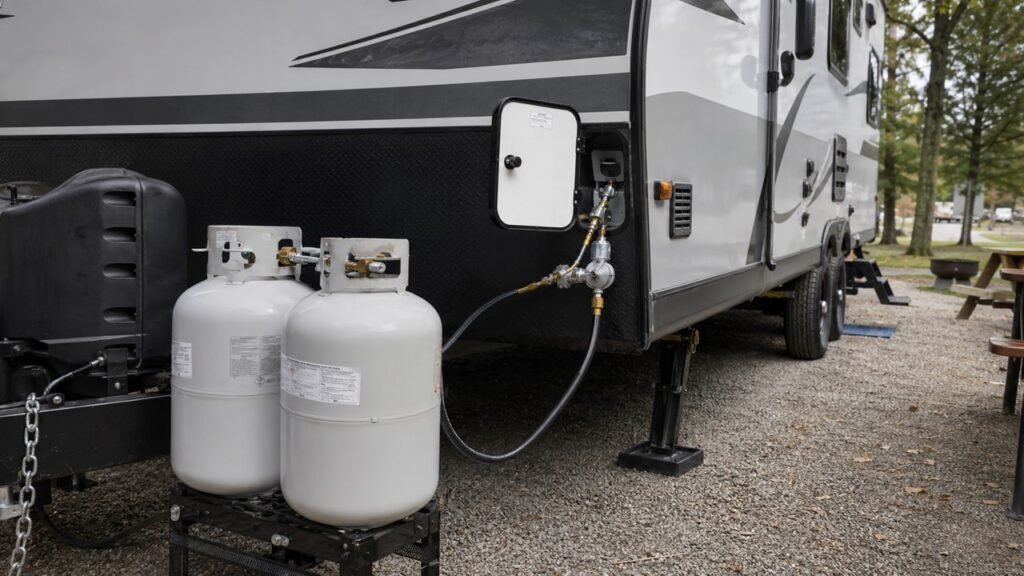
An RV propane system stores propane under pressure, reduces that pressure through a regulator, and sends low-pressure gas through dedicated lines to appliances like the furnace, stove, oven, water heater, and refrigerator. In simple words, the tank holds the fuel, the regulator makes it safe to use, and the gas lines deliver it where it needs to go.
In this guide, I’ll walk you through how the full RV propane system works, what each part does, how propane reaches your appliances, how much propane RVs use, and what safety checks you should never ignore.
Key Takeaways
- An RV propane system uses stored LP gas to power heat-producing appliances.
- Propane is stored as a pressurized liquid but used by appliances as vapor.
- The regulator lowers high tank pressure to safe appliance pressure.
- Most RV propane appliances run on low-pressure gas after the regulator.
- Travel trailers often use removable DOT cylinders.
- Motorhomes usually use permanently mounted ASME propane tanks.
- A dual-tank setup may use an automatic changeover regulator.
- Propane is great for camping without shore power.
- LP gas detectors and carbon monoxide detectors are important safety devices.
- Any leak, damaged line, or regulator issue should be handled seriously.
How an RV Propane System Works at a Glance
The easiest way to understand an RV propane system is to follow the gas from the tank to the appliance. The system looks complicated at first, but the basic path is simple once you break it down.
Here is the basic flow:
Propane tank → Service valve → Pigtail hose → Regulator → Main propane line → Appliance valve → Burner or igniter
The propane starts inside the tank under pressure. When you open the service valve, propane vapor leaves the tank and moves through a short hose toward the regulator. The regulator lowers the pressure so the gas is safe for RV appliances. From there, the gas travels through the RV’s propane lines to the appliance you want to use.
So, when you turn on your stove, furnace, or water heater, you are not using raw high-pressure propane directly from the tank. You are using controlled low-pressure propane that has already passed through the regulator.
That pressure control is what makes the system safe and usable inside a small RV.
Main Parts of an RV Propane System
An RV propane system is made of several parts that work together. Each part has a simple job, but the system only works safely when all of them are in good condition.
Propane Tank or Cylinder
The propane tank is the storage container for your RV’s LP gas. Depending on your RV type, this may be a removable cylinder or a permanently mounted tank.
Travel trailers, fifth wheels, pop-up campers, and truck campers usually use removable DOT propane cylinders. Motorhomes usually use ASME propane tanks that are mounted to the frame.
The tank stores propane as a liquid under pressure. A vapor pocket forms above the liquid, and that vapor is what leaves the tank when your RV appliances need fuel.
Service Valve
The service valve is the main valve on the propane tank. When you open it, propane can leave the tank. When you close it, propane flow stops.
This is the first valve you should think about when something propane-related is not working. Many “my RV propane is not flowing” problems start with a closed valve, a low tank, or a valve opened too quickly.
It is usually best to open the service valve slowly. Opening it too fast can sometimes trigger the excess flow safety device and restrict propane flow.
Pigtail Hose
The pigtail hose connects the propane cylinder to the regulator. On many travel trailers, you will see one or two short hoses running from the propane cylinders to the regulator mounted nearby.
This hose is important because it carries propane before the regulator lowers the pressure. That means the pigtail handles higher pressure than the propane lines inside the RV.
For that reason, you should inspect pigtail hoses regularly. Look for cracks, stiffness, rubbing, weather damage, or loose fittings. If a pigtail looks worn, replace it with the correct RV-rated hose.
Two-Stage Regulator
The regulator is one of the most important parts of the RV propane system. Its job is to take high, changing tank pressure and reduce it to a steady low pressure that your appliances can use.
Most RVs use a two-stage regulator. The first stage lowers the pressure from the tank. The second stage lowers it again to the safe operating pressure needed by RV appliances.
Without the regulator, the pressure from the tank would be far too high for your stove, furnace, refrigerator, or water heater.
Automatic Changeover Regulator
Many RVs with two propane cylinders use an automatic changeover regulator. This type of regulator lets the RV draw propane from one cylinder first. When that cylinder gets empty, the regulator can switch over to the second cylinder.
Usually, you point the selector toward the tank you want to use first. When that tank empties, the indicator may change color, often from green to red. That tells you the first tank needs to be refilled.
The benefit is convenience. You can keep camping without suddenly losing heat or hot water in the middle of the night.
Main Propane Line and Branch Lines
After the regulator lowers the pressure, propane moves through the RV’s main propane line. From there, smaller branch lines carry gas to individual appliances.
These lines may be made from copper tubing, black iron pipe, or approved flexible gas lines, depending on the RV design and location. The important point is that these lines are designed for low-pressure propane after the regulator.
You should never modify propane lines casually. If a line is damaged, leaking, or needs to be moved, it is safer to call an RV technician or qualified propane professional.
Appliance Shutoff Valves
Many propane appliances have their own shutoff valve nearby. These valves allow the gas supply to one appliance to be turned off without shutting down the entire RV propane system.
For example, your water heater, furnace, refrigerator, or stove may have a dedicated valve. These valves are helpful for service, replacement, or troubleshooting.
If one propane appliance is not working, checking its individual shutoff valve can save you a lot of confusion.
LP Gas Detector and Carbon Monoxide Detector
Your RV should have an LP gas detector mounted low inside the cabin because propane is heavier than air. If propane leaks inside the RV, it can settle near the floor.
You should also have a working carbon monoxide detector. Propane itself is not carbon monoxide, but propane-burning appliances can produce carbon monoxide if combustion or venting is poor.
Both detectors are safety devices, not optional extras. Test them regularly and replace them according to the manufacturer’s date or instructions.
RV Propane Tank Types: DOT Cylinders vs ASME Tanks
Not all RV propane tanks are the same. The two common types are DOT cylinders and ASME tanks, and the type you have depends mostly on your RV style.
| Feature | DOT Propane Cylinder | ASME Propane Tank |
| Common RV Type | Travel trailers, fifth wheels, pop-ups, truck campers | Motorhomes and some larger RVs |
| Mounting Style | Removable | Permanently mounted |
| Refill Method | Can be removed and taken to a refill station | RV usually goes to the refill station |
| Common Sizes | Often 20 lb, 30 lb, or 40 lb cylinders | Varies by motorhome size |
| Connection Style | Often ACME-style hand-tight connection | Often fixed fittings designed for mounted tanks |
| Certification | Requires periodic requalification | Different inspection and service requirements |
| Best For | Easy removal, refilling, and exchanging | Larger onboard propane capacity |
DOT cylinders are common on towable RVs because they are easy to remove. You can take them to a refill station, hardware store, propane dealer, or campground refill service.
ASME tanks are common on motorhomes because they are built into the RV. These tanks are not removed for refilling. Instead, you drive the motorhome to a propane fill station.
Both tank types do the same basic job. They store propane safely and send vapor to the RV propane system. The main differences are how they are mounted, filled, inspected, and connected.
How Propane Is Stored Inside the RV Tank
Propane storage can feel confusing because propane acts like both a liquid and a gas inside the tank. Once you understand that part, the whole system makes much more sense.
Propane Is Stored as a Liquid
Inside the tank, propane is stored as a liquid under pressure. This allows a lot of fuel to fit into a smaller container.
That is why propane is useful for RVs. A cylinder can hold enough energy to run a furnace, stove, water heater, and refrigerator without needing campground electricity.
However, your appliances do not burn the liquid propane directly. They burn propane vapor.
Appliances Use Propane Vapor, Not Liquid Propane
When propane sits inside the tank, liquid propane stays at the bottom and propane vapor forms above it. When you open the tank valve, vapor leaves from the top of the tank.
That vapor then travels to the regulator, where the pressure is reduced. After that, it can safely move through the RV’s propane lines.
This is one reason propane cylinders must be used in the correct position. Portable cylinders should normally remain upright so the system draws vapor, not liquid.
Why Propane Tanks Are Not Filled to 100%
Propane tanks are not filled completely to the top. They need empty space for vapor and expansion.
As temperature rises, propane expands. If a tank were filled completely with liquid propane, there would not be enough room for expansion. That could create unsafe pressure.
This is why propane tanks are commonly filled to about 80% of their water capacity. That empty space is not wasted space. It is part of the safety design.
Why Propane Has a Rotten-Egg Smell
Propane is naturally odorless. Because leaks would be hard to notice, a strong-smelling odorant is added to propane.
That odor is often described as rotten eggs, sulfur, or skunk-like. If you smell that inside or around your RV, treat it seriously.
Do not assume it is normal. A propane smell can mean a leak, loose fitting, appliance issue, or regulator problem.
How the Two-Stage RV Propane Regulator Works
The regulator is the part that makes high-pressure tank propane usable. Without it, your RV appliances would receive far more pressure than they are designed to handle.
Why Tank Pressure Is Too High for RV Appliances
Propane pressure inside a tank changes based on temperature and the amount of propane in the tank. On a warm day, the pressure can be much higher than on a cold day.
RV appliances cannot safely use that changing tank pressure. They need a steady, low-pressure supply.
That is where the regulator comes in. It controls the flow and pressure before propane reaches your appliances.
First Stage: High Pressure to Medium Pressure
The first stage of the regulator takes the high pressure coming from the propane tank and lowers it to a more controlled medium pressure.
This protects the downstream part of the system. It also makes the second stage’s job easier.
You can think of the first stage as the first big pressure drop.
Second Stage: Medium Pressure to Appliance Pressure
The second stage lowers the pressure again to the level RV appliances are designed to use.
Many RV propane appliances operate around 11 inches of water column, which is roughly 0.4 PSI. That may sound tiny compared with tank pressure, but it is enough for controlled appliance burners.
This low-pressure supply is what feeds your stove flame, furnace burner, water heater burner, and propane refrigerator burner.
Why RVs Use Two Stages Instead of One
A two-stage regulator gives steadier pressure than a single pressure drop. That matters because RVs often run more than one propane appliance.
For example, you might run the furnace, water heater, and refrigerator on propane during a cold night. The regulator needs to keep the gas pressure stable even as appliance demand changes.
Two-stage regulation helps prevent weak flames, poor ignition, and inconsistent appliance performance.
Signs of a Bad Propane Regulator
A bad regulator can make several appliances act strangely at the same time. If only one appliance has trouble, the appliance itself may be the problem. If many appliances have weak propane performance, look closer at the regulator.
Common signs include:
- Weak stove flame
- Yellow or lazy burner flame
- Furnace starts but does not stay lit
- Water heater fails to ignite
- Refrigerator struggles on propane mode
- Propane smell near the regulator
- Hissing sound from the regulator area
- Regulator freezing in unusual conditions
- Appliances work poorly even with full tanks
| Regulator Stage | What It Does | Why It Matters |
| First Stage | Drops high tank pressure to medium pressure | Protects the system after the tank |
| Second Stage | Drops pressure to appliance level | Helps appliances burn safely and steadily |
| Both Stages Together | Control pressure in two steps | Gives the RV a more reliable propane supply |
If you suspect a regulator problem, do not try to adjust the regulator yourself. Proper testing requires the right tools and knowledge. A qualified RV technician can check pressure with a manometer and confirm whether the regulator is working correctly.
Single-Tank vs Dual-Tank RV Propane Setups
The basic propane system is the same in most RVs, but the tank layout can be different. Smaller campers may use one tank, while larger trailers often use two.
Single-Tank Setup
A single-tank RV propane setup uses one propane cylinder connected to a regulator. This setup is common on small travel trailers, pop-up campers, and compact campers.
The propane leaves the cylinder, travels through the pigtail hose, enters the regulator, and then flows into the RV’s propane lines.
Single-tank systems are simple and easy to understand. The downside is that when the tank is empty, you are out of propane until you refill or replace it.
Dual-Tank Setup
A dual-tank setup uses two propane cylinders. This is common on larger travel trailers and fifth wheels.
The two tanks usually sit at the front of a travel trailer near the hitch. On some fifth wheels, the cylinders may be stored in separate compartments.
The main advantage is longer propane runtime. You can use one tank first while keeping the second tank as a backup.
How Automatic Changeover Works
An automatic changeover regulator lets the system switch from one tank to the other when the first tank runs empty.
Usually, you open both tank valves and point the regulator selector toward the tank you want to use first. The system draws from that service tank. When it empties, the regulator switches to the reserve tank.
The indicator shows when the selected tank is empty. This is your reminder to refill the empty cylinder while the second one keeps supplying propane.
Manual Changeover vs Automatic Changeover
Some RVs require you to switch tanks manually. Others have an automatic changeover regulator that does it for you.
| Setup | How It Works | Best For |
| Manual Changeover | You turn a lever or reconnect the supply yourself | Simple and budget-friendly setups |
| Automatic Changeover | The regulator switches to the second tank automatically | Longer trips and cold-weather camping |
| Single Tank | One tank feeds the whole system | Small campers and light propane use |
| Dual Tank | Two tanks give longer runtime | Larger RVs and frequent propane use |
An automatic changeover regulator is especially helpful when you run the furnace overnight. Nobody wants to wake up cold at 3 a.m. because the first tank emptied.
Which RV Appliances Use Propane?
Propane is mainly used for appliances that create heat. Some RV appliances need propane only, while others use both propane and 12V electricity.
RV Furnace
Your RV furnace burns propane to create heat. However, it also needs 12V battery power for the blower fan, circuit board, safety switches, and igniter.
This is important for boondocking. Even if your propane tanks are full, the furnace may not work properly if your RV battery is too low.
When the thermostat calls for heat, the furnace fan starts first. Once there is enough airflow, the safety system allows ignition. The propane burner lights, heats the air, and the blower pushes warm air through the ducts.
RV Water Heater
Many RV water heaters use propane to heat water. Some are tank-style heaters, while others are tankless.
A tank-style water heater heats a small tank of water and keeps it warm. A tankless water heater heats water as it flows through the unit.
Many RVers turn the water heater on before showers or dishwashing instead of leaving it on all day. This can save propane, especially when camping off-grid.
RV Refrigerator
Some RV refrigerators can run on propane. These are usually absorption refrigerators, not the same as a standard residential electric fridge.
A propane refrigerator uses a small flame as part of the cooling process. It may also need 12V power for the control board and ignition.
RV absorption fridges also need the RV to be reasonably level. If the RV is too far off-level, the refrigerator may not cool properly and could be damaged over time.
RV Stove and Oven
The stove and oven are the most obvious propane appliances because you can see the flame.
When you turn the burner knob and ignite the flame, propane flows through the burner and burns directly for cooking. Some RV stoves use manual ignition, while others use a spark igniter.
A healthy propane flame is usually mostly blue. A weak, yellow, or lazy flame may suggest low gas pressure, dirty burner parts, or poor air mixing.
Outdoor Kitchen, Grill, or Quick-Connect Port
Some RVs include an outdoor propane quick-connect port. This lets you connect a compatible grill, griddle, or outdoor cooking appliance.
One thing to watch closely is pressure. Many RV quick-connect ports are already low-pressure because they are located after the RV regulator.
If your grill has its own regulator and you connect it to an already regulated low-pressure port, the flame may be very weak. You need the correct setup for the appliance you are using.
| Appliance | What Propane Does | Does It Need 12V Power? | Common User Issue |
| Furnace | Creates heat | Yes | Fan runs but burner does not ignite |
| Water Heater | Heats water | Usually yes | Flame lights then shuts off |
| Refrigerator | Powers absorption cooling | Usually yes | Fridge does not cool well on propane |
| Stove/Oven | Creates cooking flame | Sometimes no | Weak or yellow flame |
| Outdoor Grill | Fuels cooking burner | Usually no | Wrong pressure connection |
| Tankless Water Heater | Heats water on demand | Yes | Ignition or flow problems |
How Propane Flows When You Turn On an Appliance
Let’s make this even simpler by using a real example. Imagine you arrive at a campsite, open your propane tank, and turn on the furnace.
Here is what happens:
- You open the propane tank valve slowly.
- Propane vapor leaves the tank.
- The pigtail hose carries propane to the regulator.
- The regulator lowers the propane pressure.
- Low-pressure gas enters the RV’s main propane line.
- The thermostat calls for heat.
- The furnace control board starts the blower fan.
- The sail switch confirms enough airflow.
- The gas valve opens inside the furnace.
- The igniter lights the propane burner.
- The burner heats the furnace chamber.
- The blower pushes warm air through the ducts.
- The thermostat shuts the furnace off when the RV reaches the set temperature.
This same basic idea applies to other propane appliances. The appliance calls for gas, a valve opens, ignition happens, and the burner runs until the appliance shuts it off.
The system feels automatic from inside the RV, but several safety steps happen before propane is allowed to burn.
How Much Propane Does an RV Use?
Propane usage depends on appliance size, outside temperature, insulation, camping habits, and how often you use each appliance. The furnace usually uses the most propane, while the refrigerator usually uses much less.
A helpful estimate is that one gallon of propane contains about 91,500 BTUs of energy.
You can use this simple formula:
Appliance BTU rating × hours used ÷ 91,500 = gallons of propane used
For example, if a furnace is rated at 30,000 BTU per hour and runs for three total hours, it uses about 90,000 BTUs. That is close to one gallon of propane.
| Appliance | Propane Use Level | What Affects Usage Most |
| Furnace | High | Outdoor temperature, insulation, thermostat setting |
| Water Heater | Medium | Shower frequency, water temperature, heater type |
| Refrigerator | Low | Fridge size, outside temperature, leveling |
| Stove/Oven | Low to Medium | Cooking time and burner size |
| Outdoor Grill | Medium | Burner output and cooking duration |
| Tankless Water Heater | Medium to High While Running | Water flow and shower length |
A 20 lb propane cylinder holds around 4.6 gallons of propane when filled properly. A 30 lb cylinder holds more, and a 40 lb cylinder holds even more.
However, runtime is not always easy to predict. If you camp in freezing weather and run the furnace often, propane can disappear quickly. If you camp in mild weather and mainly use the stove and refrigerator, one tank may last much longer.
The best habit is to track your own usage over several trips. Your RV, climate, and camping style matter more than any generic estimate.
How to Turn On an RV Propane System Safely
Turning on an RV propane system is simple, but you should still do it carefully. Most problems happen when people rush, ignore smells, or skip basic checks.
Here is a safe basic process:
- Make sure all appliance knobs are turned off.
- Check that your LP gas detector is powered.
- Check that your carbon monoxide detector is working.
- Make sure the propane tank is properly secured.
- Open the propane valve slowly.
- Wait a short moment for pressure to stabilize.
- Light a stove burner first if you need to purge air from the line.
- Turn on other propane appliances after the system is flowing.
- Watch for weak flames, strange smells, or ignition problems.
- Shut the system down if anything seems unsafe.
If propane has been off for a while, air may be trapped in the lines. Lighting the stove first often helps pull propane through the system because the stove is easy to monitor.
Never ignore a propane smell. If you smell rotten eggs, stop using the system and follow leak safety steps.
How to Know If Your RV Propane Tank Is Empty
Running out of propane is frustrating, especially when it happens during a cold night or before a shower. Thankfully, there are several ways to check your tank level.
Common methods include:
- Check the built-in gauge if your RV has one.
- Look at the automatic changeover regulator indicator.
- Use an inline propane gauge on a DOT cylinder.
- Weigh a removable cylinder and compare it to the tare weight.
- Use the warm-water method on the side of the cylinder.
- Watch for weak stove flames or appliances failing to ignite.
- Track how many days you usually get from each tank.
The warm-water method is simple. Pour warm water down the side of the propane cylinder, then feel the metal. The empty part of the cylinder will feel warmer. The area with liquid propane behind it will feel cooler.
This method is not perfect, but it can give you a quick idea of the propane level.
How to Refill or Exchange RV Propane Tanks
Refilling propane depends on what type of tank your RV uses. Removable cylinders are handled differently from fixed motorhome tanks.
Refilling DOT Cylinders
If your RV uses removable DOT cylinders, you can usually take them to a propane refill station. These cylinders are common on travel trailers, fifth wheels, truck campers, and pop-up campers.
Before refilling, close the valve, disconnect the pigtail hose, remove the cylinder from the RV, and keep it upright. The refill attendant will usually inspect the cylinder before filling it.
If the cylinder is damaged, rusty, expired, or not properly certified, the station may refuse to refill it.
Exchanging 20 lb Cylinders
Some RVers exchange 20 lb cylinders at hardware stores, gas stations, or big-box stores. This is convenient because you swap your empty cylinder for a full one.
However, exchange programs are usually limited to common 20 lb cylinders. If your RV uses 30 lb or 40 lb cylinders, refilling is usually the better option.
Exchange tanks can also cost more than refilling. You may also trade away a newer cylinder and receive an older one.
Refilling ASME Motorhome Tanks
If your motorhome has a fixed ASME propane tank, you do not remove the tank. You drive the RV to a propane refill location.
The fill connection is usually located in an exterior compartment. A trained attendant fills the tank while it remains mounted to the RV.
Before refilling, turn off propane appliances. This is especially important around fuel stations or refill areas where open flames and ignition sources are dangerous.
Checking Cylinder Dates Before Refilling
DOT cylinders have manufacturing dates stamped on the collar. They must be requalified after a certain period before they can continue being refilled.
If your cylinder is out of date, a refill station may reject it. In that case, you may need recertification or replacement.
| Option | Pros | Cons |
| Refill DOT Cylinder | Usually better value; you keep your own tank | Requires a refill station |
| Exchange 20 lb Cylinder | Very convenient and widely available | Often costs more and may not be fully filled |
| Refill ASME Tank | Good for larger onboard capacity | RV must go to the refill station |
| Carry Spare Cylinder | Helpful for long trips | Adds weight and needs safe storage |
How to Detect a Propane Leak in an RV
A propane leak is one of those problems you should never “wait and see” about. If you smell gas or your detector alarms, treat it as a real safety issue.
Common signs of a propane leak include:
- Rotten-egg or sulfur smell
- LP gas detector alarm
- Hissing sound near a tank, hose, fitting, or regulator
- Bubbles during a soapy-water test
- Propane running out unusually fast
- Weak or inconsistent appliance flame
- Smell of gas near a propane compartment
If you suspect a propane leak:
- Do not light a match or lighter.
- Do not turn electrical switches on or off.
- Do not use appliances near the suspected leak.
- Do not stay inside the RV.
- Turn off the propane valve only if you can do it safely.
- Leave the RV and move to a safe distance.
- Warn nearby campers if needed.
- Call emergency services or a propane professional from a safe location.
A soapy-water test can help find small leaks at fittings. Mix dish soap with water and apply it to the fitting. If bubbles form while propane is on, that connection may be leaking.
However, do not use this as an excuse to keep using a leaking system. If you find a leak, shut the system down and get it repaired properly.
Common RV Propane Problems and What They Mean
Propane problems can be confusing because several appliances may depend on the same tank and regulator. A simple troubleshooting table can help you narrow down the issue.
| Problem | Possible Cause | What To Check First |
| No propane to any appliance | Empty tank, closed valve, tripped excess flow valve, bad regulator | Tank level and valve position |
| Stove has weak flame | Low pressure, regulator issue, low tank level | Try another appliance |
| Yellow stove flame | Dirty burner, poor air mix, low pressure | Clean burner and check pressure symptoms |
| Furnace fan runs but no heat | No propane, low battery, ignition issue | Propane level and 12V battery |
| Water heater clicks but won’t light | Air in line, no propane, dirty burner | Light stove first and retry |
| Refrigerator won’t cool on propane | Burner issue, unlevel RV, low gas flow | Level RV and check propane mode |
| LP detector keeps alarming | Leak, fumes, old detector, low voltage | Leave RV if gas smell is present |
| Regulator freezes | Heavy demand, moisture, faulty regulator | Stop use and inspect the regulator |
| Auto-changeover not switching | Regulator issue or closed reserve tank | Check both tank valves and indicator |
| Propane smell near regulator | Loose fitting or failing regulator | Shut off propane and inspect professionally |
A helpful rule is this: if only one appliance is acting up, start with that appliance. If every propane appliance is acting up, start with the tank, valve, pigtail, and regulator.
RV Propane Safety Features You Should Know
RV propane systems include several safety features. These parts do not replace careful use, but they do help reduce risk when something goes wrong.
Excess Flow Valve
An excess flow valve restricts propane flow if gas leaves the tank too quickly. This can happen during a major leak, damaged line, or sometimes when a tank valve is opened too fast.
If your propane suddenly stops flowing after you open the valve quickly, close the valve, turn off appliances, wait a few minutes, and reopen the valve slowly.
If the problem continues, inspect for leaks or call a professional.
Overfill Prevention Device
Many portable propane cylinders include an overfill prevention device, often called an OPD valve. This helps prevent the cylinder from being overfilled.
Overfilling is dangerous because propane expands with temperature. The tank needs vapor space for safe expansion.
This is another reason propane filling should be done by trained attendants.
Pressure Relief Valve
Propane tanks include pressure relief protection. If pressure becomes too high, the relief valve is designed to release pressure in a controlled way.
You should never tamper with this valve. If you ever suspect a pressure relief problem, keep away from the tank and call a propane professional.
LP Gas Detector
The LP gas detector alerts you if propane builds up inside the RV. Since propane is heavier than air, the detector is usually mounted low.
Test the detector regularly. Also check its replacement date, because detectors do not last forever.
If the detector alarms and you smell propane, leave immediately and treat it as a real leak.
Carbon Monoxide Detector
A carbon monoxide detector is different from an LP detector. It does not detect propane leaks. It detects carbon monoxide, which can come from incomplete combustion.
A blocked furnace vent, damaged appliance, or poor combustion can create carbon monoxide risk. That is why every RV with fuel-burning appliances should have a working CO detector.
RV Propane Maintenance Checklist
A propane system does not need daily repair, but it does need regular attention. Small checks can prevent bigger problems later.
Use this simple checklist:
- Inspect propane cylinders for rust, dents, or damage.
- Keep cylinders upright and properly secured.
- Check pigtail hoses for cracks or stiffness.
- Make sure hose fittings are snug and not cross-threaded.
- Keep the regulator protected from road spray and debris.
- Make sure the regulator vent points downward.
- Test your LP gas detector regularly.
- Test your carbon monoxide detector regularly.
- Check appliance burner flames for normal blue color.
- Keep furnace and water heater vents clear.
- Do not block propane compartment ventilation.
- Close propane valves before storage.
- Turn off propane before refilling.
- Never paint over tank labels, dates, or stamped markings.
- Do not adjust regulator pressure yourself.
- Have the system inspected if you smell gas or see damaged parts.
This checklist is especially important before a long road trip, winter camping, or taking the RV out of storage.
Can You Drive With RV Propane Turned On?
Some RVers drive with propane turned on, usually to keep an absorption refrigerator running. Others turn propane off before every trip. This topic can be debated, but the safest answer is simple: turning propane off while driving reduces risk.
When propane is on, the system has active gas pressure in the lines. If there is an accident, damaged line, or appliance ignition issue, the risk is higher than if the system is shut off.
You should always turn propane off before refilling propane tanks, fueling at gas stations, entering some tunnels, boarding ferries, or going anywhere propane use is restricted.
Also, follow your RV manual, appliance manual, local laws, campground rules, ferry rules, and tunnel signs. Rules can vary by location, and posted safety restrictions should always be taken seriously.
If your concern is keeping food cold while traveling, pre-chill the refrigerator, avoid opening the door often, and consider using ice packs or electric cooling options when available.
When Should You Call a Professional?
Some RV propane checks are simple. You can check tank levels, make sure valves are open, inspect hoses visually, and test detectors. But gas-line work should not be treated like a casual DIY project.
Call a qualified RV technician or propane professional if:
- You smell propane and cannot find the source.
- Your LP detector alarms repeatedly.
- The regulator hisses, leaks, or smells like gas.
- Multiple appliances have weak flames.
- The furnace or water heater fails ignition repeatedly.
- A propane hose or line is cracked or damaged.
- You need a regulator replaced or pressure tested.
- You want to add a propane quick-connect.
- You want to install a tee fitting.
- You want to add a new propane appliance.
- You see rust, dents, or damage on a tank.
- You are not confident about a propane connection.
Propane is useful and reliable, but it is still combustible fuel. When in doubt, stop using the system and get it checked.
Final Thoughts
An RV propane system may look technical from the outside, but the basic idea is simple. The tank stores propane, the regulator lowers the pressure, the lines carry the gas, and the appliances burn it when needed.
The most important part is using the system with respect. Open valves slowly, keep detectors working, inspect hoses, watch for propane smells, and never ignore weak flames or repeated ignition problems.
Once you understand how the tank, regulator, lines, and appliances work together, your RV propane system becomes much less mysterious. It becomes just another part of camping that you can use confidently, safely, and comfortably.
Related FAQs
Here are some common questions RV owners ask about propane systems. These quick answers should help you understand the system better before your next trip.
Does an RV Propane System Need Electricity?
The propane itself does not need electricity to flow, but many propane appliances need 12V power for control boards, fans, igniters, and safety switches.
Why Is My RV Propane Not Flowing?
Common causes include an empty tank, closed valve, tripped excess flow valve, faulty pigtail hose, bad regulator, or air trapped in the propane line.
What Pressure Do RV Propane Appliances Use?
Many RV propane appliances use low-pressure propane around 11 inches of water column, which is roughly 0.4 PSI.
How Long Does a 20 lb Propane Tank Last in an RV?
It depends on your appliances and weather. A furnace can drain a tank quickly, while a refrigerator or stove may use propane much more slowly.
Are RV Propane Tanks Different From Grill Tanks?
Some RVs use 20 lb DOT cylinders similar to grill tanks, but many RVs use 30 lb or 40 lb cylinders. Motorhomes often use fixed ASME tanks.
Should I Leave Both Propane Tanks Open on a Dual-Tank RV?
With an automatic changeover regulator, many RV owners leave both tanks open so the system can switch to the backup tank. Always monitor the indicator so you know when one tank is empty.
Why Does My RV Smell Like Propane?
A propane smell may mean a leak. Turn off the propane if safe, avoid flames or sparks, leave the RV, and call a qualified professional.
Can I Add an Outdoor Grill to My RV Propane System?
Yes, but the grill must match the propane pressure connection. Many RV quick-connect ports are low-pressure, while some grills have their own regulators.
Why Is My RV Stove Flame Yellow?
A yellow flame may mean low propane pressure, dirty burner parts, poor air mixture, or regulator trouble. If all appliances show weak flames, check the regulator and propane supply.
Can I Use Propane While Boondocking?
Yes, propane is one of the best fuel sources for boondocking because it can run heat, hot water, cooking appliances, and some refrigerators without shore power.

Michael Carter is an experienced RV traveler who focuses on practical outdoor trips across the States. He writes clear, step-by-step guides and realistic reviews based on real travel needs. His aim is to help RV and camper owners plan informed, simpler journeys with confidence.