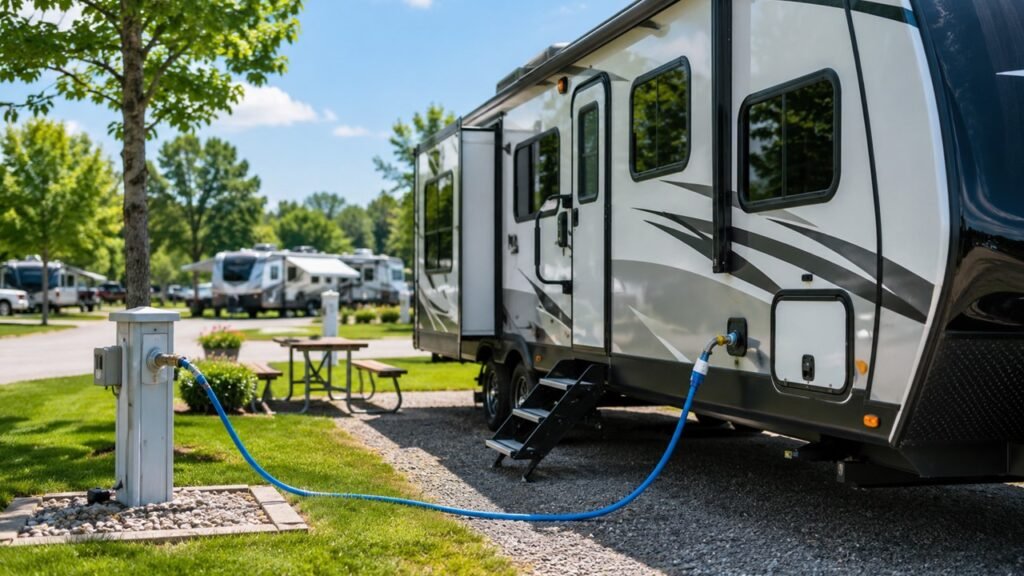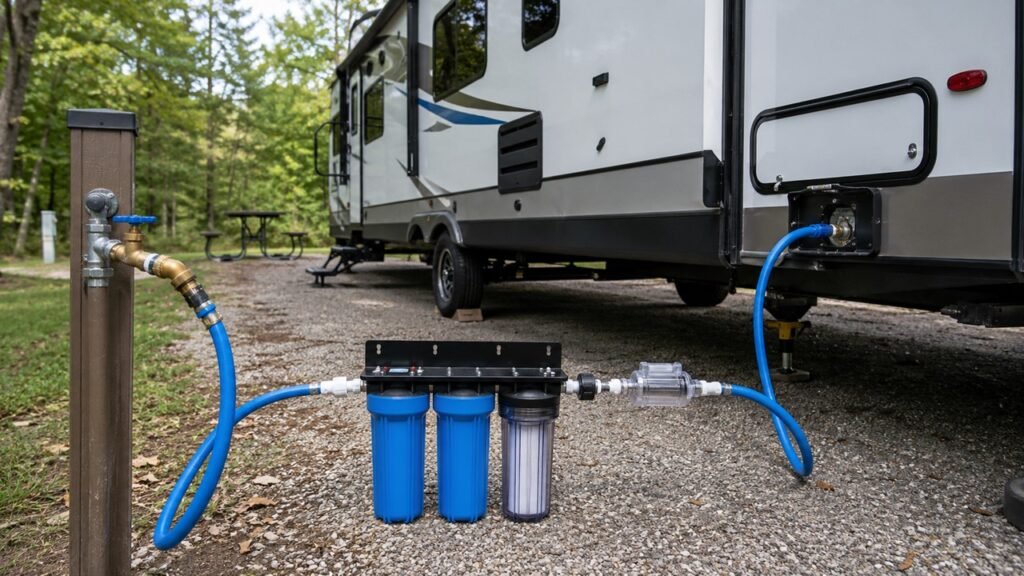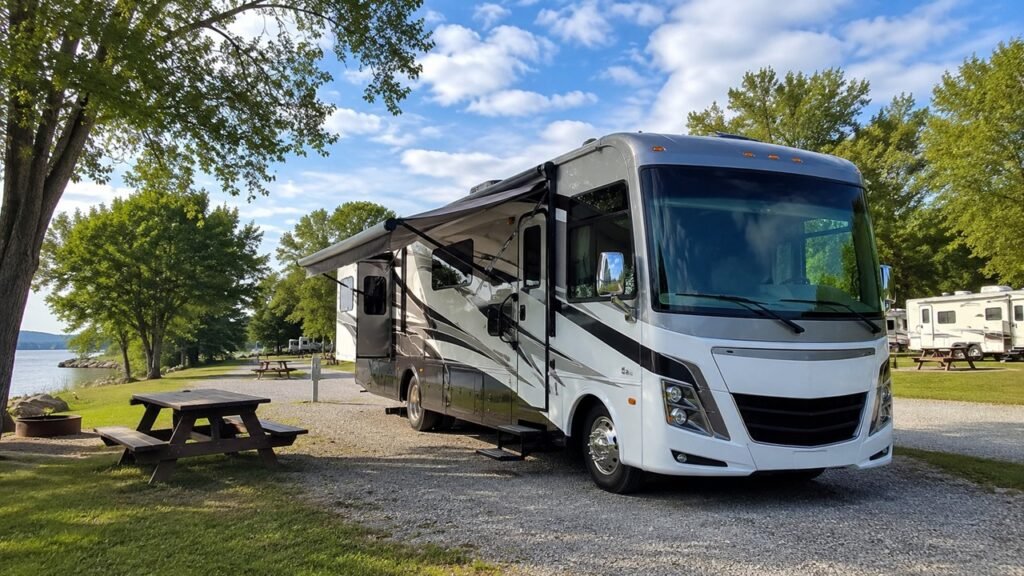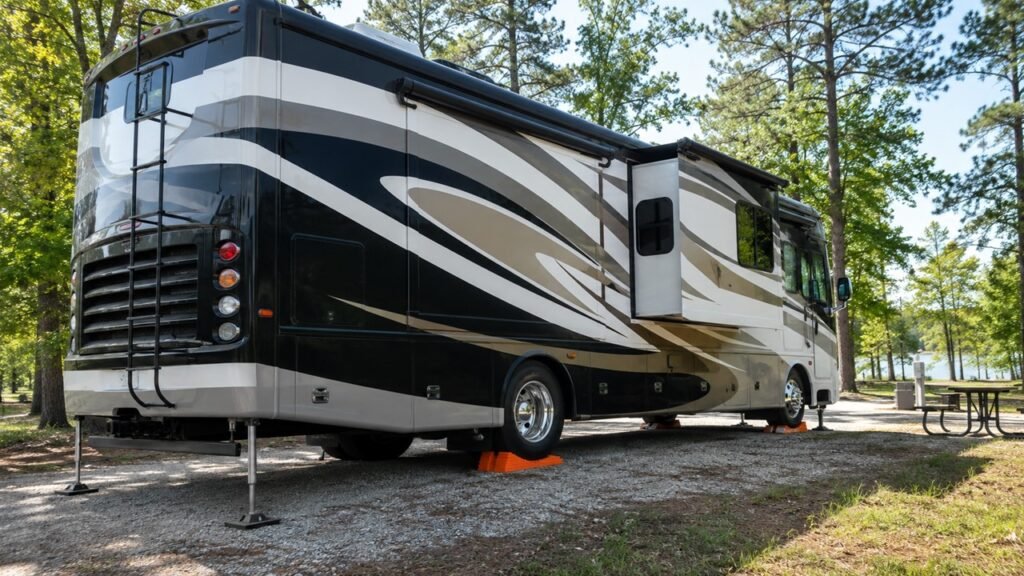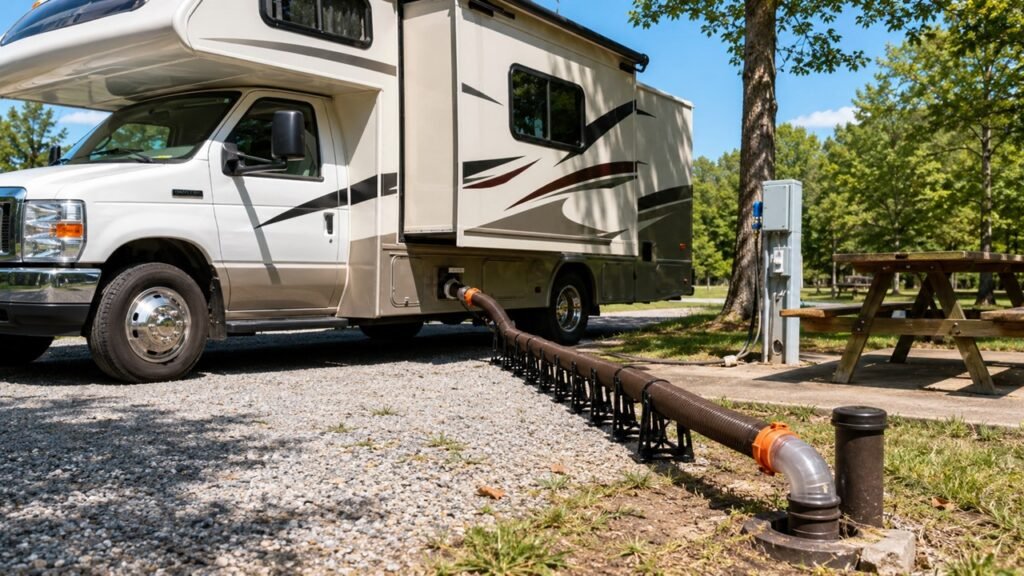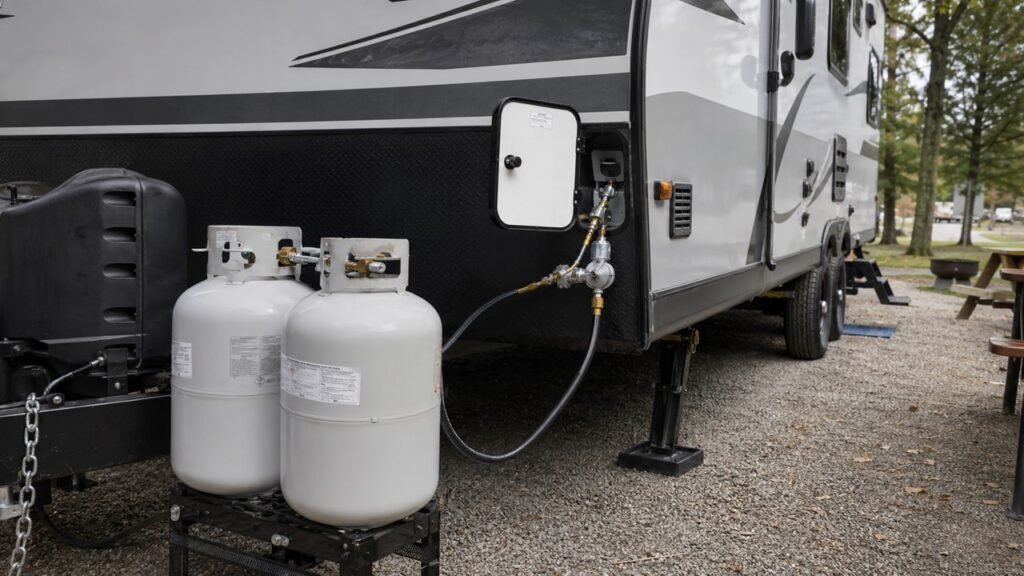
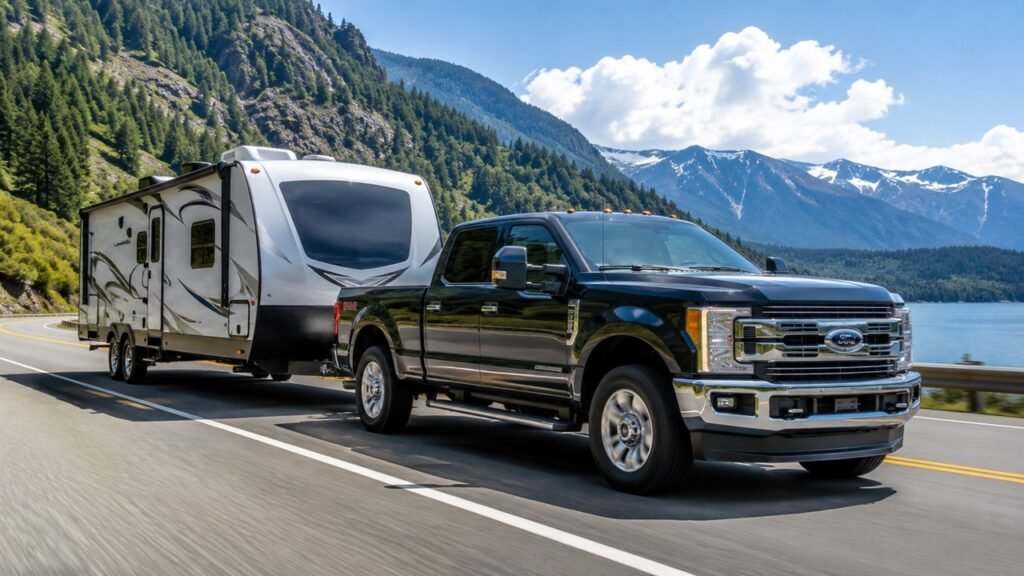
RV towing works by safely connecting one vehicle to another using a hitch system, wiring, safety chains, and braking support. In most cases, it means either pulling a towable RV trailer with a truck or SUV, or towing a smaller car behind a motorhome.
In this guide, we’ll walk through how RV towing works, the equipment you need, the weight numbers that matter, how trailer brakes work, and the safety steps every beginner should know before hitting the road.
Key Takeaways
- RV towing usually means either towing a camper trailer or towing a car behind a motorhome.
- A safe towing setup depends on the right hitch, wiring, brakes, weight limits, and driving habits.
- You should never rely only on advertised towing capacity when matching a vehicle and RV.
- Payload, tongue weight, GVWR, GCWR, and axle ratings all matter when towing.
- Travel trailers usually connect with a receiver hitch, coupler, safety chains, and wiring harness.
- Heavier trailers often need a weight distribution hitch and sway control.
- Motorhomes can tow cars by flat towing, tow dolly towing, or using a car hauler trailer.
- Safe RV towing requires slower speeds, wider turns, longer braking distance, and regular inspections.
What Does RV Towing Mean?
RV towing simply means one vehicle is pulling another vehicle or trailer. However, the term can describe two different setups, and that is where many beginners get confused.
The first type is when a truck or SUV tows a camper, travel trailer, fifth wheel, pop-up camper, or toy hauler. In that setup, the truck or SUV is the tow vehicle, and the RV trailer follows behind it.
The second type is when a motorhome tows a smaller vehicle behind it. Many Class A and Class C motorhome owners do this so they can park the RV at the campground and use the smaller car for shopping, sightseeing, or driving around town.
So, when someone asks, “How does RV towing work?” the answer depends on which setup they mean. Both setups use the same basic idea: a strong connection, proper weight limits, working lights, and safe braking. But the equipment and setup process are different.
RV towing is not just about hooking up and driving away. The tow vehicle, trailer, hitch, brakes, tires, wiring, and weight ratings all work together as one system. When one part is wrong, the whole setup can become unstable or unsafe.
The Two Main Types Of RV Towing
Before you choose a hitch or start looking at towing capacity, you need to know which type of RV towing applies to your situation. Pulling a travel trailer behind a truck is very different from towing a car behind a motorhome.
Towing A Travel Trailer Or Camper
When you tow a travel trailer, the truck or SUV does the pulling. The camper connects to the rear of the vehicle through a hitch, and the trailer follows behind as you drive.
This is the setup most people think of when they imagine RV towing. You might see a pickup truck pulling a large travel trailer, an SUV towing a small camper, or a truck bed connected to a fifth wheel.
Common towable RVs include:
- Travel trailers
- Pop-up campers
- Teardrop trailers
- Hybrid campers
- Toy haulers
- Fifth wheels
The main things that matter in this setup are the tow vehicle’s ratings, trailer weight, hitch type, tongue weight, trailer brakes, and load balance. A trailer that is too heavy or loaded poorly can cause sway, poor braking, and steering problems.
Towing A Car Behind A Motorhome
The second type of RV towing happens when a motorhome pulls a smaller car behind it. RVers often call this smaller vehicle a “toad,” “dinghy,” or “tow car.”
This setup is popular because large motorhomes are not easy to drive through narrow streets, busy towns, grocery store parking lots, or scenic backroads. Once the motorhome is parked at the campground, the tow car gives you more freedom.
A motorhome can tow a car in three main ways:
- Flat towing, where all four wheels stay on the ground
- Tow dolly towing, where two wheels sit on a dolly
- Car hauler towing, where the whole car rides on a trailer
The main concern here is vehicle compatibility. Not every car can be flat-towed. Some vehicles can be damaged if they are towed incorrectly, especially if the transmission or drivetrain is not designed for it.
RV Trailer Towing Vs Motorhome Dinghy Towing
These two towing setups may sound similar, but they work differently in real life. The table below gives you a simple side-by-side comparison before we go deeper.
| Feature | Towing An RV Trailer | Towing A Car Behind A Motorhome |
| Main vehicle | Truck or SUV | Class A, Class C, or large motorhome |
| Towed item | Camper, travel trailer, fifth wheel, or toy hauler | Car, SUV, Jeep, or small truck |
| Main connection | Ball hitch, weight distribution hitch, or fifth-wheel hitch | Tow bar, tow dolly, or car hauler |
| Braking system | Trailer brakes and brake controller | Auxiliary braking system or trailer brakes |
| Wiring | Trailer lights and brake signals | Towed vehicle lights or auxiliary lights |
| Main concern | Trailer weight, tongue weight, and sway | Vehicle compatibility and braking |
| Best for | Camping with a towable RV | Motorhome owners who want a daily-use vehicle |
Both systems have the same goal. They need to keep the combined setup stable, visible, controlled, and safe on the road. The difference is how the connection is made and what kind of weight the main vehicle is handling.
How Does Towing A Travel Trailer Work?
When you tow a travel trailer, your tow vehicle pulls the trailer through a hitch system. The trailer coupler sits over the hitch ball, safety chains provide a backup connection, and the wiring harness connects the trailer lights and brakes to the tow vehicle.
The Tow Vehicle Pulls The Trailer
The tow vehicle provides the power. It uses its engine, transmission, brakes, frame, suspension, and tires to move and control the trailer.
The trailer itself does not have an engine. It simply follows the tow vehicle through the hitch connection. That sounds simple, but the trailer still affects almost everything about how the vehicle drives.
A loaded trailer adds weight behind the vehicle. It makes acceleration slower, braking longer, turning wider, and fuel economy lower. On hills, the engine works harder. In wind, the trailer can push or pull the vehicle slightly.
This is why the tow vehicle must be properly matched to the RV. A vehicle may be able to move a trailer around a driveway, but that does not mean it can tow it safely at highway speed, through hills, in traffic, or in crosswinds.
The Hitch Connects The Trailer To The Vehicle
The hitch is the main connection between the tow vehicle and the trailer. For many travel trailers, this includes a receiver hitch on the vehicle, a ball mount, a hitch ball, and a coupler on the trailer.
The trailer coupler drops down over the hitch ball. Once it is seated properly, the latch locks the coupler around the ball. This allows the trailer to pivot as the vehicle turns.
A basic travel trailer towing setup usually includes:
- Receiver hitch
- Ball mount
- Hitch ball
- Trailer coupler
- Coupler latch or lock
- Hitch pin and clip
- Safety chains
- Breakaway cable
- Electrical connector
Safety chains are important because they act as a backup connection. If the coupler ever came loose, the chains help keep the trailer attached long enough for you to stop safely.
The breakaway cable is also important. If the trailer separates from the tow vehicle, the breakaway system activates the trailer brakes. This can help stop the trailer instead of letting it roll freely.
The Wiring Syncs Lights And Brakes
The wiring connection lets the trailer communicate with the tow vehicle. When you press the brake pedal, use your turn signal, or turn on your headlights, the trailer responds through the wiring harness.
Most small trailers may use a 4-pin connector for basic lights. Larger RV trailers usually use a 7-pin connector because they often have electric brakes, battery charging, reverse lights, or other electrical needs.
The wiring usually controls:
- Brake lights
- Turn signals
- Running lights
- Electric trailer brakes
- Reverse lights, on some setups
- Battery charge line, on some setups
Before every trip, you should test the lights. A trailer without working brake lights or turn signals is dangerous because drivers behind you cannot see what you are doing.
Trailer Brakes Help Stop The Load
RV trailers can be heavy. If your tow vehicle had to stop the full weight alone, its brakes could overheat, wear faster, or struggle during emergency stops.
That is where trailer brakes help. Many RV trailers have electric brakes built into the trailer wheels. A brake controller in the tow vehicle sends power to those brakes when you slow down.
When adjusted correctly, the trailer helps stop itself. This makes the whole rig feel more controlled and reduces the strain on the tow vehicle.
Trailer brakes are not something to ignore. A trailer may pull fine on flat roads, but stopping is where unsafe setups reveal themselves. The heavier the trailer, the more important braking control becomes.
How Does Towing A Car Behind A Motorhome Work?
When a motorhome tows a car, the motorhome pulls the vehicle behind it so you can use the smaller vehicle after parking at camp. This is common for RVers who travel in Class A or Class C motorhomes and do not want to drive the large RV everywhere.
Flat Towing Or Four-Down Towing
Flat towing means all four wheels of the towed vehicle stay on the road. This is also called four-down towing, dinghy towing, or toading.
In this setup, a tow bar connects the car to the motorhome. A baseplate is installed on the front of the car, giving the tow bar a secure attachment point. Safety cables, lighting, and an auxiliary braking system are also used.
Flat towing is popular because it is quick once everything is installed. You do not need to load the car onto a trailer, and you do not need to store a tow dolly at the campsite.
However, not every car can be flat-towed. Some vehicles can suffer transmission or drivetrain damage if they roll with all four wheels on the ground while the engine is off.
Before flat towing any vehicle, always check the exact owner’s manual. Do not rely only on what someone else is towing. Year, trim, drivetrain, and transmission can all change whether a car is safe for flat towing.
Tow Dolly Towing
A tow dolly is a small two-wheel trailer that carries the front wheels of the car. The rear wheels stay on the road and roll behind the motorhome.
This method is often used for front-wheel-drive vehicles that cannot be flat-towed. Since the front drive wheels are lifted off the ground, the drivetrain may be protected in certain vehicles.
Tow dollies can be useful, but they also add extra work. You have to load the car, secure the tires with straps, connect the dolly lights, check the dolly tires, and store the dolly when you arrive.
A dolly also adds weight to the total towing setup. That weight counts against the motorhome’s towing limit and combined weight rating.
Car Hauler Or Trailer Towing
A car hauler is a full trailer that carries the entire vehicle. None of the car’s wheels touch the road.
This is often the best option for vehicles that cannot be flat-towed or dolly-towed. It can also be useful for all-wheel-drive, four-wheel-drive, or specialty vehicles that need all four wheels off the ground.
The downside is weight and length. A car hauler is usually heavier than a tow dolly, and it makes the total setup longer. You also need room to store the trailer at home and at the campground.
Still, it is the most flexible method because it does not depend as much on the towed car’s drivetrain. As long as the motorhome can safely handle the weight, a car hauler can carry many different vehicles.
RV Towing Equipment You Need
The right equipment depends on what you are towing. A travel trailer needs different gear than a car behind a motorhome, and a fifth wheel needs a different hitch than a bumper-pull camper.
For Towing A Travel Trailer
A typical travel trailer towing setup may include:
- Receiver hitch
- Ball mount
- Hitch ball
- Trailer coupler
- Safety chains
- Breakaway cable
- 7-pin wiring connector
- Trailer brake controller
- Weight distribution hitch, if needed
- Sway control system, if needed
- Extended towing mirrors
- Wheel chocks
- Tire pressure gauge
For smaller campers, a basic ball hitch may be enough. Incase of larger travel trailers, a weight distribution hitch and sway control may make the setup safer and more comfortable.
For Towing A Fifth Wheel
A fifth wheel does not connect to a bumper-style hitch. It connects inside the pickup truck bed using a fifth-wheel hitch.
A fifth-wheel setup may include:
- Fifth-wheel hitch
- Kingpin connection
- Bed rails or factory puck system
- Breakaway cable
- Trailer wiring
- Trailer brake controller
- Safety latching system
Fifth wheels often tow more smoothly than many bumper-pull trailers because the connection point sits over or near the truck’s rear axle. However, they still require the right truck, payload capacity, bed setup, and hitch rating.
For Towing A Car Behind A Motorhome
A motorhome tow car setup may include:
- Tow bar
- Baseplate
- Safety cables
- Towed vehicle wiring kit
- Auxiliary braking system
- Breakaway system
- Tow dolly, if not flat towing
- Car hauler, if all wheels must be off the ground
The most important thing is compatibility. The motorhome must be rated to tow the vehicle, and the car must be towed in a way approved by the manufacturer.
The Weight Ratings You Must Understand Before Towing
Most towing problems start when people look only at the advertised towing capacity. In real-world RV towing, you also need to understand payload, tongue weight, GVWR, GCWR, and axle ratings.
Towing Capacity
Towing capacity is the maximum weight your vehicle is rated to pull. This is the number many people look at first.
For example, a truck may be advertised with a 9,000-pound towing capacity. That does not always mean you should buy a 9,000-pound camper. That rating may depend on engine, axle ratio, cab size, drivetrain, hitch type, and factory towing package.
Towing capacity is important, but it is only one piece of the puzzle.
Payload Capacity
Payload is how much weight your vehicle can carry on itself. This includes passengers, pets, cargo, tools, fuel, gear, and the trailer’s tongue weight.
Many beginners overlook payload. That is a mistake because payload often becomes the limiting factor before towing capacity does.
For example, your truck may be rated to tow a certain trailer weight, but once you add family members, camping gear, a cooler, a generator, and hitch weight, you may be close to the payload limit.
GVWR
GVWR stands for Gross Vehicle Weight Rating. It is the maximum loaded weight of a vehicle or trailer.
For your tow vehicle, GVWR includes the vehicle itself, passengers, cargo, and tongue weight. For your trailer, GVWR includes the trailer plus water, propane, batteries, food, clothes, tools, and camping supplies.
You should never treat dry weight as the real camping weight. Once you load a camper for a trip, it can weigh much more than the brochure number.
GCWR
GCWR stands for Gross Combined Weight Rating. It is the maximum total weight of the tow vehicle and trailer together.
This matters because towing is not just about the trailer. The vehicle also carries people, fuel, cargo, and hitch weight. The full combination must stay within the manufacturer’s combined rating.
A safe towing setup looks at both vehicles together, not just one number on a sales sheet.
Tongue Weight
Tongue weight is the downward force the trailer places on the hitch. It has a major effect on stability.
Too little tongue weight can cause trailer sway. Too much tongue weight can overload the rear axle, reduce steering control, and make the front of the tow vehicle feel light.
For many travel trailers, tongue weight often falls around 10–15% of the loaded trailer weight, but you should always follow your trailer and hitch manufacturer’s guidance.
RV Towing Weight Terms Table
| Term | What It Means | Why It Matters |
| Towing capacity | Maximum trailer weight the vehicle can pull | Helps prevent drivetrain and braking overload |
| Payload | Weight carried in or on the tow vehicle | Includes people, cargo, and tongue weight |
| GVWR | Maximum loaded weight of one vehicle or trailer | Protects frame, tires, suspension, and brakes |
| GCWR | Maximum combined weight of vehicle and trailer | Keeps the whole towing setup within limits |
| Tongue weight | Downward force on the hitch | Affects sway, steering, and rear axle load |
| GAWR | Maximum weight allowed on each axle | Helps prevent axle and tire overload |
| Dry weight | Trailer weight before cargo and supplies | Usually lower than real camping weight |
| Loaded weight | Actual trailer weight after packing | The number that matters most for towing |
Understanding these terms makes RV towing much less confusing. Once you know the numbers, you can avoid guessing and make safer decisions.
How To Know If Your Vehicle Can Tow An RV
Matching a vehicle to an RV is one of the most important steps before buying or towing anything. The goal is not just to see whether the vehicle can move the trailer, but whether it can control it safely.
Step 1: Find Your Vehicle’s Tow Rating
Start with the owner’s manual or manufacturer towing guide. You can also check the driver-side door sticker, VIN-specific towing information, or contact the manufacturer.
Do not assume every version of the same vehicle has the same towing capacity. Engine, transmission, axle ratio, cab size, drivetrain, and towing package can change the rating.
Step 2: Check Payload, Not Just Tow Rating
Next, check the payload sticker on the vehicle. This number tells you how much weight the vehicle can carry.
Remember, payload includes:
- Driver
- Passengers
- Pets
- Cargo
- Tools
- Hitch equipment
- Tongue weight
This is why a truck with a high towing capacity can still run out of payload. The trailer’s tongue weight pushes down on the vehicle, so it counts as part of the load the vehicle is carrying.
Step 3: Use The Trailer’s Loaded Weight
Do not base your decision only on dry weight. Dry weight usually means the trailer before water, propane, batteries, camping gear, and personal items.
Real camping weight may include:
- Fresh water
- Propane
- Batteries
- Food
- Clothing
- Tools
- Bikes
- Outdoor chairs
- Generator
- Kitchen supplies
- Bedding
- Personal gear
A trailer that looks safe on paper at dry weight may be much heavier once loaded for a real trip.
Step 4: Compare Against GCWR
After you know the loaded vehicle weight and loaded trailer weight, compare the total against the GCWR.
The combined number includes everything: vehicle, trailer, passengers, cargo, fuel, water, and gear. This is the number that shows whether the entire rig is within the manufacturer’s limit.
Step 5: Leave A Safety Margin
Avoid towing at the absolute maximum limit. Even if the numbers technically fit, a maxed-out setup may feel stressful on hills, highways, rough roads, and windy days.
A safety margin gives your vehicle more breathing room. It can also make towing more comfortable, especially for beginners.
How Weight Distribution And Sway Control Work
A trailer does not just add weight behind your vehicle. It changes how the tow vehicle steers, brakes, turns, and reacts to wind. That is why weight distribution and sway control matter.
What A Weight Distribution Hitch Does
A weight distribution hitch helps spread some of the trailer’s tongue weight across the tow vehicle and trailer axles. It can help restore steering feel, reduce rear-end sag, and improve stability.
Without weight distribution, a heavy trailer can push down on the back of the tow vehicle. This may lift weight off the front axle, making steering feel lighter and less controlled.
A weight distribution hitch does not increase your official towing capacity. It only helps manage the weight more effectively within the ratings you already have.
What Sway Control Does
Sway control helps reduce side-to-side trailer movement. Trailer sway can happen because of crosswinds, passing trucks, sudden steering, poor loading, or too little tongue weight.
Some weight distribution hitches include built-in sway control. Other systems use separate friction sway bars or other designs.
However, sway control is not a cure for a badly loaded trailer. The first defense against sway is proper weight balance, correct tire pressure, safe speed, and smooth driving.
When You May Need A Weight Distribution Hitch
You may need a weight distribution hitch if:
- The trailer is heavy for the tow vehicle.
- The rear of the tow vehicle squats.
- The front of the tow vehicle feels light.
- Steering feels loose or vague.
- The trailer feels unstable.
- The manufacturer recommends it.
- The hitch receiver requires it above a certain weight.
- You want better control with a longer travel trailer.
A properly set up weight distribution hitch can make towing feel more controlled. But it must be adjusted correctly to work as intended.
How Trailer Brakes And Brake Controllers Work
Trailer brakes are one of the most important parts of a safe RV towing setup. They help the trailer slow itself down instead of letting the tow vehicle handle all the braking alone.
A brake controller is the device that sends braking power from the tow vehicle to the trailer’s electric brakes. When you press the brake pedal, the controller tells the trailer brakes how much braking force to apply.
Common brake controller types include:
- Time-delayed brake controllers
- Proportional brake controllers
- Factory-integrated brake controllers
A time-delayed controller applies braking based on a preset delay and power level. A proportional controller senses how quickly the tow vehicle is slowing and applies trailer brakes in a smoother, more natural way.
Many modern trucks have built-in brake controllers from the factory. If your vehicle does not, an aftermarket controller may be installed.
Before every trip, test the trailer brakes at low speed. The trailer should help slow the rig without jerking, locking the wheels, or pushing the tow vehicle forward.
How To Hitch An RV Trailer Step By Step
Hitching an RV trailer becomes easier with practice, but it should never be rushed. A missed latch, loose chain, dragging cable, or unplugged connector can quickly become dangerous.
- Park the trailer on level ground.
- Chock the trailer wheels.
- Raise the trailer coupler above the hitch ball.
- Back the tow vehicle into position.
- Lower the coupler onto the hitch ball.
- Make sure the coupler is fully seated.
- Lock the coupler latch.
- Insert the coupler pin or lock.
- Cross the safety chains under the coupler.
- Attach the safety chains to the tow vehicle.
- Connect the breakaway cable.
- Plug in the electrical connector.
- Attach weight distribution bars, if used.
- Attach sway control, if separate.
- Raise the trailer jack fully.
- Check brake lights, turn signals, and running lights.
- Test the trailer brakes.
- Remove wheel chocks.
- Do a full walkaround.
- Stop after a short distance and recheck everything.
Crossing the safety chains is important because it can help catch the trailer tongue if the coupler disconnects. The chains should have enough slack for turning, but they should not drag on the road.
How To Connect A Car Behind A Motorhome
Connecting a car behind a motorhome depends on the towing method. Flat towing, tow dolly towing, and car hauler towing each have different steps and safety checks.
Flat Towing Setup Steps
For flat towing, use this basic process:
- Confirm the vehicle is approved for flat towing.
- Read the exact owner’s manual instructions.
- Inspect the baseplate and tow bar.
- Align the car behind the motorhome.
- Connect the tow bar arms.
- Attach safety cables.
- Connect the lighting cable.
- Install or activate the auxiliary braking system.
- Attach the breakaway cable.
- Follow the required transmission and steering procedure.
- Test brake lights, turn signals, and running lights.
- Pull forward slowly to lock the tow bar arms.
- Stop after a short distance and inspect the setup.
Never guess the transmission procedure. Some vehicles require neutral, accessory mode, fuse removal, battery disconnects, or special steps. The owner’s manual is the safest source.
Tow Dolly Setup Steps
For tow dolly towing, use this basic process:
- Park the dolly on level ground.
- Attach the dolly to the motorhome hitch.
- Connect the safety chains.
- Connect the dolly wiring.
- Drive the car’s front wheels onto the dolly.
- Center the tires properly.
- Secure the tires with rated straps.
- Attach vehicle safety chains.
- Check dolly tire pressure.
- Test dolly lights and brakes.
- Recheck straps after a short drive.
Tow dolly straps can loosen after the first few miles. A quick recheck helps prevent problems before you get on the highway.
Car Hauler Setup Steps
For car hauler towing, use this basic process:
- Connect the trailer to the motorhome.
- Test the trailer lights and brakes.
- Lower the ramps.
- Drive the car onto the trailer.
- Position the car for proper balance.
- Secure the car with rated straps or chains.
- Check strap angles and tension.
- Raise and secure the ramps.
- Confirm the trailer tongue weight is safe.
- Recheck everything before driving.
A car hauler gives you flexibility, but it also adds significant weight. Always include the trailer weight and vehicle weight when checking the motorhome’s limits.
How RV Towing Feels On The Road
Towing changes how your vehicle drives. Even a well-matched setup needs more room, slower movements, and smoother decisions.
Acceleration Is Slower
A trailer or tow car adds weight. That means your vehicle will accelerate more slowly, especially when merging onto highways or climbing hills.
Plan your moves earlier than normal. Do not expect the vehicle to respond like it does without a trailer.
Braking Takes Longer
The combined weight takes longer to stop. Even with good trailer brakes, you need more following distance.
Avoid tailgating, sudden stops, and last-second lane changes. Smooth braking is safer and more comfortable for everyone.
Turns Need More Space
Trailers cut corners. This means the trailer wheels may track inside the path of the tow vehicle.
Take wider turns, especially at gas stations, campgrounds, and city intersections. Watch curbs, signs, pumps, posts, and parked cars.
Backing Up Takes Practice
Backing up with a trailer can feel confusing at first because the trailer reacts differently than the tow vehicle. Small steering movements work better than big corrections.
Practice in an empty parking lot before your first camping trip. Use cones, lines, or markers to learn how the trailer responds.
Flat-towed cars are different. In most cases, you should not back up while a car is flat-towed behind a motorhome. The tow bar can bind, and the car’s front wheels may not track correctly.
Wind And Passing Trucks Can Move The Rig
Crosswinds and large trucks can push air against the trailer or motorhome. This can make the rig feel like it is being pulled or nudged.
The best response is usually to slow down, hold the steering wheel steady, and avoid sudden corrections. If the trailer starts swaying, do not panic or jerk the wheel.
Common RV Towing Mistakes Beginners Make
Most towing mistakes are preventable. Beginners usually get into trouble when they rush the setup, ignore weight limits, or drive like they are not towing anything.
Common mistakes include:
- Looking only at advertised towing capacity
- Ignoring payload capacity
- Using dry trailer weight instead of loaded weight
- Forgetting about tongue weight
- Loading too much weight behind the trailer axle
- Not using trailer brakes correctly
- Skipping the light test
- Driving too fast
- Following too closely
- Turning too sharply
- Forgetting the trailer is wider than the vehicle
- Not checking tire pressure
- Not checking the hitch after the first few miles
- Assuming any car can be flat-towed
- Backing up while flat towing a car
- Forgetting campground or fuel station clearance
- Overloading the rear of the tow vehicle
- Ignoring strange noises, smells, or sway
The safest RVers are not always the ones with the biggest trucks. They are the ones who check their numbers, inspect their equipment, load carefully, and drive smoothly.
RV Towing Safety Checklist Before Every Trip
A quick checklist can prevent many towing problems. Before each travel day, take a few minutes to inspect the tow vehicle, trailer or tow car, and full connection.
Tow Vehicle Checks
Check these items before towing:
- Tire pressure
- Engine oil
- Coolant level
- Transmission temperature, if available
- Brake function
- Mirrors
- Hitch receiver
- Hitch pin and clip
- Brake controller setting
- Cargo weight
- Payload limit
- Fuel level
- Headlights and turn signals
The tow vehicle does most of the work, so it needs to be ready. Pay extra attention to tires, brakes, fluids, and mirrors.
Trailer Or Towed Car Checks
Check these items on the trailer or towed vehicle:
- Tire pressure
- Tire condition
- Wheel lug nuts
- Brake lights
- Turn signals
- Running lights
- Trailer brakes
- Coupler or tow bar
- Safety chains or cables
- Breakaway cable
- Cargo doors
- Roof vents
- Steps
- Stabilizer jacks
- Propane compartment
- Battery compartment
Many RV problems start with small missed details. A loose hatch, low tire, or dragging cable can turn into a major issue on the road.
Final Walkaround
Before leaving, walk around the entire setup. Look at the rig from every side.
Confirm that:
- The coupler is locked.
- The jack is fully raised.
- Chains are not dragging.
- Wiring has enough slack.
- Lights work correctly.
- Tires look properly inflated.
- Cargo is secure.
- Steps are stored.
- Windows and vents are closed.
- The trailer or tow car tracks straight.
This final walkaround should become a habit. It only takes a few minutes, and it can save you from serious trouble.
Do You Need A Special License To Tow An RV?
In many places, smaller RV towing setups do not require a special license. However, rules can change based on weight, length, location, and vehicle type.
Large fifth wheels, heavy trailers, long motorhomes, or commercial-style setups may have different requirements. Some states, provinces, or countries may also have rules for trailer brakes, total length, safety chains, lighting, and license class.
The safest approach is to check your local DMV, transport authority, or licensing agency before towing a large RV. Also check the rules for any states or regions you plan to travel through.
Do not assume the rules are the same everywhere. A setup that is legal in one place may need extra equipment or a different license somewhere else.
Can Any RV Tow A Car?
No, not every RV can tow a car safely. A motorhome must have enough towing capacity, hitch rating, GCWR, braking support, and engine power for the added weight.
Before towing a car behind a motorhome, check:
- Motorhome towing capacity
- Hitch receiver rating
- GCWR
- Towed vehicle weight
- Tow dolly or trailer weight, if used
- Auxiliary braking requirements
- Combined length limits
- Owner’s manual restrictions
- Insurance or rental restrictions
Also remember that the tow car is not the only weight. If you use a dolly or car hauler, that equipment adds more weight to the total.
A small car may seem easy to tow, but the full setup can still overload the motorhome if the ratings are not checked carefully.
Can Any Vehicle Tow An RV Trailer?
No, not every vehicle can tow an RV trailer safely. A vehicle may physically pull a camper but still be overloaded, unstable, or unsafe.
The right tow vehicle depends on many factors, including:
- Trailer loaded weight
- Tongue weight
- Tow vehicle payload
- Towing capacity
- GCWR
- Wheelbase
- Brake system
- Cooling system
- Transmission
- Suspension
- Tire ratings
- Hitch rating
This is where many beginners make a mistake. They see an SUV with a 5,000-pound tow rating and assume it can tow a 5,000-pound camper. In real life, passengers, cargo, hitch weight, and loaded trailer weight may push the setup over the limit.
A better approach is to choose a trailer that leaves room within the vehicle’s ratings. That makes towing safer, smoother, and less stressful.
RV Towing Tips For Beginners
RV towing gets easier with practice. The key is to slow down, think ahead, and avoid sudden movements.
Helpful beginner tips include:
- Practice in an empty parking lot.
- Start with short trips before long highway drives.
- Drive slower than normal.
- Leave extra following distance.
- Avoid sudden steering.
- Avoid sudden braking.
- Use lower gears on steep grades when needed.
- Stop after the first few miles to inspect the hitch.
- Check tire pressure before every travel day.
- Plan fuel stops with enough turning room.
- Avoid tight city roads when possible.
- Watch your height, width, and length.
- Use a spotter when backing up.
- Do not let other drivers pressure you into speeding.
- Pull over if the rig feels unstable.
Confidence comes from repetition. Once you practice turning, braking, backing up, and parking, towing starts to feel more natural.
RV Towing Maintenance You Should Not Ignore
Towing equipment needs regular care. Small problems with the hitch, tires, brakes, or wiring can become serious when you are pulling thousands of pounds.
Hitch And Coupler Maintenance
Inspect the hitch before every trip. Look for rust, cracks, loose bolts, worn pins, or damaged parts.
The coupler should latch securely around the hitch ball. If it feels loose, sticks, or does not lock properly, fix it before towing.
Use lubrication where the manufacturer recommends it. Some hitch parts need grease, while other sway control parts may not. Always follow the instructions for your specific hitch system.
Tire Maintenance
Trailer tires are extremely important because they carry heavy loads and often sit unused for long periods.
Check tire pressure before every travel day. Also inspect the sidewalls for cracks, bulges, cuts, or dry rot.
Do not forget the spare tire. A spare that is flat, old, or damaged will not help when you need it most.
Brake Maintenance
Trailer brakes should be tested regularly. If the trailer jerks, pulls, locks up, or feels like it is pushing the tow vehicle, the brake controller may need adjustment.
Brake components also wear over time. Have them inspected based on your trailer manufacturer’s schedule, mileage, and usage.
Wiring Maintenance
Trailer wiring is exposed to weather, road dirt, vibration, and corrosion. Check the plug, cable, and connectors often.
If lights flicker or brakes act strangely, inspect the wiring before assuming the problem is somewhere else. A loose or corroded connector can cause confusing issues.
Tow Bar Or Dolly Maintenance
If you tow a car, inspect the tow bar, dolly, or trailer regularly. Check pivot points, pins, straps, tires, bearings, safety cables, and lights.
Tow dolly tire straps should be checked after loading and again after a short drive. Straps can settle as the tires shift slightly.
RV Towing Example: How The Numbers Work
A simple example can show why towing capacity is not the only number that matters. In this case, the truck may have enough tow rating, but payload still gets tight.
| Item | Example Weight |
| Truck GVWR | 7,200 lbs |
| Truck curb weight | 5,400 lbs |
| Available payload | 1,800 lbs |
| Passengers and cargo | 700 lbs |
| Remaining payload | 1,100 lbs |
| Loaded trailer weight | 6,500 lbs |
| Estimated tongue weight at 12% | 780 lbs |
| Payload left after tongue weight | 320 lbs |
In this example, the truck may be rated to pull the trailer. However, once passengers, cargo, and tongue weight are included, only 320 pounds of payload remain.
That does not leave much room for extra gear in the truck. This is why payload and tongue weight matter so much when choosing an RV towing setup.
A trailer that looks fine by tow rating alone may still push the vehicle close to its payload limit.
Is RV Towing Hard?
RV towing is not hard once you understand the basics, but it does require patience and practice. The hardest parts for beginners are usually backing up, turning wide enough, managing sway, and remembering that stopping takes longer.
Most new RVers become more comfortable after a few practice sessions. A large empty parking lot is one of the best places to learn. Practice driving forward, turning, backing up, stopping, and parking before you try a busy campground or gas station.
The biggest mindset change is this: you cannot drive like you are in a normal car. You need to look farther ahead, slow down earlier, turn wider, and give yourself more space.
Once you build those habits, towing becomes much less stressful.
Final Thoughts
RV towing works by creating a safe, controlled connection between a tow vehicle and an RV trailer, or between a motorhome and a smaller vehicle. The hitch, wiring, brakes, safety chains, tires, weight ratings, and driver habits all work together.
The most important step is understanding your numbers. Towing capacity matters, but so do payload, tongue weight, GVWR, GCWR, hitch rating, and loaded weight.
Before towing anything, check the owner’s manuals, confirm the real loaded weight, inspect your equipment, and practice slowly before heading into traffic. A careful setup makes RV towing safer, smoother, and much more enjoyable.
Related FAQs
What Is The Safest Way To Tow An RV?
The safest way to tow an RV is to stay within all weight ratings, use the correct hitch, balance the load, test the brakes and lights, and drive with extra space.
What Is The Difference Between GVWR And GCWR?
GVWR is the maximum loaded weight of one vehicle or trailer. GCWR is the maximum combined weight of the tow vehicle and trailer together.
Do I Need Trailer Brakes To Tow An RV?
Most heavier RV trailers need trailer brakes for safe stopping. Requirements vary by location and trailer weight, so check local rules and manufacturer guidance.
Can I Tow A Travel Trailer With An SUV?
Some SUVs can tow smaller travel trailers, but you must check towing capacity, payload, tongue weight, GCWR, brakes, and the trailer’s loaded weight.
Can You Back Up While Flat Towing A Car?
In most cases, you should not back up while flat towing a car. The tow bar can bind, and the towed vehicle’s front wheels may turn incorrectly.
What Is Tongue Weight In RV Towing?
Tongue weight is the downward force the trailer places on the hitch. It affects steering, braking, rear suspension, payload, and trailer sway.
What Is A Weight Distribution Hitch?
A weight distribution hitch helps spread trailer tongue weight across the tow vehicle and trailer axles. It can improve stability but does not increase official tow capacity.
What Is Flat Towing?
Flat towing means towing a vehicle with all four wheels on the ground behind a motorhome. It usually requires a tow bar, baseplate, lighting, and auxiliary braking.
Is A Tow Dolly Better Than Flat Towing?
A tow dolly can work well for some front-wheel-drive cars, but it adds weight, storage needs, and loading steps. Flat towing is simpler when the vehicle supports it.
Can Any Car Be Towed Behind An RV?
No, not every car can be towed behind an RV. Always check the exact owner’s manual for the vehicle’s year, trim, drivetrain, and transmission.

Michael Carter is an experienced RV traveler who focuses on practical outdoor trips across the States. He writes clear, step-by-step guides and realistic reviews based on real travel needs. His aim is to help RV and camper owners plan informed, simpler journeys with confidence.