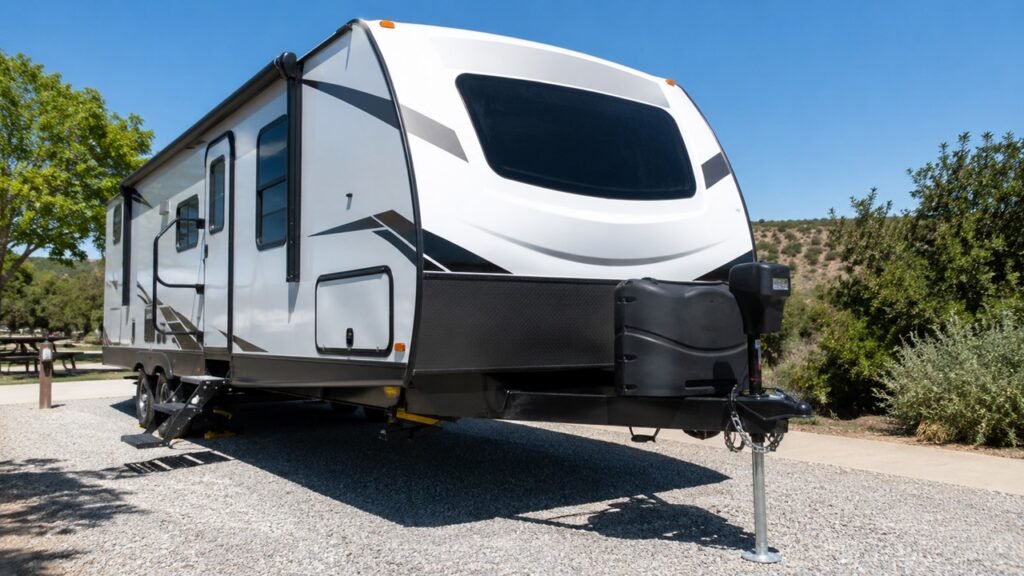
Your electric trailer jack may not be working because of a weak 12-volt battery, blown fuse, tripped breaker, corroded wiring, poor frame ground, faulty switch, overloaded motor, or internal mechanical damage. Start by checking the battery and fuse before opening the jack housing.
In this guide, I will walk you through each possible cause, explain what different sounds mean, and show you how to operate the jack manually if you need to move your trailer.
Key Takeaways
- A trailer battery can power the jack light but still be too weak to run the motor.
- Check the inline fuse or circuit breaker before replacing expensive parts.
- Many electric tongue jacks ground through their mounting bolts.
- Clicking, humming, silence, and slow movement point to different problems.
- Never install a higher-amperage fuse to stop repeated fuse failures.
- Use the manual override when you need to hitch or unhitch immediately.
- Stop operating the jack if you hear grinding or notice mechanical binding.
Quick Electric Trailer Jack Troubleshooting Guide
Your jack’s symptoms can often narrow down the problem before you remove any covers or disconnect wiring.
| Jack symptom | Most likely cause | First thing to check |
| No sound or movement | Dead battery, blown fuse, disconnected wire, or poor ground | Battery voltage and inline fuse |
| Light works, but motor does not | Weak battery or excessive voltage drop | Battery voltage while operating |
| Jack only works when connected to the truck | Discharged or failing trailer battery | Battery condition and charging system |
| Jack clicks but does not move | Low voltage, seized motor, or mechanical binding | Battery under load and manual override |
| Motor hums without movement | Overload, damaged gears, or bent jack tube | Jack load and manual operation |
| Jack moves slowly | Weak battery, corrosion, or excessive tongue weight | Battery and cable connections |
| Jack works in only one direction | Faulty rocker switch or loose internal wire | Switch terminals |
| Fuse repeatedly blows | Shorted wire, overloaded motor, or mechanical jam | Wiring and jack binding |
Start With Trailer and Jack Safety
An electric tongue jack supports a considerable amount of weight. Secure the trailer before testing, cleaning, or removing any jack components.
- Park the trailer on firm, level ground.
- Chock the trailer wheels securely.
- Keep the trailer connected to the tow vehicle when practical.
- Never crawl under a trailer supported only by the tongue jack.
- Use properly rated jack stands before removing the jack.
- Disconnect battery power before opening the motor housing.
- Keep your hands away from exposed gears and moving parts.
- Follow the manufacturer’s weight limits and service instructions.
Do not continue pressing the switch if the jack hums, grinds, or refuses to move. Continued operation can overheat the motor or damage the gears.
Why Electric Trailer Jacks Stop Working
Most electric trailer jack failures fall into three categories: insufficient electrical power, a failed control component, or a mechanical problem inside the jack.
Weak or Discharged Trailer Battery
A weak trailer battery is one of the most common reasons an electric jack stops working.
The jack motor requires considerably more current than a small light, water pump indicator, or control panel. Your trailer lights may still work even when the battery cannot provide enough power to lift the trailer tongue.
You may also notice that the jack moves down but struggles to raise the trailer. Lowering the tongue often requires less effort because gravity is helping. Raising it places the motor under a much heavier load.
A battery can show reasonable voltage while resting and then drop sharply when you press the jack switch. That is why testing the battery under load is more useful than checking resting voltage alone.
Blown Inline Fuse or Tripped Circuit Breaker
Most electric trailer jacks have a fuse or small circuit breaker installed in the positive power wire.
Follow the jack’s power cable toward the trailer battery. You may find a plastic inline fuse holder or a small breaker mounted near the battery box.
The fuse protects the wiring and jack motor if the circuit draws excessive current. It may blow because of a temporary overload, damaged wiring, a seized jack mechanism, or an internal electrical failure.
Fuse ratings vary between jack models. Many use fuses within the 20-amp to 30-amp range, but you should always follow the rating printed on the jack, fuse holder, wiring diagram, or owner’s manual.
Loose, Corroded, or Damaged Wiring
Electric jacks are mounted at the front of the trailer, where their wires are exposed to rain, road spray, mud, salt, vibration, and temperature changes.
Common wiring problems include:
- Loose battery terminals
- Corroded ring connectors
- Broken wire strands
- Poorly crimped terminals
- Damaged fuse holders
- Pinched power cables
- Insulation rubbing against the trailer frame
- Corrosion hidden beneath heat-shrink tubing
A connection may look secure while still having enough internal corrosion to restrict current. The jack motor may receive voltage but not enough current to operate under load.
Poor Ground Through the Trailer Frame
Many electric tongue jacks have only one visible power wire. This is because the jack grounds through its metal mounting plate and bolts into the trailer frame.
Rust, paint, powder coating, sealant, dirt, or loose bolts can interrupt this ground path. The jack may work intermittently, move slowly, or stop completely.
A poor ground is especially likely after:
- Replacing the jack
- Painting the trailer A-frame
- Removing and reinstalling mounting bolts
- Driving in wet or salty conditions
- Allowing rust to form beneath the mounting plate
Cleaning and tightening the mounting connection often restores normal operation.
Faulty Extend-and-Retract Switch
The rocker switch reverses polarity to change the jack’s direction. Over time, moisture, dirt, electrical arcing, and repeated use can damage the switch contacts.
A failed switch may cause:
- No movement in either direction
- Movement in only one direction
- Intermittent operation
- Movement only when the switch is held at a certain angle
- Heat or discoloration around the terminals
Loose spade connectors behind the switch can create similar symptoms.
Overloaded or Overheated Motor
An electric trailer jack can stop working if it is carrying more weight than it was designed to lift.
The jack does not lift the trailer’s total weight, but it must support and raise the loaded tongue weight. Extra cargo near the front of the trailer can increase tongue weight significantly.
The motor may also overheat after repeated extending and retracting. Some models include thermal protection that temporarily shuts the motor down until it cools.
Signs of overload or overheating include:
- Slower movement than normal
- Humming without lifting
- Hot motor housing
- Temporary shutdown
- Fuse failure
- Operation returning after a cooling period
Do not repeatedly cycle the switch while waiting for the motor to restart.
Internal Mechanical Damage
The electrical system may be working correctly while the jack remains unable to move.
Possible internal problems include:
- Stripped gears
- Damaged bevel gears
- Worn thrust bearings
- A seized screw mechanism
- A bent inner tube
- Contamination inside the jack tube
- Dried or hardened lubricant
- Water intrusion inside the gearbox
- A disconnected manual-drive mechanism
Mechanical failure becomes more likely if the motor runs but the jack leg does not move.
Diagnose the Jack by Its Symptoms
The sound and movement of the jack can tell you a lot about what is happening inside the electrical and mechanical systems.
The Jack Is Completely Silent
If the jack makes no sound at all, begin with the electrical supply.
Check the trailer battery, battery disconnect switch, inline fuse, circuit breaker, power wire, frame ground, and rocker switch.
A completely failed motor can also remain silent, but it should not be your first assumption. Battery and connection problems are far more common and easier to correct.
The Jack Clicks but Does Not Move
A clicking sound usually means part of the electrical system is receiving power. However, the motor may not be receiving enough current to turn.
Possible causes include:
- Weak battery
- Corroded battery terminals
- Poor ground connection
- Defective breaker
- Failed switch contacts
- Seized motor
- Mechanically jammed jack
Try testing the battery while holding the jack switch. If the voltage drops sharply, the battery or a high-resistance connection may be the problem.
The Motor Hums but the Jack Will Not Move
A humming motor is trying to turn but cannot overcome the load or mechanical resistance.
The jack may be overloaded, fully extended, bent, jammed, or damaged internally. Low voltage can also make a motor hum without producing enough torque.
Release the switch immediately. Holding it down can overheat the motor and damage the wiring.
Use the manual override to determine whether the mechanism can still turn.
The Jack Moves Slowly
Slow operation usually indicates a power supply or resistance problem.
Check for:
- Low battery charge
- Battery failure under load
- Corroded terminals
- Loose mounting bolts
- A poor frame ground
- Damaged or undersized wiring
- Excessive tongue weight
- Thick or dried lubricant
- Internal gear wear
Cold weather may also reduce battery performance and make old grease more resistant.
The Jack Works in Only One Direction
A jack that extends but will not retract, or retracts but will not extend, often has a rocker-switch problem.
The switch reverses electrical polarity to change motor direction. One side of the switch can fail while the other remains functional.
Loose internal terminals, damaged wires, and worn switch contacts are common causes. Mechanical loading can also make the jack lift in one direction more easily than the other.
The Jack Stops Partway Through Its Travel
A jack that stops halfway may have reached a mechanical limit, encountered an obstruction, overheated, or experienced a voltage drop.
Allow the motor to cool and check the battery. Also inspect the exposed jack tube for dirt, rust, bending, or damage.
Do not hold the switch after the jack reaches its full travel. Some models do not have an automatic limit switch, and continued operation can damage the gears.
The Jack Works Only When Connected to the Tow Vehicle
This usually points to a trailer battery problem.
Connecting the trailer’s 7-pin plug to a running tow vehicle may provide additional charging voltage. If the jack starts working, the trailer battery may be discharged, failing, disconnected, or not receiving a proper charge.
Possible charging problems include:
- Failed converter or charger
- Faulty tow-vehicle charge line
- Blown charging-system fuse
- Battery disconnect switch turned off
- Loose battery cables
- A battery that no longer accepts a charge
Not every tow vehicle supplies enough current through the 7-pin connector to operate a jack reliably. Treat this test as a diagnostic clue, not a universal solution.
How to Troubleshoot an Electric Trailer Jack Step by Step
Work from simple external checks toward internal components. This approach saves time and reduces the chance of replacing a working part.
1. Confirm the Jack Is Not Overloaded or at Its Travel Limit
Check whether the jack is fully extended or retracted. Continuing to operate the motor at the end of its travel can place heavy pressure on the gears.
Also consider whether cargo has increased the trailer’s tongue weight. Batteries, propane cylinders, generators, water, tools, and storage boxes near the front can add more weight than expected.
The jack should have a lifting capacity greater than the trailer’s actual loaded tongue weight. A higher rating also provides a reasonable safety margin and reduces motor strain.
Side loading can create another problem. The jack tube should remain straight while lifting. Uneven ground or trailer movement can cause the tube to bind.
2. Check the Trailer Battery
Start with the battery disconnect switch if your trailer has one. Make sure it is in the position that supplies power to the jack.
Then inspect the battery connections.
- Confirm that both battery terminals are tight.
- Look for white, green, or blue corrosion.
- Inspect the cable ends for looseness.
- Check whether the positive cable is damaged.
- Make sure the negative battery cable is attached securely.
- Charge the battery if its state of charge is low.
- Test voltage while someone operates the jack.
A fully charged 12-volt lead-acid battery often rests around 12.6 to 12.8 volts after resting, although readings vary with temperature and battery condition.
Lithium batteries use different voltage ranges and charging behavior. Follow the battery manufacturer’s specifications instead of applying lead-acid values.
The most revealing test is voltage under load. If voltage drops significantly when the switch is pressed, the battery may be weak or the circuit may have excessive resistance.
3. Try the Jack With the Tow Vehicle Connected
Connect the trailer’s 7-pin plug to your tow vehicle. Start the engine if the vehicle manufacturer allows charging through the connector while running.
Try operating the jack again.
If it works, investigate why the trailer battery is not supplying adequate power. The battery may be discharged, damaged, disconnected, or improperly charged.
Check whether the trailer’s converter, solar controller, or tow-vehicle charging circuit is replenishing the battery.
Avoid relying on the tow vehicle as a permanent solution. The trailer battery and wiring should be able to operate the jack as designed.
4. Inspect the Inline Fuse or Mini Breaker
Follow the positive jack wire toward the battery. The fuse or breaker is usually installed close to the battery.
- Disconnect battery power before removing a fuse.
- Open the inline fuse holder.
- Inspect the metal element inside the fuse.
- Test the fuse with a multimeter when damage is not visible.
- Replace it only with the specified type and amperage.
- Inspect the fuse holder for corrosion or heat damage.
- Test both sides of a circuit breaker for voltage.
- Investigate the cause if the replacement fuse blows again.
A fuse can develop poor contact inside a corroded holder even when the fuse element remains intact.
Removing and reinserting the fuse may temporarily scrape corrosion from the contact points. If that restores operation, clean or replace the holder rather than assuming the problem is permanently solved.
5. Inspect the Battery Cables and Jack Power Wire
Examine the full length of the positive wire where possible.
Look for crushed insulation, sharp bends, loose clamps, exposed copper, damaged ring terminals, and sections rubbing against the frame.
Pay special attention to:
- The battery terminal
- The fuse holder
- Circuit breaker studs
- Wire splices
- The point where wiring enters the jack housing
- Areas near metal edges
- Sections exposed to road spray
A wire can corrode internally while its outer insulation appears normal. Swollen insulation or green powder near a terminal often indicates moisture has traveled beneath the covering.
6. Clean and Test the Jack Ground
Many A-frame trailer jacks complete the circuit through their mounting plate.
To restore the ground connection:
- Disconnect the trailer battery.
- Secure the trailer with rated supports.
- Inspect the jack mounting bolts.
- Remove the jack only when the trailer is safely supported.
- Clean rust and corrosion from the bolt surfaces.
- Clean the jack plate and trailer mounting surface.
- Expose clean metal where the ground path requires contact.
- Reinstall and tighten the bolts evenly.
- Protect surrounding metal from future corrosion.
- Add a dedicated negative wire only when permitted by the manufacturer.
Do not place paint, thick grease, or insulating sealant directly between surfaces that must provide electrical continuity.
A dedicated negative cable can provide a more reliable ground on some installations, but the cable size and connection method should match the jack manufacturer’s requirements.
7. Test Voltage at the Jack
Voltage testing can show whether power is being lost between the battery and motor.
| Test location | Normal result | What a poor result may indicate |
| Battery terminals at rest | Voltage appropriate for the charged battery type | Discharged or failing battery |
| Battery while operating the jack | Limited voltage drop | Weak battery or excessive current draw |
| Jack’s positive input wire | Close to battery voltage | Resistance in the cable, fuse, or breaker |
| Output side of the rocker switch | Voltage changes with switch direction | Failed switch or loose connection |
| Ground path to battery negative | Minimal voltage drop under load | Rusty bolts or poor frame ground |
A voltage-drop test should be performed while the motor circuit is under load. A damaged connection may show full voltage when the jack is idle but fail once current begins flowing.
Resistance or continuity testing should only be performed with circuit power disconnected.
8. Inspect the Extend-and-Retract Switch
Disconnect the battery before removing the switch or opening the housing.
Look for:
- Loose spade connectors
- Corroded terminals
- Melted plastic
- Burned contacts
- Water damage
- Broken wires
- A cracked switch boot
Take a photo before disconnecting wires so you can reinstall them correctly.
Replacement switches must match the jack’s voltage, current capacity, terminal arrangement, and reversing function. A switch that physically fits may not be electrically suitable.
9. Check for Water Inside the Jack Head
Electric jacks live outside in difficult conditions. A cracked housing, loose cover, damaged switch boot, or missing manual-override cap can allow water inside.
Water intrusion may cause:
- Corroded terminals
- Intermittent operation
- Motor failure
- Switch failure
- Rusty gears
- Blown fuses
- Short circuits
Disconnect power before opening the head. Drying the housing may restore temporary operation, but corroded components should be cleaned, tested, or replaced.
Correct the leak before reassembling the jack.
10. Test the Jack With the Manual Override
The manual override helps separate electrical problems from mechanical ones.
If the jack turns smoothly by hand, the lifting mechanism is probably still functional. The fault is more likely related to the battery, wiring, fuse, switch, or motor.
If the jack is extremely stiff or impossible to turn manually, you may have a mechanical problem involving the screw, bearings, gears, or jack tube.
Stop if you feel severe resistance. Applying excessive leverage can break gears or damage the manual-drive shaft.
How to Manually Raise or Lower an Electric Trailer Jack
Most electric tongue jacks include a manual override. The access point, tool size, and turning direction can differ, so check your jack’s instructions when available.
- Park the trailer on firm, stable ground.
- Chock the wheels securely.
- Keep the tow vehicle connected when practical.
- Turn off the jack switch and disconnect power.
- Locate the rubber plug, top cap, or side access cover.
- Insert the supplied crank handle or correct socket.
- Turn slowly in the direction required for movement.
- Watch the coupler and jack tube while cranking.
- Stop if the jack binds or becomes unusually difficult.
- Reinstall the weather cap after finishing.
A 3/4-inch socket fits many electric trailer jacks, but it is not universal. Carry the manufacturer-supplied crank or confirm your jack’s socket size before traveling.
Some jacks extend clockwise, while others extend counterclockwise. If the jack does not move with light effort, verify the correct direction rather than forcing it.
What the Manual Override Test Tells You
How the jack responds to manual operation can help you identify the next troubleshooting step.
| Manual operation result | Likely problem |
| Jack turns smoothly by hand | Battery, fuse, wiring, ground, switch, or motor issue |
| Jack feels stiff in both directions | Dry screw, corrosion, damaged bearing, or bent tube |
| Jack moves briefly and then locks | Damaged gear, obstruction, or internal misalignment |
| Manual crank turns without movement | Stripped or disconnected internal gear |
| Jack lowers but will not lift | Excessive load or damaged lifting mechanism |
| Manual shaft will not turn | Severe mechanical seizure or internal damage |
Manual operation should feel firm but reasonably smooth. Grinding, skipping, or sudden free-spinning often indicates damaged gears.
Why Does the Electric Trailer Jack Fuse Keep Blowing?
A repeatedly blown fuse is a warning that the circuit is drawing too much current or shorting to ground. Replacing the fuse without finding the cause can damage the wiring.
The Jack Is Drawing Too Much Current
A motor draws more current when it must work against excessive resistance.
This can happen because of:
- Excessive tongue weight
- A bent jack tube
- Dry internal components
- Damaged gears
- A seized screw mechanism
- Low battery voltage
- A failing motor
Low voltage may seem unrelated to fuse failure, but an electric motor can draw higher current while struggling to produce torque.
The Positive Wire Is Shorting to the Frame
Inspect the positive cable for damaged insulation.
A bare section touching the trailer frame can create a direct short and immediately blow the fuse. Common damage points include frame openings, metal clips, battery boxes, sharp brackets, and areas where the wire vibrates during travel.
Do not install another fuse until the damaged wire is repaired correctly.
The Motor or Switch Has an Internal Short
Water intrusion, melted switch contacts, damaged motor windings, and overheated terminals can create an internal short.
You may notice a burning smell, discolored connectors, heat around the switch, or a fuse that blows as soon as power is restored.
Disconnect the circuit and have the jack inspected if you suspect internal electrical damage.
The Wrong Fuse Is Installed
Use the fuse size specified by the jack manufacturer.
A fuse with too low an amperage may blow during normal operation. A fuse with too high an amperage may allow wiring or motor components to overheat before the fuse opens.
Never increase the fuse size simply because the correct fuse keeps blowing.
Why Does My Electric Trailer Jack Work Intermittently?
Intermittent operation often means a connection is changing as the trailer vibrates, the switch moves, or the motor warms up.
Loose Battery or Fuse Connections
A loose battery terminal or fuse contact may work when stationary and disconnect when the trailer moves.
Tighten the terminals and inspect the fuse holder. Replace damaged holders instead of bending the contacts repeatedly.
Corroded Ground Contact
Rust beneath the jack plate can create an inconsistent ground path.
The jack may begin working when the mounting bolts shift slightly or when vibration temporarily improves metal contact. Clean the mounting surfaces and tighten the bolts properly.
Worn Rocker Switch Contacts
A worn switch may work only when pressed firmly or held slightly off-center.
This usually becomes worse over time. Replace the switch with a matching component rather than repeatedly forcing it.
Worn Motor Brushes or Internal Connections
Some jack motors use brushes that wear over time. Tapping the housing may temporarily restore contact, but that does not solve the underlying problem.
Intermittent motor operation after the external wiring checks have passed usually requires internal inspection or motor replacement.
Thermal Protection Is Cycling
If the jack stops after repeated use and starts again after cooling, the motor’s thermal protector may be opening.
Allow the motor to cool. Then check for excessive load, low voltage, or mechanical resistance that may be causing overheating.
Electric Trailer Jack Problems in Cold or Wet Weather
Weather affects battery output, electrical connections, lubrication, and exposed jack components.
Cold Battery Performance
Batteries provide less usable power in cold conditions. A battery that operates the jack normally in warm weather may struggle when temperatures fall.
Keep the battery charged and test its condition if cold-weather jack performance becomes noticeably weaker.
Thickened Grease and Mechanical Resistance
Old or unsuitable lubricant can become stiff in cold weather.
The motor must work harder to turn the screw and gears, causing slow movement, humming, overheating, or fuse failure.
Use only the lubricant recommended for your jack.
Water Intrusion and Corrosion
Rain can enter through a damaged top cap, cracked housing, worn switch boot, or loose wiring entry.
Regularly inspect seals and covers. Replace missing caps before moisture reaches the motor and switch terminals.
Frozen or Contaminated Jack Tube
Mud, road salt, water, or ice around the inner tube can restrict movement.
Clean exposed tubing before retracting the jack. Retracting a dirty tube can pull abrasive debris into seals and sliding surfaces.
Should You Lubricate an Electric Trailer Jack?
Some electric trailer jacks require periodic lubrication, while others use sealed components that should not be opened by the owner.
Check your owner’s manual before removing covers or adding grease. Using the wrong lubricant can attract dirt, damage seals, or interfere with electrical components.
Clean dirt from the exposed inner tube with a suitable cloth. Apply lubricant only to the areas approved by the manufacturer.
Do not spray penetrating oil into the switch, motor, wiring connectors, or sealed gearbox. Penetrating products may displace protective grease and contaminate electrical contacts.
If the jack has an accessible grease fitting, use the recommended grease and amount. More grease is not always better.
Signs the Problem Is Mechanical
Mechanical damage is more likely when the electrical system appears functional but the jack will not move correctly.
- The jack cannot be moved with the manual crank.
- The inner tube is visibly bent.
- The motor runs, but the jack leg does not move.
- Grinding or popping noises come from the jack head.
- The jack binds at the same position during every cycle.
- Metal shavings appear inside the housing.
- The jack slips or fails to hold its height.
- The manual shaft spins without moving the leg.
- The mounting plate or trailer A-frame is distorted.
Stop using the jack if it slips under load. A jack that cannot hold the tongue securely should be repaired or replaced before further travel.
Can You Repair an Electric Trailer Jack Yourself?
Many external electrical problems are manageable with basic tools. Internal mechanical repairs require more experience and may affect the warranty.
Repairs Most Owners Can Usually Handle
- Charging or replacing the trailer battery
- Cleaning battery terminals
- Replacing the correct fuse
- Replacing an approved circuit breaker
- Repairing accessible wire terminals
- Cleaning the mounting-ground connection
- Tightening mounting bolts
- Replacing a matching external rocker switch
- Installing a new weather cap or switch boot
Follow the wiring diagram and disconnect battery power before electrical work.
Repairs Better Left to a Technician
- Opening a sealed gearbox
- Repairing motor windings
- Replacing internal motor brushes
- Straightening or replacing a bent lifting tube
- Replacing thrust bearings
- Replacing bevel gears
- Diagnosing repeated high-current draw
- Repairing a damaged A-frame
- Rewiring the jack without a manufacturer diagram
A professional inspection is also sensible when the jack supports a heavy trailer or shows structural damage.
When Should You Replace the Electric Trailer Jack?
Replacing the jack may be safer and more economical than rebuilding a heavily damaged unit.
Consider replacement when:
- The inner tube is bent.
- The jack slips under load.
- The gears repeatedly strip or bind.
- Water has severely damaged the motor housing.
- Replacement parts are unavailable.
- Repair costs approach the cost of a new jack.
- The current jack is undersized for the tongue weight.
- The mounting plate is cracked or deformed.
- Electrical failures continue after proper wiring repairs.
- The jack cannot be operated manually.
Choose a replacement based on actual loaded tongue weight, not total trailer weight alone.
How to Choose the Correct Replacement Jack
The correct replacement must fit the trailer, lift the required weight, and connect safely to the existing electrical system.
| Feature | What to check |
| Lift capacity | Choose a rating above the trailer’s loaded tongue weight |
| Lift height | Confirm it reaches the tow vehicle’s coupler height |
| Retracted length | Make sure the foot clears the ground while towing |
| Mounting pattern | Verify bolt-hole spacing and A-frame compatibility |
| Power requirements | Match the trailer’s 12-volt system |
| Fuse rating | Follow the replacement jack’s specifications |
| Manual override | Choose an accessible emergency crank system |
| Weather protection | Look for sealed switches and secure covers |
| Drop leg | Reduces motor run time during setup |
| Footplate size | A larger foot helps on soft ground |
| Warranty | Check coverage for the motor, switch, and gears |
| Replacement parts | Confirm switches, caps, and motors are available |
A 3,500-pound-rated jack does not necessarily mean your trailer weighs 3,500 pounds. The rating refers to how much vertical load the jack can lift.
How to Prevent Electric Trailer Jack Failure
Preventive maintenance cannot stop every motor or switch failure, but it can eliminate many common battery, corrosion, overload, and water-related problems.
Keep the Trailer Battery Charged
Maintain the battery according to its chemistry and manufacturer instructions.
Avoid leaving a lead-acid battery discharged for long periods. Confirm that the converter, solar charger, or external charger is operating correctly.
Check battery condition before long trips, especially if the trailer has been stored.
Protect the Switch and Motor Housing From Water
Keep the top cap, switch boot, and wiring entry seals in good condition.
A fitted jack cover can reduce exposure during storage, but it should not trap moisture against the housing.
Inspect the cover after storms, washing, or extended outdoor storage.
Inspect the Fuse Holder and Wiring Regularly
Open the fuse holder periodically and check for corrosion, heat damage, and loose contacts.
Inspect the wire anywhere it touches the trailer frame. Secure loose cable sections before vibration wears through the insulation.
Keep Mounting Bolts Clean and Tight
Loose bolts can weaken both the mechanical mounting and electrical ground.
Check the mounting plate for movement, rust, cracks, or chipped coating. Tighten the bolts to the manufacturer’s specifications.
Avoid Holding the Switch at the Travel Limit
Release the switch as soon as the jack reaches the desired height.
Do not keep the motor running against the upper or lower mechanical stop. This places unnecessary stress on the gears, motor, and fuse.
Use a Jack Foot on Soft Ground
A wide jack foot or suitable support pad prevents the jack tube from sinking into mud, gravel, sand, or soft asphalt.
It also reduces how far the jack must extend and helps keep the tube aligned.
Stay Within the Jack’s Rated Capacity
Check the trailer’s loaded tongue weight after adding cargo, batteries, propane cylinders, toolboxes, generators, or storage racks.
An overloaded jack may still move, but the motor and gears will wear faster.
Carry Manual-Override Tools and Spare Parts
Keep a small emergency kit near the trailer tongue.
- Correct manual crank or socket
- Ratchet and extension
- Manufacturer-specified spare fuses
- Multimeter or 12-volt test light
- Wire brush
- Battery-terminal cleaning supplies
- Wheel chocks
- Rated jack stands
- Work gloves
- Jack owner’s manual
Test the manual override at home so you are not learning how it works during bad weather or an emergency.
Electric Trailer Jack Maintenance Schedule
A simple inspection routine can help you find corrosion, loose hardware, and weather damage before the jack fails.
| Maintenance task | Suggested interval |
| Test movement in both directions | Before each towing trip |
| Check battery state of charge | Before travel and after storage |
| Inspect battery terminals | Monthly during regular use |
| Inspect jack power wire | Every few months |
| Check fuse holder or breaker | Every few months |
| Inspect mounting bolts and ground | Every few months |
| Clean the exposed inner tube | After muddy or dusty trips |
| Inspect top cap and switch boot | Before wet-weather storage |
| Lubricate approved components | According to the owner’s manual |
| Test the manual override | Once or twice each towing season |
| Confirm jack capacity | After major cargo changes |
The jack manufacturer’s maintenance schedule should take priority over general intervals.
Common Troubleshooting Mistakes to Avoid
- Assuming the battery is healthy because the jack light turns on
- Testing only resting battery voltage
- Ignoring the mounting-ground connection
- Installing a higher-amperage fuse
- Replacing the fuse without finding why it failed
- Continuing to run a humming motor
- Forcing a jammed manual crank
- Operating the jack at its travel limit
- Spraying lubricant into electrical components
- Working beneath a trailer supported only by the tongue jack
- Replacing the motor before checking voltage at the jack
- Assuming every jack uses a 30-amp fuse
- Assuming every manual override uses a 3/4-inch socket
- Using the tow vehicle as a permanent power source
Final Thoughts
When an electric trailer jack stops working, begin with the battery, fuse, wiring, and mounting ground. These are the most common problems and are usually easier to correct than switch, motor, or gearbox failures.
Pay attention to what the jack is doing. Silence usually points toward a power problem, clicking suggests low current or binding, and humming often means the motor is struggling against a heavy load or mechanical obstruction.
Use the manual override if you need to hitch or unhitch before completing repairs. Keep the correct crank or socket, spare fuses, a multimeter, and basic tools in your trailer.
Stop using the jack if the tube is bent, the gears grind, the jack slips, or manual operation requires excessive force. Those symptoms may indicate structural or internal mechanical damage that needs professional attention or complete replacement.
Related FAQs
Why Does My Electric Trailer Jack Light Work but Not the Motor?
Your jack light may work while the motor does not because the light uses very little power. A weak battery, corroded terminal, poor frame ground, damaged wire, faulty switch, or failing motor may prevent enough current from reaching the motor.
Why Does My Electric Trailer Jack Click but Not Move?
An electric trailer jack may click without moving because the switch is receiving power, but the motor lacks enough current or is mechanically stuck. Common causes include a weak battery, poor ground, corroded connection, faulty breaker, seized motor, or jammed jack mechanism.
Why Does My Trailer Jack Only Work When Plugged Into My Truck?
Your trailer jack may only work when connected to the truck because the trailer battery is weak, discharged, disconnected, or not charging properly. The truck’s 7-pin connection may temporarily supply enough voltage to operate the jack.
Where Is the Fuse for an Electric Trailer Jack?
The fuse is usually installed in the positive power wire between the electric jack and the trailer battery. Follow the jack’s wire toward the battery and look for a small inline fuse holder or mini circuit breaker.
What Size Fuse Does an Electric Trailer Jack Use?
Electric trailer jack fuse sizes vary by model, although many use 20-amp to 30-amp fuses. Always use the exact fuse type and amperage listed on the jack label, fuse holder, wiring diagram, or owner’s manual.
Can I Manually Crank an Electric Trailer Jack?
Yes, most electric trailer jacks have a manual override under a top or side access cap. Insert the supplied crank or correct socket and turn it in the direction specified by the manufacturer, stopping immediately if the jack binds.
Will a 7-Pin Trailer Plug Power an Electric Jack?
A 7-pin trailer plug may provide enough power to operate an electric jack, depending on the tow vehicle’s charge circuit, wiring, fuse, and available current. However, the trailer battery should remain the jack’s primary power source.
Can a Bad Ground Stop a Trailer Jack From Working?
Yes, a poor ground can stop an electric trailer jack from working. Many A-frame jacks ground through their mounting plate and bolts, so rust, paint, corrosion, sealant, or loose hardware can interrupt the electrical circuit.
Why Does My Electric Trailer Jack Keep Blowing Fuses?
An electric trailer jack may keep blowing fuses because of damaged wiring, a short circuit, excessive tongue weight, mechanical binding, a failing motor, or an internal switch fault. Never install a larger fuse without finding and repairing the cause.
Why Is My Electric Trailer Jack Moving Slowly?
An electric trailer jack may move slowly because of a weak battery, voltage drop, corroded terminals, poor grounding, excessive tongue weight, cold lubricant, or internal mechanical wear. Test the battery under load and inspect the jack for binding.
Can I Use an Electric Trailer Jack With a Dead Battery?
You can usually operate an electric trailer jack with a dead battery by using its manual override. External 12-volt power may also work if it meets the manufacturer’s requirements and includes correct polarity and proper fuse protection.
Why Does My Electric Trailer Jack Stop After a Few Seconds?
Your electric trailer jack may stop after a few seconds because the motor is overheating, battery voltage is dropping, or the mechanism is binding. Let the motor cool, test the battery under load, and inspect the tube and gears.
Why Does My Electric Trailer Jack Grind or Pop?
Grinding or popping usually indicates stripped gears, internal misalignment, a worn bearing, or a bent jack component. Stop operating the jack immediately because continued use may cause complete gear failure or allow the jack to slip.
How Long Does an Electric Trailer Jack Last?
An electric trailer jack can last many years when properly sized, protected, and maintained. Its lifespan depends on tongue weight, weather exposure, battery condition, water intrusion, maintenance, operating frequency, and whether the motor is repeatedly overloaded.

Michael Carter is an experienced RV traveler who focuses on practical outdoor trips across the States. He writes clear, step-by-step guides and realistic reviews based on real travel needs. His aim is to help RV and camper owners plan informed, simpler journeys with confidence.