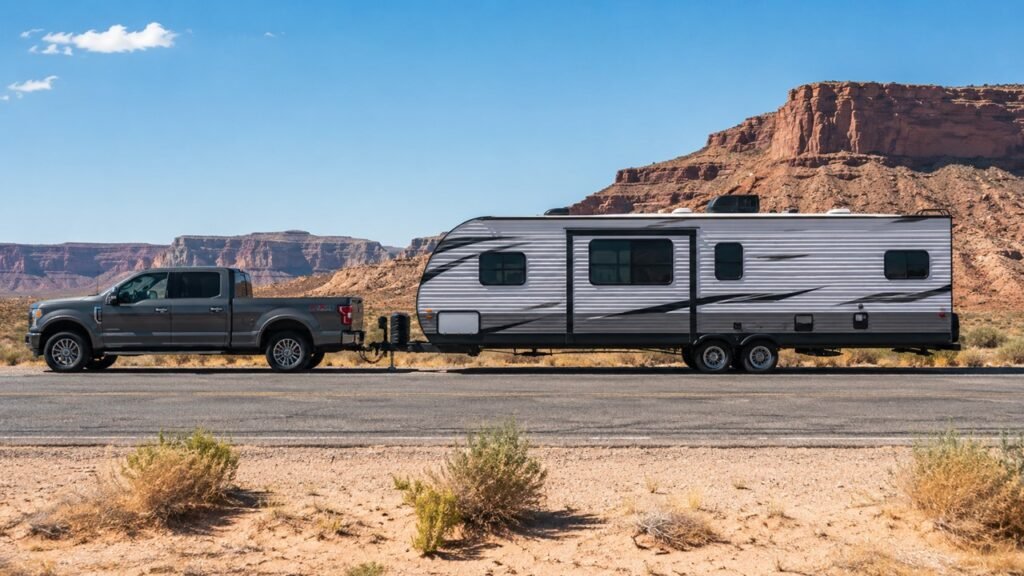
Your trailer may feel unstable because of low tongue weight, poor cargo placement, incorrect tire pressure, an unlevel hitch, excessive speed, or worn towing components. These problems can cause swaying, wandering, bouncing, or a feeling that the trailer is pushing your vehicle.
In this guide, I’ll help you identify the movement you are feeling, find the likely cause, and make your towing setup safer before your next trip.
Key Takeaways
- Low tongue weight is one of the most common causes of trailer sway.
- Heavy cargo should stay low, secured, and mostly forward of the axles.
- Check trailer and tow-vehicle tire pressures before every trip.
- The trailer should sit level when connected and fully loaded.
- Speed, wind, and passing trucks can expose an unstable setup.
- Sway-control equipment cannot correct poor loading or damaged parts.
- Stop towing if the trailer cannot track safely behind your vehicle.
What Does an Unstable Trailer Feel Like?
Not every unstable trailer behaves the same way. Identifying the exact movement can help you narrow down the problem much faster.
Side-to-Side Sway or Fishtailing
Trailer sway happens when the trailer begins moving from side to side behind your vehicle. It may start as a small wiggle, but each swing can become wider if you maintain speed.
You may feel the trailer tugging at the rear of your vehicle. The steering wheel may also require constant correction to keep the vehicle in its lane.
This movement is often linked to low tongue weight, cargo loaded behind the axles, excessive speed, or strong crosswinds.
Wandering or Floating
A wandering trailer does not always swing sharply. Instead, it may feel loose, vague, or unable to follow a steady line.
The trailer may drift slightly within the lane, especially when driving over road grooves or uneven pavement. Underinflated tires, axle alignment problems, or loose hitch components can cause this feeling.
Bouncing or Hopping
Bouncing is mainly an up-and-down movement. It often happens when towing an empty or lightly loaded utility trailer because the suspension is designed to carry more weight.
Overinflated tires, stiff suspension, rough roads, or poor cargo placement can make the bouncing worse. A trailer that repeatedly hops can lose tire contact and become difficult to control.
Porpoising or Front-to-Back Rocking
Porpoising is a repeating rise-and-fall movement between the tow vehicle and trailer. The rear of the tow vehicle drops while the trailer tongue rises, and then the movement reverses.
This can happen when the hitch weight is not distributed correctly. Soft suspension, worn shocks, poor weight-distribution hitch adjustment, and uneven roads may also contribute.
Pushing or Pulling the Tow Vehicle
Your trailer may feel like it is pushing the tow vehicle during braking or downhill travel. It may also pull sideways when the trailer brakes engage.
This movement can indicate excessive trailer weight, weak brakes, uneven brake adjustment, or a trailer that is not tracking correctly.
A properly set up trailer should follow the tow vehicle. It should not feel like it is controlling the direction of travel.
Common Causes of Trailer Instability
Trailer instability often comes from several small issues working together. The table below can help you connect the movement you feel with the first area you should inspect.
| Possible Cause | What It May Feel Like | When It Often Happens | First Thing to Check |
| Low tongue weight | Sway or fishtailing | Highway speeds and downhill roads | Loaded tongue weight |
| Cargo too far back | Tail-wagging movement | After loading equipment | Cargo position |
| Uneven side loading | Leaning or wandering | Turns and uneven roads | Left-to-right balance |
| Low tire pressure | Floating or squirming | At higher speeds | Cold tire pressure |
| Excessive tire pressure | Harsh bouncing | Bumps and rough pavement | Recommended pressure |
| Trailer not level | Poor tracking or axle loading | Immediately after hitching | Ball-mount height |
| Loose hitch parts | Clunking and delayed movement | Starts, stops, and bumps | Coupler and receiver |
| Excessive speed | Increasing sway | Highways and descents | Towing speed |
| Wind or passing trucks | Sudden sideways push | Open roads and highways | Weather and traffic |
| Worn suspension | Wandering and uneven wear | Most road conditions | Springs and bushings |
| Axle misalignment | Sideways tracking | At nearly all speeds | Axle condition |
| Weak trailer brakes | Pushing or pulling | Braking and downhill travel | Brake controller and brakes |
| Underrated tow vehicle | Constant nervous handling | Most towing conditions | Weight ratings |
Is Incorrect Tongue Weight Making the Trailer Unstable?
Tongue weight is the downward force the trailer places on the hitch ball. It helps keep the trailer firmly connected and tracking behind your vehicle.
What Happens When Tongue Weight Is Too Low?
Low tongue weight allows the rear of the trailer to act like a pendulum. The trailer can begin swinging from one side to the other because there is not enough downward force at the hitch.
This often happens when too much cargo is placed behind the trailer axles. Moving heavy equipment, coolers, motorcycles, or water containers toward the rear can dramatically change the balance.
A trailer with low tongue weight may feel acceptable at low speed. Once you reach highway speed, hit a bump, or encounter wind, the trailer may begin to sway.
What Happens When Tongue Weight Is Too High?
Too much tongue weight can overload the rear axle of your tow vehicle. The rear suspension may sag while weight is removed from the front tires.
When the front axle becomes too light, steering can feel slow or vague. Braking performance may also suffer because the front tires no longer have their intended contact with the road.
Excessive tongue weight can also overload the hitch, receiver, tires, and rear suspension. Moving all cargo forward is not a safe solution if it pushes your equipment beyond its ratings.
How Much Tongue Weight Should a Trailer Have?
Many conventional bumper-pull trailers tow best when tongue weight is around 10% to 15% of the trailer’s total loaded weight.
For example, a loaded trailer weighing 5,000 pounds may need approximately 500 to 750 pounds of tongue weight. The correct amount still depends on the trailer design and manufacturer instructions.
Boat trailers and specialty trailers may use different recommendations. Always follow the limits provided for your trailer, hitch, receiver, and tow vehicle.
How to Measure Loaded Tongue Weight
Measure tongue weight after the trailer has been loaded exactly as it will travel. Include batteries, propane tanks, water, tools, camping equipment, and personal belongings.
You can use a tongue-weight scale or visit a public vehicle scale. Some bathroom-scale methods may work for lighter trailers, but they must be set up correctly.
Do not estimate tongue weight by looking at rear suspension sag. Suspension condition and tow-vehicle design can make visual estimates misleading.
How Cargo Placement Affects Trailer Stability
The total cargo weight matters, but its location can affect stability just as much. A trailer may remain below its maximum weight and still become unsafe because of poor load placement.
- Place heavier cargo low to reduce the trailer’s center of gravity.
- Keep most cargo weight forward of the trailer axles.
- Use the 60/40 guideline as a starting point when practical.
- Confirm the final balance by measuring tongue weight.
- Keep left-to-right loading as even as possible.
- Avoid stacking heavy items near one sidewall.
- Secure cargo so it cannot slide during braking or cornering.
- Consider the weight of water, batteries, propane, and fuel.
- Check cabinets, storage bays, and toy-hauler garages.
- Reinspect tie-downs after the first few miles.
The 60/40 guideline means placing roughly 60% of the cargo weight in the front half and 40% in the rear half. However, trailer layouts vary, so measured tongue weight is more reliable than a simple loading formula.
Cargo movement can also create sudden instability. A generator, toolbox, or motorcycle that slides backward may reduce tongue weight while you are driving.
Use properly rated straps, wheel chocks, cargo bars, and anchor points. Close and secure every drawer, cabinet, and storage compartment before leaving.
Can Incorrect Tire Pressure Make a Trailer Feel Unstable?
Tires support the entire towing combination and strongly affect how it responds. Check all pressures while the tires are cold and before the trailer has been driven.
Underinflated Tires
Underinflated tires flex more than they should. Excessive sidewall movement can make the trailer feel soft, squirmy, or delayed when changing direction.
Low pressure also creates heat. Heat can weaken the tire and increase the risk of tread separation or a blowout.
One low tire on a tandem-axle trailer can also shift more load onto the remaining tires. That extra load may cause additional heat and instability.
Overinflated Tires
Overinflated tires may create a harsh, bouncy ride. The tire becomes less able to absorb small road imperfections, so more movement travels into the suspension and hitch.
For trailer tires, the correct pressure is often tied closely to load capacity and manufacturer guidance. For tow-vehicle tires, the maximum pressure printed on the tire sidewall is not automatically the correct towing pressure.
Use the tow vehicle’s loading information and owner’s manual. Use the trailer or tire manufacturer’s guidance for the trailer tires.
Uneven or Mismatched Tires
Tires on the same axle should normally match in size, construction, load range, and pressure. Mismatched tires can respond differently to weight and road forces.
One tire may flex more than another, causing the trailer to lean or wander. Large differences in tread depth can also affect tracking.
Check that every tire has enough load capacity for the weight it carries. Tire capacity should include a reasonable safety margin.
Tire Damage and Age
Inspect your tires for cracks, bulges, cuts, exposed cords, unusual wear, and objects in the tread. Run your hand near the tread surface to feel for uneven shapes, but do not do this while the tire is hot.
Uneven wear may point to axle alignment, bearing, suspension, or inflation problems. A tire can look acceptable from the outside while having internal damage.
Do not forget the spare tire. A flat, cracked, or underinflated spare will not help when you are stranded beside the road.
Does the Trailer Need to Be Level While Towing?
Your trailer should normally sit level or close to level when connected, loaded, and parked on flat ground. A level trailer helps the axles share weight correctly and keeps the hitch geometry closer to its intended position.
A trailer that rides nose-high may place too much weight on the rear trailer axle. It can also reduce effective tongue weight and make the trailer more likely to sway.
A severely nose-low trailer may place extra load on the tow vehicle’s rear axle. On some tandem-axle trailers, it can also change how weight is divided between the trailer axles.
To check the setup, park the tow vehicle and loaded trailer on a flat surface. Measure the trailer frame at the front and rear using the same reference point.
You can also measure the coupler height while the trailer is level and compare it with the hitch-ball height. Choose a ball mount with the correct rise or drop to bring the trailer closer to level.
Do not flip or modify towing parts unless the manufacturer allows it. The ball mount, hitch ball, coupler, and receiver must all have suitable weight ratings.
Hitch Problems That Can Cause Unstable Towing
The hitch transfers every movement between your vehicle and trailer. Incorrect, loose, or worn hitch components can make a small movement feel much larger.
Incorrect Hitch-Ball or Coupler Size
The hitch ball and coupler must be the same size. A coupler designed for a 2-inch ball should not be connected to a smaller ball, even if it appears to latch.
A poor match can allow excessive movement or cause the trailer to separate. Check the stamped size on both the ball and coupler.
After lowering the coupler, close the latch and insert the correct safety pin. Raise the tongue jack slightly to confirm that the coupler is holding securely.
Excessive Receiver or Ball-Mount Movement
A small amount of movement between a ball mount and receiver may be normal. Excessive play can cause clunking, delayed movement, and a loose feeling behind the vehicle.
Inspect the receiver tube, hitch pin, pin holes, shank, and welds. Rust, worn holes, cracks, or bent parts require professional attention.
Anti-rattle devices can reduce normal movement, but they should not be used to hide damage or badly worn components.
Incorrect Ball-Mount Height
A hitch ball that sits too high or low can make the trailer tow nose-up or nose-down. This may change tongue weight, axle loading, and stability.
Measure the setup rather than choosing a ball mount based only on the vehicle’s appearance. Remember that the tow vehicle may settle after the trailer is connected.
Improper Weight-Distribution Hitch Adjustment
A weight-distribution hitch uses spring bars to transfer some hitch load toward the tow vehicle’s front axle and the trailer axles.
If the system is adjusted incorrectly, the tow vehicle’s front axle may remain too light. Excessive adjustment can also create poor handling or place unnecessary stress on the hitch system.
Follow the hitch manufacturer’s setup procedure. Measure the vehicle’s front wheel-well height or axle loads before and after connecting the trailer.
Missing or Incorrect Sway-Control Equipment
Some towing combinations benefit from friction sway control, integrated weight-distribution and sway-control systems, or electronic trailer stability control.
The correct equipment depends on trailer size, tongue weight, hitch type, and manufacturer requirements.
Sway control should be viewed as additional protection. It is not a replacement for proper loading, correct tire pressure, suitable equipment, and safe driving.
Tow Vehicle Problems That Affect Trailer Stability
A well-loaded trailer can still feel unstable when the tow vehicle is overloaded, poorly matched, or mechanically worn.
- The trailer exceeds the vehicle’s towing capacity.
- The vehicle’s payload capacity has been exceeded.
- The rear axle carries more than its rated limit.
- The receiver hitch has an insufficient rating.
- The wheelbase is short compared with the trailer’s size.
- The rear suspension is soft, damaged, or worn.
- The shocks or struts no longer control movement.
- The tow-vehicle tires have insufficient load capacity.
- Tire pressure is too low for the towing load.
- Wheel alignment is incorrect.
- The rear of the vehicle sags excessively.
- The weight-distribution hitch is poorly adjusted.
- Heavy cargo in the vehicle has overloaded the rear axle.
Remember that payload includes more than tongue weight. Passengers, luggage, tools, accessories, bed cargo, and aftermarket equipment all use part of the available payload.
The towing setup is limited by its lowest-rated component. A high towing-capacity number does not override the payload, axle, tire, hitch, or receiver limits.
Trailer Suspension, Axle, and Brake Problems
If loading, tire pressure, and hitch height are correct, ongoing instability may indicate a mechanical problem. These issues usually require a closer inspection before further towing.
Worn Springs, Shackles, and Bushings
Leaf springs support the trailer and help control axle movement. Cracked springs, worn bushings, loose shackles, or damaged equalizers can allow the axles to shift.
Look for uneven ride height, missing hardware, metal-to-metal contact, or parts that appear crooked. Rust stains around a bolt may also show that a joint has been moving.
Loose or Damaged U-Bolts
U-bolts hold the axle to the leaf springs. If they become loose, the axle may move out of position.
This can cause the trailer to steer slightly on its own, wear tires unevenly, or feel unstable during braking.
U-bolts must be tightened to the correct specification. Severely rusted, stretched, or damaged hardware should be replaced rather than reused.
Bent or Misaligned Axles
A bent or misaligned axle can make the trailer travel at an angle. You may notice the trailer sitting slightly to one side of the tow vehicle.
Other clues include rapid shoulder wear, one tire wearing faster than the others, or a trailer that constantly pulls in one direction.
Axle alignment requires accurate measurements and specialized equipment. A qualified trailer repair shop should inspect suspected alignment problems.
Worn Wheel Bearings or Hub Problems
Loose wheel bearings allow unwanted movement at the wheel. You may hear grinding, humming, or clicking sounds.
A damaged bearing or poorly lubricated hub may also create excessive heat. Stop and investigate if one hub becomes much hotter than the others.
Bearing failure can cause serious wheel damage or even wheel separation. Do not continue towing when a wheel feels loose or a hub is overheating.
Weak or Uneven Trailer Brakes
Trailer brakes should apply smoothly and evenly. If one side brakes harder, the trailer may pull sideways.
Weak trailer brakes can also make the trailer push the tow vehicle during stops or downhill travel. This adds load to the tow vehicle’s brakes and reduces control.
Check the brake-controller settings, wiring, connectors, magnets, drums, shoes, and adjustment. Test the brakes at low speed in a safe location before entering traffic.
How Speed, Wind, and Road Conditions Trigger Instability
Driving conditions often expose a problem that was already present. A trailer may feel stable at 30 mph but begin moving once speed, wind, or road forces increase.
- Driving faster increases the energy behind every movement.
- Crosswinds push against the trailer’s large side area.
- Wind gusts can shift the trailer suddenly.
- Passing trucks create air pressure and suction.
- Downhill travel allows speed to build quickly.
- Abrupt steering can start or increase sway.
- Hard braking can upset the towing combination.
- Potholes may shift cargo and suspension weight.
- Concrete joints can create repeated bouncing.
- Road ruts may pull the trailer away from its path.
- Gravel and wet roads reduce tire grip.
- Road-edge drop-offs can cause sudden steering corrections.
Reducing speed is one of the most effective ways to improve control. Slower travel gives you more reaction time and removes energy from sway, bouncing, and steering movements.
Do not use the posted speed limit as a target. Choose a speed that fits your trailer, tires, road, visibility, traffic, and weather conditions.
What to Do If the Trailer Starts Swaying While Driving
Trailer sway can become severe very quickly. Your goal is to reduce speed smoothly without adding sudden steering or braking forces.
- Stay calm and keep your eyes on the road ahead.
- Hold the steering wheel firmly with both hands.
- Keep the tow vehicle pointed as straight as possible.
- Ease your foot off the accelerator gradually.
- Avoid rapid steering corrections.
- Do not accelerate in an attempt to pull the trailer straight.
- Avoid slamming on the tow vehicle’s brakes.
- Gently apply the trailer brakes manually if you have a working brake controller.
- Allow the vehicle and trailer to slow until the movement settles.
- Move to a safe location and stop.
- Inspect the tires, hitch, cargo, suspension, and trailer brakes.
- Correct the cause before returning to normal speed.
Manual trailer braking can help pull the trailer back into line because it slows the trailer without immediately braking the tow vehicle. Apply it smoothly rather than suddenly.
Normal braking advice does not override collision avoidance. Brake as needed when you must prevent an immediate crash.
After stopping, do not assume the sway happened only because of wind. Check the complete setup before continuing.
How to Diagnose an Unstable Trailer Step by Step
A systematic inspection helps you avoid replacing parts randomly. Start with the easiest checks and then move toward weighing and mechanical inspection.
- Identify whether you feel sway, wandering, bouncing, porpoising, or pushing.
- Confirm the trailer’s loaded weight.
- Check the tow vehicle’s towing and payload limits.
- Verify the receiver, hitch, ball mount, and ball ratings.
- Measure the loaded tongue weight.
- Move heavy cargo forward when tongue weight is too low.
- Balance cargo from left to right.
- Secure everything that could slide or tip.
- Check cold tire pressure on the tow vehicle and trailer.
- Inspect every tire for damage and uneven wear.
- Confirm the trailer sits level when connected.
- Check the hitch ball, coupler, latch, and safety pin.
- Look for excessive movement in the receiver.
- Test the trailer brakes and controller.
- Inspect springs, shackles, bushings, and U-bolts.
- Check wheel-bearing looseness and hub temperature.
- Look for axle misalignment or unusual tire wear.
- Perform a cautious low-speed road test.
- Increase speed gradually only if the trailer remains stable.
- Arrange a professional inspection if the problem continues.
Change one major factor at a time when possible. This makes it easier to identify what caused the improvement.
Never conduct high-speed tests with a trailer that already feels unsafe. A repair shop or towing specialist can inspect the system without exposing you to unnecessary risk.
How to Prevent the Trailer From Feeling Unstable
Stable towing starts before you enter the road. A consistent pre-trip routine can catch most common problems.
- Load the trailer before measuring its weight.
- Keep tongue weight within the recommended range.
- Place heavier items low and forward.
- Secure cargo with properly rated equipment.
- Balance the trailer from side to side.
- Empty or manage tanks that affect weight distribution.
- Confirm the trailer sits level.
- Use the correct ball size and ball-mount height.
- Check the coupler latch and safety pin.
- Cross the safety chains beneath the coupler.
- Connect the breakaway cable correctly.
- Check all tire pressures while cold.
- Inspect tires for damage and age.
- Test the lights, brakes, and brake controller.
- Stay within every weight and load rating.
- Reduce speed during wind and poor weather.
- Avoid sudden steering and braking.
- Stop after the first few miles to inspect the load.
- Check tires, hubs, straps, and hitch parts at rest stops.
A short inspection takes far less time than recovering from a dangerous sway event. Create a checklist and use it before every trip, even when towing the same trailer regularly.
Will a Weight-Distribution Hitch Fix Trailer Instability?
A weight-distribution hitch can improve handling in the correct situation. However, it cannot compensate for poor loading, an overloaded trailer, damaged tires, or worn mechanical parts.
What a Weight-Distribution Hitch Does
A conventional hitch places tongue weight mainly on the rear of the tow vehicle. A weight-distribution hitch uses spring bars to redistribute part of that load.
Some load is restored to the tow vehicle’s front axle, and some is transferred toward the trailer axles. This can reduce rear sag and improve steering response.
The system must be rated and adjusted for the trailer’s actual loaded tongue weight. A spring-bar rating that is too low or too high may reduce performance.
When Sway Control May Help
Friction sway-control bars resist side-to-side movement at the hitch. They can help manage small movements but require correct adjustment.
Some weight-distribution hitches include built-in sway control. These systems use friction or hitch geometry to resist unwanted trailer rotation.
Electronic stability-control systems monitor trailer movement and apply trailer brakes when sway is detected. Availability and compatibility depend on the trailer and braking system.
What Sway Control Cannot Fix
Sway-control equipment cannot make an unsafe setup safe. It will not correct:
- Low tongue weight
- Cargo loaded too far behind the axles
- An overloaded trailer
- An overloaded tow vehicle
- Damaged or underinflated tires
- A loose coupler
- Worn suspension parts
- Misaligned axles
- Weak trailer brakes
- An underrated hitch or receiver
Correct the cause first. Treat sway control as an additional layer of protection.
When Professional Setup Is Recommended
Professional help is a good idea when you are unfamiliar with weight-distribution adjustments or cannot measure the setup confidently.
You should also seek help when the trailer continues swaying after correcting its load, tongue weight, tire pressure, and hitch height.
A trailer specialist can weigh individual axles, inspect alignment, evaluate suspension parts, test brakes, and confirm that your hitch equipment is suitable.
When Should You Stop Towing and Get the Trailer Inspected?
Some instability problems should not be tested further on public roads. Stop towing when the combination cannot be controlled safely.
- The sway continues after you reduce speed.
- The trailer suddenly handles differently than before.
- A tire has a bulge, crack, exposed cord, or unusual shape.
- One tire repeatedly loses pressure.
- A wheel or hub becomes unusually hot.
- You hear grinding, scraping, or knocking.
- A wheel appears loose or tilted.
- The trailer leans on level ground.
- The coupler or receiver shows cracks or damage.
- Suspension parts are bent, broken, or missing.
- The trailer pulls strongly during braking.
- The tow vehicle’s steering feels unusually light.
- The rear suspension is severely compressed.
- The trailer tracks sideways.
- Cargo cannot be secured properly.
- Any weight rating has been exceeded.
- You cannot keep the trailer inside its lane.
Arrange roadside assistance when the trailer cannot be moved safely. Do not continue simply because the next exit or repair shop seems close.
Final Thoughts
When your trailer feels unstable, treat the movement as a warning rather than a normal part of towing. Low tongue weight, poor cargo placement, incorrect tire pressure, an unlevel hitch, excessive speed, and worn parts are common causes.
Start by slowing down, weighing the loaded setup, and checking each component carefully. A stable trailer should follow your vehicle predictably without swaying, wandering, bouncing excessively, or taking control of the drive.
Related FAQs
Why Does My Trailer Feel Like It Is Pushing My Vehicle?
Your trailer may push the tow vehicle because the trailer brakes are weak, poorly adjusted, or not working. Excessive trailer weight and downhill speed can make the problem worse.
Why Does My Trailer Wander Even When It Is Not Swaying?
Trailer wandering can result from low tire pressure, loose hitch parts, worn suspension, axle misalignment, or road grooves. Check both the trailer and tow vehicle before towing again.
Can Too Much Tongue Weight Make a Trailer Unstable?
Yes. Too much tongue weight can overload the tow vehicle’s rear axle, lighten the front tires, and reduce steering and braking control.
Can an Empty Trailer Feel More Unstable Than a Loaded Trailer?
Yes. Empty trailers often bounce more because their suspension is designed to carry weight, and some may also have insufficient tongue weight when unloaded.
Why Does My Trailer Bounce More on Concrete Highways?
Concrete road joints can create repeated up-and-down movement that matches the trailer’s wheelbase. Slowing down often reduces the bouncing.
Why Does My Trailer Move When a Semi-Truck Passes?
A passing semi-truck creates air pressure and suction that can push and pull your trailer. Keep the wheel steady and reduce speed if the movement feels strong.
Can Bad Wheel Bearings Cause Trailer Sway?
Yes. Worn wheel bearings can create looseness, heat, and irregular wheel movement, which may cause wandering or instability.
At What Speed Does Trailer Sway Usually Start?
Trailer sway can begin at almost any speed, depending on loading, tongue weight, wind, tires, and road conditions. Poorly balanced trailers may sway even at moderate speeds.
Should I Accelerate to Stop Trailer Sway?
No. Accelerating can add energy to the sway and make it worse. Ease off the accelerator, steer steadily, and apply the trailer brakes gently if available.
Can a Weight-Distribution Hitch Stop All Trailer Sway?
No. A weight-distribution hitch may improve stability, but it cannot fix low tongue weight, poor loading, tire problems, damaged suspension, or excessive speed.

Michael Carter is an experienced RV traveler who focuses on practical outdoor trips across the States. He writes clear, step-by-step guides and realistic reviews based on real travel needs. His aim is to help RV and camper owners plan informed, simpler journeys with confidence.