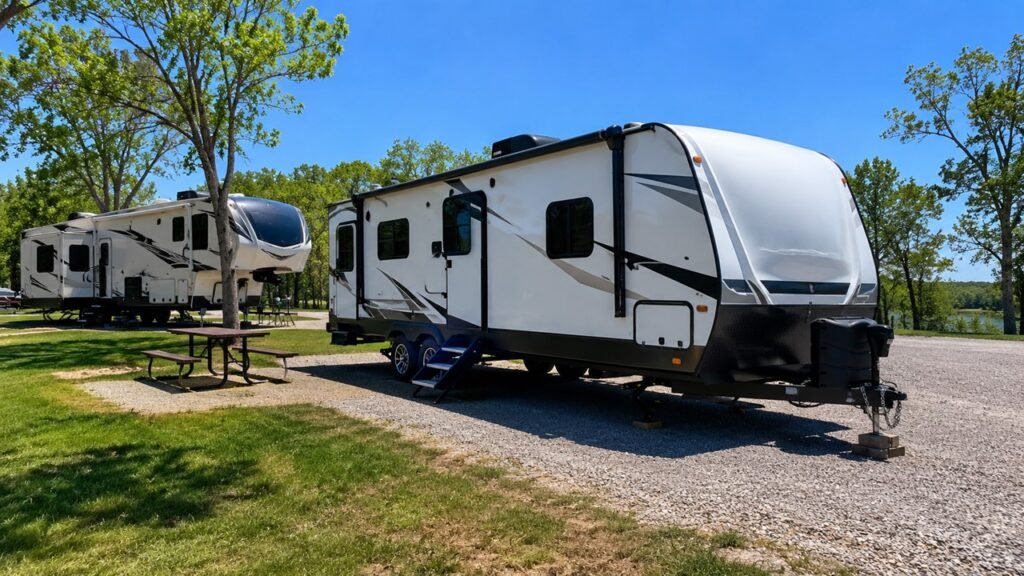
Yes, a trailer can be stolen from a campsite, especially when it is left unattended with an accessible coupler and limited security. A thief may connect it to another tow vehicle, bypass a weak lock, or use unsecured safety chains to move it.
The good news is that you can make trailer theft much harder. In this guide, I will explain how campsite theft happens, which security devices help, how to park defensively, and what to do if your trailer disappears.
Key Takeaways
- Trailers can be stolen from developed campgrounds, remote campsites, storage areas, and private property.
- A basic coupler latch does not provide meaningful theft protection.
- A fitted coupler lock works best when combined with a wheel immobilizer.
- Securing the safety chains can prevent another method of moving the trailer.
- Defensive parking makes it harder for someone to access the trailer tongue.
- A hidden GPS tracker may help locate the trailer after a theft.
- Photos, VIN records, registration details, and insurance documents support recovery.
- No trailer is completely theft-proof, but layered security can discourage opportunistic thieves.
How Can a Trailer Be Stolen From a Campsite?
A trailer can be stolen when someone connects its coupler to another tow vehicle and drives away. This is easier when the tongue is accessible, the coupler is unlocked, and the campsite is unattended.
Some thieves may try to break, pry, cut, or remove a lightweight coupler lock. Others may use an alternative hitch ball size, attach equipment around the trailer tongue, or temporarily drag the trailer using unsecured safety chains.
A trailer does not always need to be moved normally to be stolen. If its wheels can rotate and the front can be lifted, someone may be able to move it far enough to finish securing it elsewhere.
Thieves may also target individual items instead of the entire trailer. Generators, batteries, propane tanks, bicycles, tools, grills, and equipment stored in exterior compartments can be easier to take.
The risk varies by trailer type. A small utility trailer may be easier to move than a large travel trailer, but an expensive camper may be more attractive because of its resale value and the equipment stored inside.
Why Are Campsite Trailers Vulnerable to Theft?
Several campsite conditions can make trailers attractive to opportunistic thieves. Understanding these weak points can help you remove them before leaving your site.
The Trailer Is Left Unattended
Many campers leave their trailers while hiking, fishing, shopping, sightseeing, or visiting nearby attractions.
An empty campsite gives a thief time to inspect the hitch, test locks, and check whether anyone is watching. Even a short absence may create an opportunity when the trailer has little visible security.
The Coupler Is Easy to Access
The coupler is the main connection point between the trailer and tow vehicle. When the trailer is unhitched, the tongue is often left facing the campground road.
This position lets someone back a vehicle toward the coupler without moving other equipment. An unlocked coupler can then be lowered onto a compatible hitch ball.
Basic Locks May Be Easy to Defeat
A lock may look secure without providing strong resistance. Lightweight metals, exposed shackles, loose-fitting designs, and large gaps can make some locks vulnerable to common tools.
A universal lock may also fit several coupler styles without fitting any of them closely. Excess movement can leave room for prying, cutting, or bypass attempts.
Remote Campsites Have Less Natural Surveillance
Remote campsites often have fewer people, limited lighting, weak cellular coverage, and no overnight staff.
These conditions do not guarantee theft, but they can reduce the chance that suspicious activity will be noticed quickly. A vehicle approaching an isolated trailer may not attract immediate attention.
Keys and Hitch Components May Be Left Nearby
Some owners hide spare keys under steps, inside storage compartments, or near the trailer frame. These places may be easy for an experienced thief to check.
Removable hitch parts, unlocked safety chains, and unsecured stabilizing equipment may also give someone additional ways to move or access the trailer.
Which Trailers Are Most Likely to Be Targeted?
Any towable trailer can be stolen, but thieves often look for trailers that appear valuable, accessible, and easy to move.
Common risk factors include:
- Small or lightweight trailers
- Trailers parked beside an easy campground exit
- Unlocked or poorly fitted couplers
- Trailers without wheel locks
- Units parked in dark or isolated areas
- Trailers with visible generators or expensive equipment
- Open curtains that reveal valuables
- Trailers without alarms, trackers, or visible identification
- Trailers left unattended for predictable periods
- Units with keys hidden nearby
An older trailer can still be targeted. Utility trailers, enclosed cargo trailers, boat trailers, and basic campers may contain tools or equipment that are valuable even when the trailer itself is not.
What Are the Best Ways to Secure a Trailer at a Campsite?
The strongest campsite security uses several devices that protect different parts of the trailer. One lock may slow a thief, but multiple barriers require more time, tools, and noise.
Install a Properly Fitted Coupler Lock
A coupler lock fills or covers the space where a hitch ball would normally connect. This prevents someone from simply backing up, lowering the trailer, and driving away.
Choose a lock designed for your specific coupler shape and size. A close fit reduces the gaps that could be used for prying or striking the lock.
Look for durable construction, protected locking components, and minimal exposed hardware. The strongest material will not help much when the lock fits loosely.
Test the lock before your trip. Make sure it cannot be twisted, pulled free, or removed while the coupler latch is manipulated.
Add a Coupler Latch or Hitch Pin Lock
A latch lock prevents the coupler handle from opening normally. Depending on the trailer design, a hitch pin lock may also secure removable components.
These locks are useful as secondary barriers, but they should not be your only protection. Many latch locks have small shackles that may be easier to attack than a full coupler enclosure.
Using both a fitted coupler lock and a latch lock creates two separate problems for a thief to overcome.
Immobilize the Wheels
A wheel clamp, wheel boot, or security-focused locking chock prevents the trailer from rolling normally.
Wheel immobilizers are valuable because they protect a different part of the trailer. Even when someone defeats the coupler lock, the trailer may remain difficult to move.
Choose a device that fits the tire, wheel, brake components, and available clearance. A poorly sized clamp may be loose enough to remove or may interfere with brake lines and suspension parts.
Remember that ordinary plastic or rubber wheel chocks are mainly designed to prevent rolling while parked. They are not a substitute for a lockable security device.
Secure the Safety Chains
Do not leave the safety chains hanging freely when the trailer is unattended.
Someone may attempt to loop the chains over a hitch, place them around towing equipment, or use them to drag the trailer a short distance. This may be enough to move the trailer away from a visible location.
You can wrap and secure the chains with a suitable hardened lock, provided the arrangement does not damage the chain links. Inspect the chains before towing again and replace them if you notice cracks, deformation, or serious wear.
Use More Than One Security Device
Layered security is more effective because each device requires a different approach.
A practical combination might include:
- A fitted coupler lock
- A latch lock
- A wheel boot
- Secured safety chains
- A hidden tracker
- A motion alarm
A thief who expects a quick hitch-and-go theft may leave when faced with several visible barriers.
Lock Doors, Windows, and Storage Compartments
Complete trailer theft is not the only concern. Someone may break into the camper while leaving the trailer in place.
Lock every entry door, baggage door, storage compartment, and accessible window. Close blinds and curtains so people cannot see electronics, tools, cameras, or other valuables.
Factory compartment locks are not always highly resistant to forced entry. Consider upgrading weak latches if you regularly store valuable equipment inside them.
Install an Alarm or Motion Sensor
An alarm can attract attention when someone moves the trailer, opens a door, or tampers with an exterior compartment.
Available options include:
- Vibration alarms
- Door and window sensors
- Motion detectors
- Sirens
- Security lights
- Smartphone notifications
- Camera alerts
Test the sensitivity before relying on the system. Wind, rain, wildlife, and nearby movement can cause false alerts when the settings are too sensitive.
Also confirm whether the system depends on campground Wi-Fi or cellular coverage. Remote campsites may prevent mobile alerts from reaching you.
Hide a GPS Tracking Device
A GPS tracker does not physically stop a theft, but it may help locate the trailer afterward.
Place the tracker somewhere that is difficult to notice and remove. Avoid obvious locations near the battery, tongue box, or exterior access doors.
Check the device before each trip. Confirm that:
- The battery is charged
- The subscription is active
- The app works
- Location updates are appearing
- Cellular coverage is available
- Emergency contacts understand how to access the information
Some owners use two trackers in different locations. A visible or easily discovered device may distract attention from a second concealed tracker.
Trailer Security Devices Compared
Each security device has a different purpose. The table below can help you build a system instead of relying on one product.
| Security Method | Main Purpose | Visible Deterrent | Physical Protection | Important Limitation |
| Coupler lock | Blocks a normal hitch connection | High | High when fitted correctly | Loose-fitting models may leave gaps |
| Latch lock | Prevents normal coupler opening | Medium | Medium | Usually too small to use alone |
| Hitch pin lock | Secures removable hitch components | Medium | Medium | Does not immobilize the trailer |
| Wheel clamp or boot | Restricts wheel movement | High | High | Must fit the wheel and brake setup |
| Locking wheel chock | Limits wheel rotation | Medium | Medium | Some models provide more stability than security |
| Safety-chain lock | Prevents easy use of the chains | Medium | Medium | Incorrect use may damage chain links |
| Motion alarm | Detects movement or tampering | Medium | Low | False alarms may occur |
| GPS tracker | Helps locate a stolen trailer | Low | None | Does not prevent the initial theft |
| Security camera | Records activity or sends alerts | Medium | Low | Requires power, storage, or connectivity |
| Defensive parking | Limits access to the trailer tongue | Medium | Medium | Not practical at every campsite |
For most campers, a coupler lock and wheel boot provide the strongest starting combination. An alarm and tracker then add detection and recovery support.
How Should You Park a Trailer to Reduce Theft Risk?
Where and how you park can matter almost as much as the locks you install. Defensive parking limits access and makes suspicious activity easier for others to notice.
Block Access to the Trailer Tongue
When campground rules allow it, position the trailer tongue near a wall, fence, large tree, vehicle, or other fixed obstacle.
The goal is to prevent another tow vehicle from lining up directly with the coupler. Even a strong lock becomes more effective when the thief cannot reach it comfortably.
Maintain enough clearance for safe evacuation, utility connections, slide-outs, and campground traffic. Never park against trees or structures in a way that causes damage.
Choose a Visible, Well-Lit Site
A site near other campers, lighting, staffed facilities, or a monitored entrance may discourage opportunistic theft.
Visibility increases the chance that someone will notice a vehicle backing toward your trailer or a person working around the hitch.
Ask campground staff about security patrols, entrance controls, camera coverage, and past concerns in the area.
Avoid Parking Beside an Easy Exit
A campsite beside the main road or campground exit may allow a thief to leave quickly.
When possible, choose a site that requires slow turns or passes occupied campsites before reaching the exit. This creates more opportunities for suspicious activity to be noticed.
Do not choose an unsafe or inaccessible site only for security. Emergency access and towing clearance remain important.
Park Near Trusted Campers
Introduce yourself to nearby campers when you arrive. People are more likely to notice suspicious activity when they know who belongs at the site.
Let a trusted neighbor know when you plan to be away for several hours. You do not need to share private details. Simply ask them to contact campground staff if someone unfamiliar begins handling your trailer.
Keep the Site Looking Maintained
An obviously abandoned campsite may attract unwanted attention.
Close curtains, store loose equipment, remove trash, and avoid leaving signs that the trailer will remain empty for an extended period.
A motion-activated light may also increase visibility at night. Make sure it does not shine into neighboring campsites or violate campground rules.
What Should You Do Before Leaving the Trailer Unattended?
A quick security routine can prevent you from forgetting an important step. Use this checklist each time you leave the campground.
- Close and lock all doors.
- Secure every accessible window.
- Lock exterior storage compartments.
- Install the coupler lock.
- Lock the coupler latch.
- Attach the wheel clamp or wheel boot.
- Secure the safety chains.
- Activate the alarm.
- Confirm the GPS tracker is online.
- Remove or lock generators and bicycles.
- Secure grills, tools, coolers, and camping equipment.
- Close curtains and blinds.
- Move expensive items away from windows.
- Keep keys and ownership documents with you.
- Photograph the campsite setup.
- Tell a trusted neighbor when you expect to return.
- Avoid posting your empty campsite publicly in real time.
Performing the same routine every time makes it less likely that you will leave a lock open or a valuable item exposed.
Should You Remove a Trailer Wheel to Prevent Theft?
Removing a wheel can immobilize a trailer, but it is usually impractical for a normal campground stay.
The trailer must be supported with properly rated equipment on solid, level ground. Stabilizer jacks are not always designed to carry the full weight of a trailer, and incorrect support can damage the frame or create a serious collapse hazard.
Removing a wheel may also cause problems if you need to leave quickly because of severe weather, fire, flooding, or another emergency. Some campgrounds may prohibit extended repairs or wheel removal at the site.
This method may be appropriate for certain long-term storage situations, but a fitted wheel boot is generally safer and more convenient for temporary campsite security.
Can You Lock a Trailer to a Tree or Fixed Object?
You may be able to secure a trailer with a hardened chain and fixed anchor, but only when the property owner or campground permits it.
Do not wrap chains around trees, utility posts, electrical equipment, water connections, signs, fences, or campground structures without permission. Chains can damage bark, paint, pipes, and structural surfaces.
Natural areas may have strict rules against attaching equipment to trees. Even when it seems harmless, the chain could harm the tree or interfere with other campers.
A wheel immobilizer and defensive parking position are usually more practical than attaching the trailer to campground property.
How Can You Protect Items Outside the Trailer?
External equipment is often easier to steal than the trailer itself. Each item should be locked, stored, or removed when you leave the campsite.
Generators and Batteries
Portable generators are valuable and easy to carry when they are left beside the trailer.
Store the generator in a locked compartment after it has cooled, or secure it to an approved frame point with hardened chain and a quality lock. Never operate a generator inside a compartment, trailer, vehicle, tent, or other enclosed area.
Trailer batteries can also be removed quickly. A locking battery box or secured mounting system can make theft more difficult without blocking ventilation or service access.
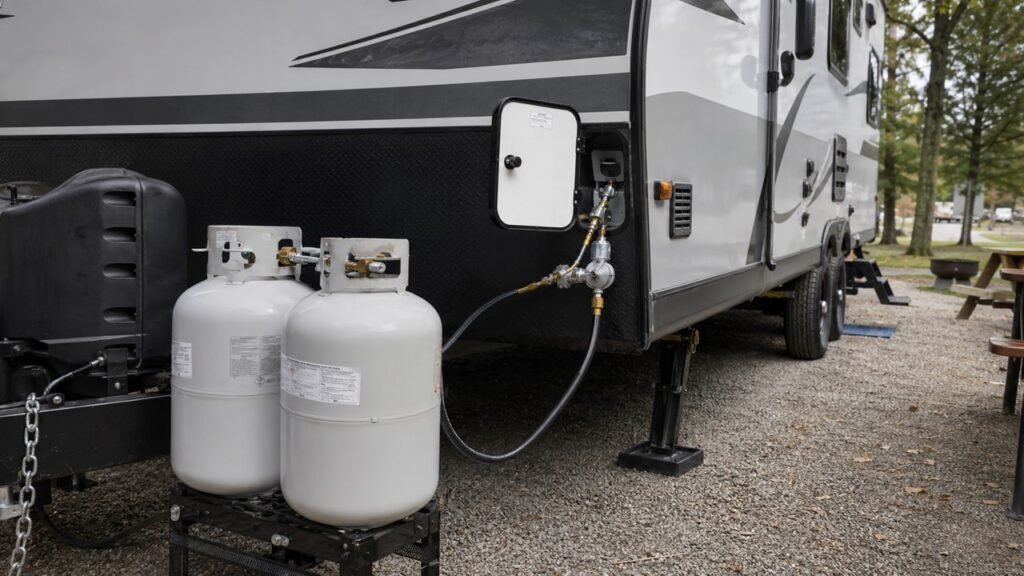
Propane Tanks
Propane cylinders may be targeted because they can be removed and resold.
Use a suitable locking bracket or secured cover that does not interfere with the valves, regulator, hoses, or emergency access. Never modify the cylinder or attach a lock in a way that could damage the valve.
Inspect the mounting hardware regularly for rust and looseness.
Bikes, Grills, and Camping Equipment
Lock bicycles to a secure rack or approved frame point. Remove quick-release seats, lights, computers, and accessories when leaving the site.
Grills, coolers, tools, fishing equipment, and camping furniture should be placed inside locked storage when possible.
Thin cables may discourage casual handling, but hardened chains generally provide more resistance against cutting.
License Plates and Identification
Use tamper-resistant fasteners on the trailer license plate where legally permitted.
Record the VIN, plate number, make, model, year, color, and unique exterior markings. Personal graphics or distinctive modifications can make a stolen trailer easier to identify.
Avoid covering or altering legally required identification numbers.
What Information Should You Record Before a Trip?
Accurate records can help law enforcement, campground staff, and your insurer identify the trailer after a theft.
Keep a record of:
- Vehicle identification number
- Registration number
- License plate number
- Manufacturer and model
- Model year
- Exterior color and graphics
- Trailer length and axle configuration
- Unique dents, repairs, or modifications
- Coupler type
- Tire and wheel details
- Photographs from every side
- Photographs of the interior
- Photographs of installed security devices
- Generator and equipment serial numbers
- Insurance company information
- Insurance policy number
- Purchase receipts
- Tracker account information
Store digital copies in a secure cloud account or another location outside the trailer. Keeping the only copies inside the camper will not help when the entire trailer is missing.
You should also photograph the campsite after setting up. The images may show the trailer’s condition, location, locks, neighboring vehicles, and equipment present before the theft.
Does Trailer Insurance Cover Campsite Theft?
Trailer theft coverage depends on your policy, trailer classification, location, deductible, exclusions, and selected coverage. Never assume that registration or tow vehicle insurance automatically protects the trailer.
Coverage for the Trailer Itself
A policy with comprehensive or theft coverage may pay for a stolen trailer, subject to its terms and deductible.
Liability-only coverage usually protects against damage you cause to others. It may not pay when your own trailer is stolen.
Ask the insurer whether coverage applies while the trailer is:
- At a developed campground
- At a remote campsite
- In storage
- Parked at home
- Unhitched from the tow vehicle
- Used as a temporary residence
- Left unattended for an extended period
Policy wording varies, so confirm the details directly with your insurance provider.
Coverage for Personal Belongings
The contents of the trailer may not be covered under the same limits as the trailer itself.
Clothing and basic personal items may receive different treatment from electronics, cameras, tools, sporting equipment, jewelry, and business property.
Personal belongings might be covered by an RV policy, homeowners policy, renters policy, or separate endorsement. Coverage limits and deductibles can differ for each category.
Keep receipts, photographs, model numbers, and serial numbers for expensive equipment.
Security Requirements and Policy Conditions
An insurer may require a police report, ownership documents, keys, photographs, receipts, or proof of the trailer’s condition.
Some policies may also contain conditions related to commercial use, long-term occupancy, storage, geographic areas, or security devices.
Read the policy before traveling and ask questions about unclear exclusions. Written confirmation is more useful than relying only on a verbal explanation.
What Should You Do If Your Trailer Is Stolen From a Campsite?
Act quickly, but do not put yourself in danger. The first steps can affect recovery, evidence preservation, and your insurance claim.
1. Contact the Police Immediately
Report the theft as soon as you confirm that the trailer was not moved by campground staff or another authorized person.
Provide:
- VIN
- Registration number
- License plate
- Make and model
- Photographs
- Unique markings
- Last known location
- Approximate time of disappearance
- Tracker information
- Descriptions of missing equipment
Ask for the police report or incident number for your insurance claim.
2. Notify the Campground
Tell the manager or security staff immediately.
Ask them to preserve:
- Entrance camera footage
- Campground security recordings
- Gate access records
- Vehicle descriptions
- Payment records
- Staff observations
- Witness contact information
Video may be automatically deleted after a limited period, so early notice matters.
3. Check the Tracking Device
Open the tracker app and save screenshots of current and recent locations.
Share the information directly with law enforcement. Do not travel to the location and confront anyone yourself.
A tracker location may identify a general area rather than an exact building or vehicle. Let police handle the recovery process.
4. Contact Your Insurance Provider
Report the theft promptly and follow the insurer’s instructions.
You may need to provide:
- Police report number
- Registration
- Title or proof of ownership
- Photographs
- Purchase documents
- Receipts
- List of stolen contents
- Copies of keys
- Details about installed locks
- Campground information
Keep copies of every document and record the dates of all conversations.
5. Report Stolen Equipment Separately
List missing generators, bicycles, tools, electronics, and other equipment individually.
Include serial numbers, model numbers, photographs, receipts, and identifying marks. These details can help police identify items that are recovered or offered for resale.
6. Protect Your Personal Information
A stolen trailer may contain more than physical property.
Cancel or replace payment cards, identification documents, keys, access cards, and devices that were inside.
Change passwords for stolen phones, laptops, tablets, security systems, and accounts that may have remained logged in.
If house keys or documents showing your home address were taken, consider changing the locks at home.
Common Trailer Security Mistakes to Avoid
Small mistakes can weaken an otherwise strong security setup.
- Relying only on the coupler latch
- Buying a lock without checking the coupler fit
- Using only one lightweight universal lock
- Leaving safety chains hanging freely
- Treating ordinary wheel chocks as security locks
- Hiding spare keys near the trailer
- Leaving doors unlocked while visiting campground facilities
- Forgetting exterior storage compartments
- Displaying valuables through open curtains
- Leaving generators unsecured
- Installing a tracker in an obvious location
- Forgetting to charge the tracker or alarm
- Depending entirely on campground Wi-Fi
- Posting an empty campsite publicly
- Keeping all ownership documents inside the trailer
- Assuming a busy campground guarantees security
- Confronting suspected thieves without police assistance
Review your setup from the perspective of someone trying to move or enter the trailer. Visible gaps often become easier to recognize when you deliberately inspect each access point.
Can a Trailer Be Made Completely Theft-Proof?
No trailer can be made completely theft-proof.
A determined thief with enough time, equipment, and privacy may defeat even strong security devices. Locks can be cut, alarms can be disabled, and trackers can be removed or lose their signal.
Your goal is to make the trailer slower, noisier, harder, and riskier to steal. Opportunistic thieves often prefer the easiest available target.
A fitted coupler lock, wheel immobilizer, secured safety chains, alarm, tracker, and defensive parking position create several separate obstacles. This layered approach provides much stronger protection than one expensive lock.
A Practical Campsite Trailer Security Setup
You do not need to cover the trailer with dozens of devices. A balanced system should be strong, convenient, and easy enough to use every time you leave.
A practical setup includes:
- A hardened coupler lock fitted to your coupler
- A coupler latch or hitch pin lock
- A visible wheel clamp or wheel boot
- Secured safety chains
- Locked doors and storage compartments
- A hidden GPS tracker
- A motion or vibration alarm
- A motion-activated exterior light
- Defensive parking that limits tongue access
- Current photographs and ownership records
- Appropriate theft insurance
- A consistent departure checklist
The best security system is one you will actually use. Complicated devices offer little value when they remain inside a storage compartment because they take too long to install.
Final Thoughts
A trailer can be stolen from a campsite when its hitch is accessible and its security is easy to defeat. Busy campgrounds can also create a false sense of safety because unfamiliar vehicles and people may not attract attention.
Start with a properly fitted coupler lock and a visible wheel immobilizer. Then secure the chains, lock every compartment, hide a tracker, and park where hitch access is difficult.
No single device guarantees protection. However, several well-chosen barriers can make your trailer a much less appealing target and improve your chances of recovering it if a theft occurs.
Related FAQs
Can Someone Steal a Trailer With a Coupler Lock?
Yes. A weak, damaged, or poorly fitted coupler lock may be cut, broken, or bypassed. Combine it with a wheel immobilizer and secured safety chains.
Are Campgrounds Responsible for a Stolen Trailer?
It depends on local law, campground policies, security promises, and the circumstances. Many campgrounds limit responsibility for unattended vehicles and personal property.
Do Wheel Chocks Prevent Trailer Theft?
Ordinary wheel chocks mainly prevent accidental rolling. A locking wheel chock, wheel clamp, or wheel boot provides better theft protection.
Can Thieves Tow a Trailer Using the Safety Chains?
Unsecured safety chains may be used to drag or temporarily move a trailer. Locking the chains adds another obstacle to a quick theft attempt.
Is a GPS Tracker Worth Installing in a Trailer?
Yes, a concealed tracker may help locate a stolen trailer. However, it supports recovery and should not replace physical locks or wheel security.
Should I Leave My Trailer Hitched at the Campsite?
Leaving it hitched can make quick removal harder, but it may place both the trailer and tow vehicle at risk. Lock the hitch connection and follow campground rules.
Are Remote Campsites More Vulnerable to Trailer Theft?
Remote sites may have fewer witnesses, less lighting, limited cellular coverage, and slower emergency response. Strong physical security becomes especially important in these locations.
Should I Report Suspicious Activity at a Campground?
Yes. Report people inspecting trailers, tampering with equipment, or repeatedly driving through campsites to campground staff or local authorities.
Can an AirTag Replace a GPS Trailer Tracker?
An AirTag may help locate nearby property, but it relies on compatible devices passing within range. A dedicated cellular GPS tracker may provide more consistent location updates.
Should I Lock My Trailer While I Am Still at the Campsite?
Yes. Lock the doors, compartments, coupler, and valuable equipment whenever you are sleeping, showering, visiting facilities, or spending time away from the trailer.

Michael Carter is an experienced RV traveler who focuses on practical outdoor trips across the States. He writes clear, step-by-step guides and realistic reviews based on real travel needs. His aim is to help RV and camper owners plan informed, simpler journeys with confidence.