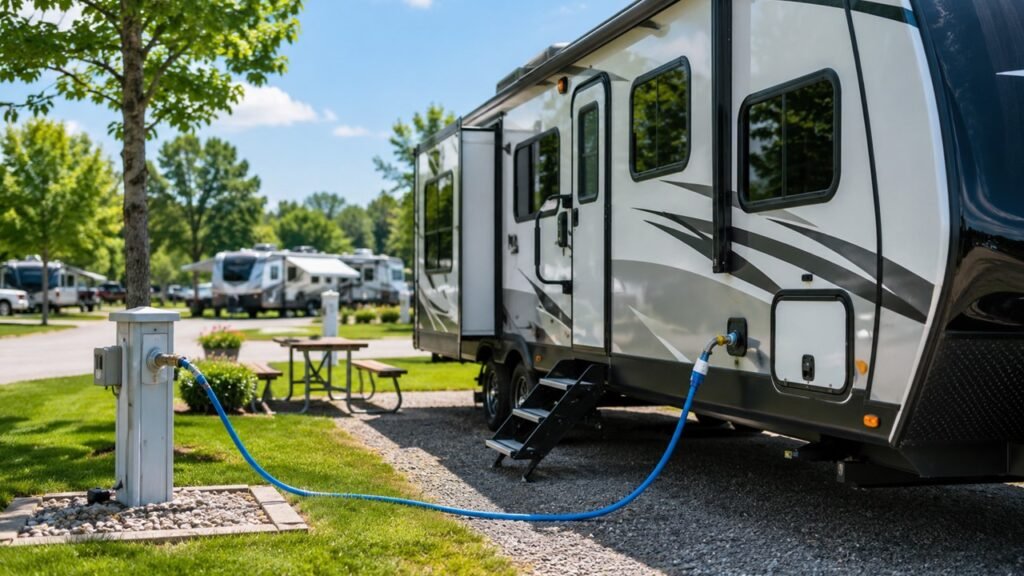
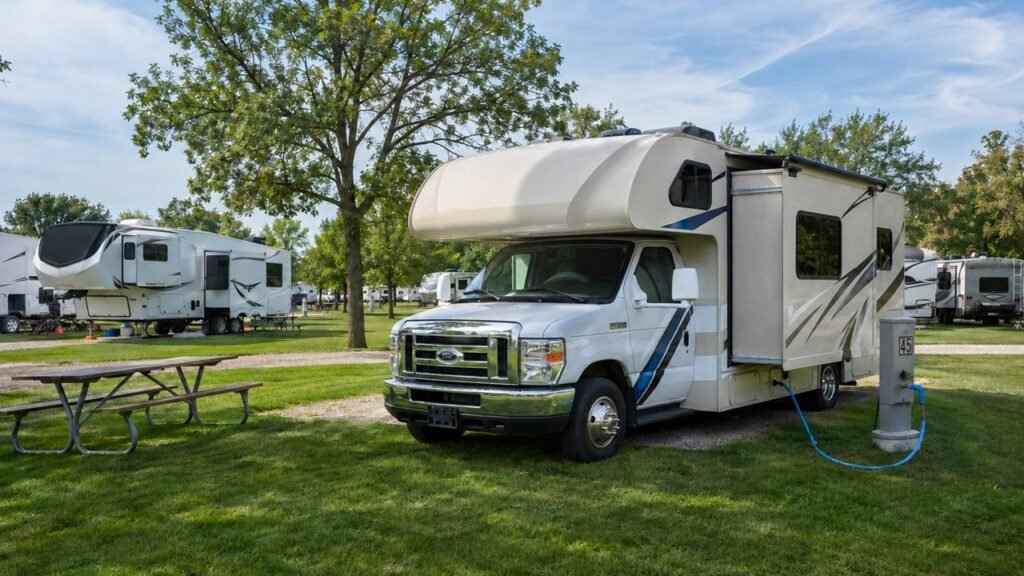
Yes, high campground water pressure can damage an RV’s plumbing system. Excessive pressure can strain fittings, seals, faucets, toilet valves, water filters, supply lines, and appliances. It may cause an immediate burst or create a slow, hidden leak behind a cabinet, wall, or floor.
In this guide, I’ll explain what pressure is generally safe, how excessive pressure damages an RV, which warning signs to watch for, and how to protect your plumbing with a properly installed water pressure regulator.
Key Takeaways
- High campground water pressure can damage RV pipes, fittings, seals, fixtures, and appliances.
- Many RV owners regulate incoming water to approximately 40–50 PSI.
- Your RV owner’s manual should determine the correct maximum pressure.
- Campground pressure can change between sites and throughout the day.
- Install the regulator directly at the campground spigot before the hose.
- A pressure gauge measures pressure, but it does not reduce it.
- Turn off city water when leaving your RV unattended.
- Inspect the plumbing immediately after an accidental unregulated connection.
What Is Considered High Water Pressure for an RV?
Water pressure that is safe for one RV may be too high for another. Your RV’s age, plumbing design, fittings, fixtures, and manufacturer recommendations all affect how much pressure the system can safely handle.
What PSI Is Usually Safe for an RV?
For many RVs, an incoming pressure of approximately 40–50 PSI provides a comfortable balance between plumbing protection and usable water flow.
However, this should not be treated as a universal rule. Some manufacturers recommend staying closer to 40 or 45 PSI, while others may permit slightly higher pressure.
Older RVs may also have weakened fittings, aging seals, brittle plastic connections, or previous plumbing repairs. Even when the original system handled higher pressure, its safe working limit may have changed over time.
The safest approach is simple: check your owner’s manual and set your regulator according to the manufacturer’s recommendation.
Why Campground Water Pressure Can Change
Campground water pressure is rarely identical at every location. One site may have weak pressure, while another site a few rows away may have much stronger pressure.
Pressure can also change because of:
- The campground’s pump system
- The number of guests using water
- The site’s distance from the main supply
- Changes in elevation
- Municipal water pressure
- Maintenance work
- Overnight drops in water demand
You might test a safe pressure during the afternoon and experience a higher reading late at night when fewer campers are using water. This is why a regulator should remain connected throughout your stay.
General RV Water Pressure Guide
The following table offers general guidance. Your RV owner’s manual should always take priority over these ranges.
| Incoming Water Pressure | What It May Mean | Recommended Action |
| Below 30 PSI | Weak campground pressure or restricted flow | Check the regulator, hose, filter, and water source |
| 30–40 PSI | Usable but possibly weak at multiple fixtures | Confirm the recommended range for your RV |
| 40–50 PSI | Common operating range for many RVs | Usually suitable when approved by the manufacturer |
| 50–60 PSI | May exceed some RV recommendations | Check the owner’s manual before connecting |
| Above 60 PSI | Potentially unsafe for many RV plumbing systems | Reduce pressure with a regulator |
| 80 PSI or higher | High-risk unregulated pressure | Do not connect directly to the RV |
How Can High Campground Water Pressure Damage an RV?
An RV plumbing system contains many more vulnerable parts than the visible hose outside. Once high-pressure water enters the city water connection, it places continuous stress on fittings, valves, seals, filters, and appliances throughout the vehicle.
Loosened or Failed Plumbing Fittings
Plumbing fittings are among the most likely places for pressure-related leaks to develop.
Your RV may contain:
- Crimped PEX connections
- Threaded plastic fittings
- Elbows and tees
- Swivel connections
- Flexible supply lines
- Rubber washers
- Push-to-connect fittings
Excessive pressure can force water through a connection that previously appeared secure. A fitting does not always burst dramatically. It may begin with a few drops that slowly soak the surrounding wood, insulation, or flooring.
Connections beneath sinks and behind toilets are especially important to inspect because movement from traveling can already place stress on them.
Cracked or Leaking Water Lines
Most modern RVs use PEX or another flexible plumbing material. PEX itself can tolerate considerable pressure when properly installed, but that does not make the entire RV plumbing system equally strong.
The fittings, clamps, connectors, valves, and transitions between materials may fail before the tubing does.
Older plumbing lines can also become stiff, worn, or damaged. If a line has rubbed against a cabinet edge or frame component, excessive pressure may expose that weak area and create a leak.
Damaged Faucet and Toilet Seals
High water pressure can shorten the life of small internal components inside faucets, shower controls, and toilets.
Potentially affected parts include:
- Faucet cartridges
- O-rings
- Toilet fill valves
- Shower valves
- Flexible faucet lines
- Outdoor shower fittings
You may notice a faucet dripping after it is turned off, a toilet valve leaking, or water appearing around a fixture connection.
These problems can also result from ordinary wear, but excessive pressure may cause an already weakened seal to fail sooner.
City Water Inlet and Check Valve Failure
The RV’s city water inlet usually contains a check valve that helps prevent water from flowing backward through the connection.
When campground pressure is too high, the valve and its internal seal may experience excessive stress. A damaged check valve can leak around the inlet or allow water to flow in the wrong direction.
In some RVs, a failed check valve may also allow water to enter the freshwater tank while connected to city water. The tank may eventually overflow through its vent or fill opening.
Water Heater and Appliance Stress
The water heater is connected to the same pressurized plumbing system. Excessive pressure can stress its fittings, valves, tank connections, and supply lines.
Other connected appliances may include:
- Washing machines
- Dishwashers
- Ice makers
- Residential refrigerators
- Outdoor kitchens
A dripping water-heater pressure relief valve does not automatically prove that campground pressure is too high. Thermal expansion, sediment, a faulty valve, or excessive water temperature can produce similar symptoms.
Still, unusually high incoming pressure should be investigated whenever the water heater begins leaking or discharging water.
Water Filter and Hose Damage
Your freshwater hose and filter are also exposed to campground pressure.
A regulator installed only at the RV’s city water inlet may protect the RV’s internal plumbing, but the hose and filter remain exposed to the full pressure of the campground supply.
High pressure can cause:
- Hose swelling
- Leaking hose fittings
- Cracked filter housings
- Failed washers
- Loose threaded connections
Installing the regulator directly at the spigot protects everything located after it, including the filter and freshwater hose.
Hidden Water Damage Inside the RV
The plumbing repair may be relatively small, but the water damage surrounding it can become extremely expensive.
A hidden leak can cause:
- Swollen cabinet panels
- Soft or rotten flooring
- Stained walls
- Damaged insulation
- Mold and mildew
- Delamination
- Musty odors
- Corrosion near electrical components
Because RV walls and floors contain enclosed spaces, water may travel away from the original leak before it becomes visible.
A small drip behind a kitchen cabinet can eventually appear several feet away. By then, the surrounding materials may already be saturated.
What Are the Signs of Excessive Water Pressure in an RV?
High pressure does not always produce one obvious symptom. Some problems appear immediately after connecting, while others develop slowly as seals and connections begin to leak.
Watch for these warning signs:
- Water surging aggressively from faucets
- Banging or shaking plumbing lines
- A sudden leak at a hose connection
- Dripping faucets after they are turned off
- Water around the toilet valve or supply line
- Leaks beneath sinks
- A city water inlet that drips
- Swelling or leaking around a filter housing
- Unusual water-heater relief-valve discharge
- Water appearing inside storage compartments
- Damp flooring near plumbing fixtures
- A musty smell inside cabinets
- Unexplained freshwater tank filling
- The water pump cycling after city water is disconnected
These symptoms do not prove that high pressure is the only cause. Loose fittings, worn seals, freezing damage, debris, and normal component failure can create similar problems.
The best way to confirm the incoming pressure is to test it with a water pressure gauge.
What Should You Do If Campground Water Pressure Is Too High?
- Turn off the campground spigot immediately.
- Open a cold-water faucet inside the RV briefly to release pressure from the plumbing.
- Disconnect the freshwater hose from the campground supply.
- Attach a water pressure gauge or adjustable regulator to the spigot.
- Open the spigot and check the pressure before reconnecting the RV.
- Set the regulator according to your RV manufacturer’s recommendation.
- Reconnect the hose and slowly turn the water back on.
- Inspect the hose, filter, inlet, sinks, toilet, shower, and water heater for leaks.
- Check inside cabinets and storage areas for moisture.
- Leave the water disconnected if you suspect a hidden leak or damaged fitting.
If you discover water inside a wall, beneath the floor, or near electrical components, professional inspection may be necessary.
How Do You Test Campground Water Pressure?
You cannot accurately judge campground pressure by looking at the stream from a faucet. Strong flow can occur at safe pressure, while weak flow may be caused by a clogged filter or restrictive regulator.
Test Static Water Pressure
Static pressure is the pressure in the system while no water is actively flowing.
To test it:
- Disconnect your RV freshwater hose.
- Attach a pressure gauge directly to the campground spigot.
- Make sure no outlet on the gauge is open.
- Open the campground spigot fully.
- Wait for the reading to stabilize.
This reading shows the pressure that the hose and RV could experience when all fixtures are closed.
Static pressure is particularly important because partially closing the campground spigot does not necessarily prevent pressure from building when water stops flowing.
Test Dynamic Water Pressure
Dynamic pressure is measured while water is flowing.
Connect your regulator and gauge, then turn on a faucet inside the RV. Watch how much the pressure drops while the water is running.
A large drop may indicate:
- A clogged filter
- A restrictive regulator
- A kinked hose
- Sediment inside the spigot
- Low campground flow
- An undersized connection
This is why pressure and flow should not be treated as the same thing.
Watch for Pressure Spikes
A normal reading during the day does not guarantee that the pressure will remain unchanged overnight.
Some gauges include a second pointer that records the highest pressure reached. This feature can help identify pressure spikes that occur when you are not watching the gauge.
Even without a peak-reading gauge, leaving a regulator installed provides ongoing protection against changing campground conditions.
How Do You Protect an RV From High Campground Water Pressure?
A reliable pressure regulator is the main line of protection, but its location and adjustment are equally important. Regular inspections and careful hookup habits further reduce the risk of plumbing damage.
Install the Regulator at the Campground Spigot
The regulator should normally be attached directly to the campground water source.
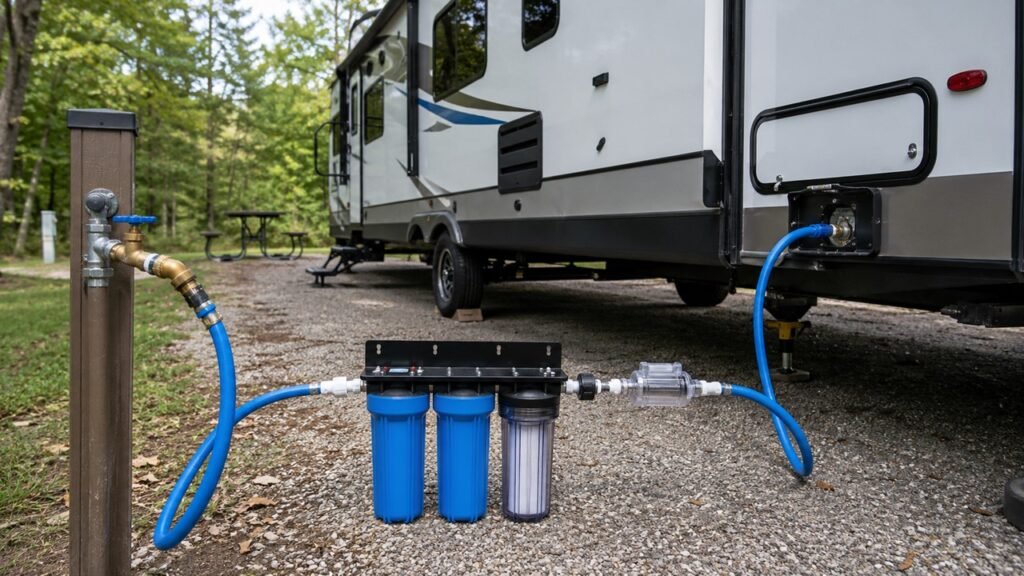
A practical connection order is:
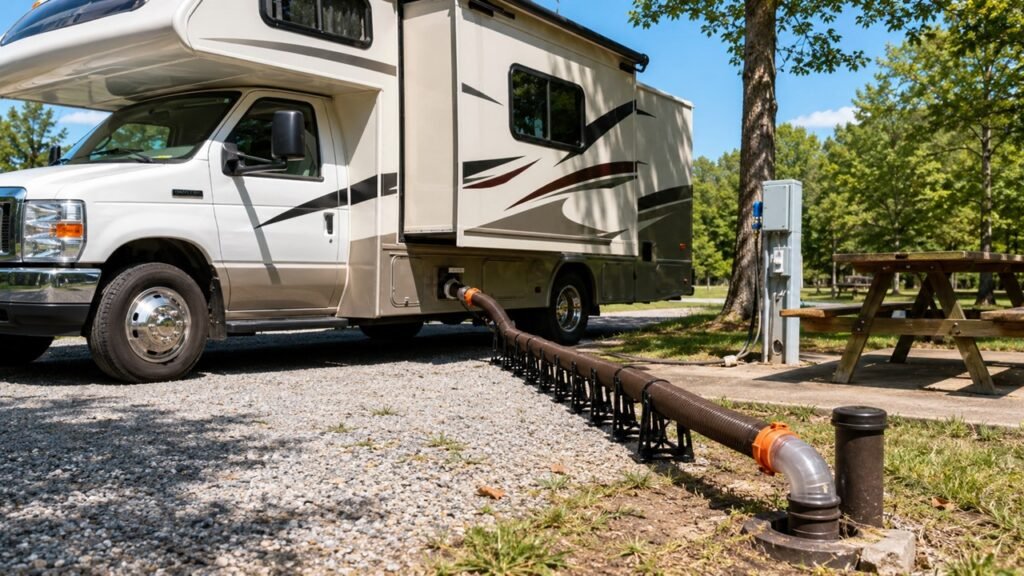
Campground spigot → water pressure regulator → water filter → potable-water hose → RV city water inlet
This arrangement lowers the pressure before water reaches the filter, hose, or RV.
Some campers install the regulator at the RV inlet because it is easier to monitor. Although this can protect the RV’s internal plumbing, the hose and filter remain exposed to full campground pressure.
A short hose elbow or flexible connector may help reduce strain when a heavy adjustable regulator is hanging from the spigot.
Set the Correct Outlet Pressure
Check your owner’s manual before adjusting the regulator.
For many RVs, a setting around 40–50 PSI works well. However, you should not increase the pressure simply because the shower feels weak.
Low flow can result from:
- A clogged filter
- A kinked hose
- A dirty faucet aerator
- A clogged inlet screen
- A restrictive preset regulator
- Sediment in the showerhead
Check these possible restrictions before increasing the regulator setting.
When adjusting an adjustable regulator, make small changes and verify the result using its gauge.
Use a Potable-Water Hose
Use a hose specifically designed for drinking water and RV freshwater connections.
A potable-water hose is made for delivering water used for drinking, cooking, washing, and bathing. A standard garden hose may add unwanted taste, odor, or materials not intended for potable-water use.
The hose should also have a suitable pressure rating and secure fittings.
Replace it if you notice:
- Bulging
- Cracks
- Loose ends
- Leaking threads
- Significant discoloration
- Damage from freezing
Inspect Washers, Threads, and Connections
A pressure regulator cannot prevent leaks caused by damaged or poorly installed connections.
Before each hookup, inspect:
- Rubber washers
- O-rings
- Hose ends
- Regulator threads
- Filter connections
- City water inlet threads
- Plastic elbows
- Swivel fittings
Hand-tighten most hose connections first. Excessive force from pliers can damage threads, crack plastic fittings, or crush washers.
Thread-sealing tape may help on certain tapered pipe threads, but it is usually unnecessary on standard garden-hose connections that seal with a rubber washer.
Turn Off City Water When Leaving the RV
Turning off the campground supply is a simple precaution whenever you leave the RV unattended.
Even a correctly regulated system can develop a leak because of:
- A failed hose
- A loose fitting
- A cracked filter housing
- A damaged toilet valve
- A worn faucet line
When the spigot remains open, water can continue flowing until someone discovers the problem.
Turning it off limits how much water can escape if a component fails while you are away. Many RV owners also shut off city water before sleeping for the same reason.
What Type of RV Water Pressure Regulator Should You Use?
RV pressure regulators are available in several designs. The best choice depends on your budget, desired flow, and how much control you want over the outlet pressure.
Preset Inline Regulator
A preset regulator reduces incoming pressure to a fixed range, often around 40–50 PSI.
Its advantages include:
- Low cost
- Compact size
- Simple operation
- No adjustment required
However, inexpensive preset models may restrict water flow. You may notice weaker pressure when several fixtures are being used at once.
You also cannot change the setting to match different RV manufacturer recommendations.
Adjustable Regulator With a Gauge
An adjustable regulator allows you to select the outlet pressure and monitor it with a built-in gauge.
This design is helpful because campground pressure varies. You can set the regulator according to your RV’s recommended limit instead of relying on a fixed factory setting.
Adjustable models are generally larger and more expensive, but they usually provide better control and flow.
The gauge should still be inspected for damage. A stuck or inaccurate gauge may give you false confidence even when the regulator is not working correctly.
High-Flow Regulator
A high-flow regulator is designed to deliver a greater volume of water while still maintaining a safe pressure.
This can help when you are:
- Running a shower
- Filling a sink
- Flushing the toilet
- Using multiple fixtures
- Operating a washing machine
Higher flow does not mean the regulator should be adjusted to a higher PSI. A well-designed regulator can improve flow without exposing the RV to unsafe pressure.
Features Worth Looking For
- Lead-free material approved for potable water
- Standard hose-thread connections
- An easy-to-read pressure gauge
- Adjustable outlet pressure
- Adequate flow capacity
- Corrosion-resistant brass construction
- Clear manufacturer instructions
- A suitable maximum inlet pressure rating
- Replaceable washers or repairable parts
- Freeze-resistant storage instructions
Does Partially Closing the Campground Spigot Reduce Pressure?
Partially closing the campground spigot can reduce the amount of water flowing through the opening, but it does not reliably control static pressure.
While a faucet is running, the restricted spigot may make the water stream appear weaker. Once every faucet is closed, pressure can gradually build downstream until it approaches the campground’s full supply pressure.
That means the RV may still experience excessive pressure even though the spigot is only partially open.
A partially closed spigot is a flow restriction, not a dependable pressure regulator. Use a proper RV water pressure regulator instead.
Does an RV Water Filter Regulate Water Pressure?
An RV water filter does not safely regulate water pressure.
A filter may reduce water flow, especially as sediment builds inside the cartridge. This restriction can make the pressure at the faucet feel lower, but it does not hold the outlet pressure at a controlled setting.
A filter and regulator perform different jobs:
- The regulator reduces and stabilizes pressure.
- The filter removes sediment, odor, taste, or specific contaminants.
You generally need both devices if you want controlled pressure and filtered campground water.
Does the RV Water Pump Protect Against Campground Pressure?
The onboard water pump controls pressure only when it draws water from the freshwater tank. It does not normally regulate campground water entering through the city water connection.
When Connected Directly to City Water
When the RV is connected to city water, campground pressure pushes water through the plumbing.
The onboard pump should normally remain switched off because it is not needed. It does not sit between the campground spigot and the fixtures, so it cannot protect the system from excessive incoming pressure.
The external regulator provides that protection.
When Using the Freshwater Tank
When you disconnect from city water and use the freshwater tank, the onboard pump creates the plumbing pressure.
The pump turns on when a faucet opens and shuts off after reaching its preset pressure.
In this mode, campground pressure is not continuously entering the plumbing. The pump’s pressure switch controls the system instead.
When Filling the Freshwater Tank
Filling methods vary between RVs. Some have a gravity-fill opening, while others use a valve system connected to the city water inlet.
Follow your owner’s manual and never leave the tank filling unattended.
Overfilling may force water from the tank vent, overflow line, or fill connection. Blocked vents can also cause tank deformation or plumbing problems.
What Should You Inspect After Connecting Without a Regulator?
An accidental unregulated hookup does not always cause damage, but you should inspect the plumbing before assuming everything is fine.
Turn off and disconnect the city water, then inspect:
- The freshwater hose
- The pressure regulator connections
- The water filter housing
- The city water inlet
- Plumbing beneath the kitchen sink
- Plumbing beneath the bathroom sink
- The toilet supply line and valve
- The indoor and outdoor shower
- The water heater compartment
- The plumbing manifold
- Low-point drain valves
- Storage bays beneath plumbing fixtures
- Appliances connected to the water system
- Cabinet bases and floor edges
Use a dry paper towel around fittings to detect small amounts of moisture that may be difficult to see.
After reconnecting with a regulator, keep the system pressurized while monitoring each area. Check again after several minutes because a slow leak may not appear immediately.
If you find dampness but cannot locate the source, shut off the water and arrange a professional pressure test.
Can High Water Pressure Cause Damage Immediately?
High water pressure can cause immediate damage, but it can also weaken components gradually.
A cracked hose, loose fitting, or brittle connector may fail as soon as the campground spigot is opened. Water may spray inside a cabinet or storage compartment within seconds.
In other cases, the pressure produces only a slow seep. The fitting may leak whenever the system is pressurized and stop after the water is disconnected.
Repeated exposure can also weaken seals and connections. A component that survives one high-pressure hookup may fail during a later trip.
This is why previous trouble-free hookups do not prove that connecting without a regulator is safe.
Common RV Water-Pressure Mistakes to Avoid
- Connecting directly to an unfamiliar campground spigot
- Assuming every campground provides safe pressure
- Using a gauge without an actual regulator
- Partially closing the spigot instead of regulating pressure
- Installing the regulator only after the hose and filter
- Increasing PSI before checking for a clogged filter
- Ignoring the RV manufacturer’s pressure recommendation
- Assuming a newer RV cannot be damaged by high pressure
- Leaving city water running while away from the RV
- Ignoring small drips beneath sinks
- Overtightening plastic hose connections
- Using a damaged or frozen regulator
- Allowing the regulator or filter to hang unsupported
- Mistaking low flow for low pressure
- Failing to inspect plumbing after an unregulated hookup
Final Verdict
High campground water pressure can damage an RV’s pipes, fittings, seals, faucets, toilet valves, filter housings, water heater connections, and other plumbing components. The damage may occur immediately or begin as a small hidden leak that gradually affects walls, cabinets, insulation, and flooring.
Before connecting to campground water, check your RV owner’s manual and install a reliable pressure regulator directly at the spigot. For many RVs, approximately 40–50 PSI is a common operating range, but the manufacturer’s recommendation should always come first.
Test unfamiliar water sources, inspect every connection after pressurizing the system, and turn off city water whenever you leave the RV unattended. These simple habits can prevent a small plumbing failure from becoming a costly repair.
Related FAQs
These answers address common questions RV owners have about campground hookups, pressure regulators, and safe plumbing operation.
How Much Water Pressure Can an RV Handle?
Many RVs are commonly operated around 40–50 PSI, but the maximum safe pressure depends on the manufacturer, model, age, and condition of the plumbing. Check your RV owner’s manual before selecting a regulator setting.
Is 60 PSI Too High for an RV?
Sixty PSI may exceed the recommended limit for many RVs, particularly older models or those with plastic fittings and aging seals. Do not assume that 60 PSI is safe unless your RV manufacturer specifically allows it.
Is 40 PSI Enough for an RV?
Forty PSI is enough for many RV plumbing systems and usually provides adequate water for showering, washing dishes, and flushing the toilet. If the flow feels weak, inspect the hose, filter, aerators, and regulator before increasing the pressure.
Where Should an RV Water Pressure Regulator Be Installed?
Install the regulator directly on the campground spigot before the water filter and freshwater hose. This placement protects the regulator’s downstream components, including the filter, hose, fittings, and RV plumbing.
Do I Need a Regulator at Every Campground?
Yes, you should use a regulator whenever you connect your RV to an external pressurized water source. Campground pressure can vary between parks, sites, and different times of day. A previous safe experience does not guarantee that the next hookup will be safe.
Can a Bad Regulator Cause Low Water Pressure?
A clogged, damaged, undersized, or incorrectly adjusted regulator can reduce water flow inside the RV. Remove and inspect it for debris. If pressure and flow improve after replacing the regulator, the original unit was likely restricted or faulty.
Does a Pressure Gauge Protect an RV?
A standard pressure gauge only measures pressure. It does not reduce or control it. Some adjustable regulators include a built-in gauge. In that case, the regulator controls pressure while the gauge displays the reading.
Should I Turn Off Campground Water at Night?
Turning off campground water at night is not mandatory, but it can reduce the amount of damage caused by a plumbing failure while you are asleep. At minimum, shut it off whenever you leave the RV unattended.
Can High Pressure Damage an RV Black Tank Flush System?
Excessive pressure may damage black tank flush fittings, hoses, check valves, or internal spray components. Use regulated pressure, follow the RV manufacturer’s instructions, and connect a separate non-potable hose that is never used for drinking water.
Why Does My RV Have Low Flow Even With Good Pressure?
Low flow can result from a clogged water filter, kinked hose, blocked faucet aerator, dirty inlet screen, restrictive regulator, or sediment inside the showerhead. Test the pressure and inspect each restriction before increasing the regulator setting.
Can a Water Pressure Regulator Fail?
Yes. Internal components can become clogged, corroded, worn, frozen, or damaged. Periodically compare the regulated outlet pressure with a separate gauge. Replace the regulator if it cannot maintain the selected pressure.

Michael Carter is an experienced RV traveler who focuses on practical outdoor trips across the States. He writes clear, step-by-step guides and realistic reviews based on real travel needs. His aim is to help RV and camper owners plan informed, simpler journeys with confidence.