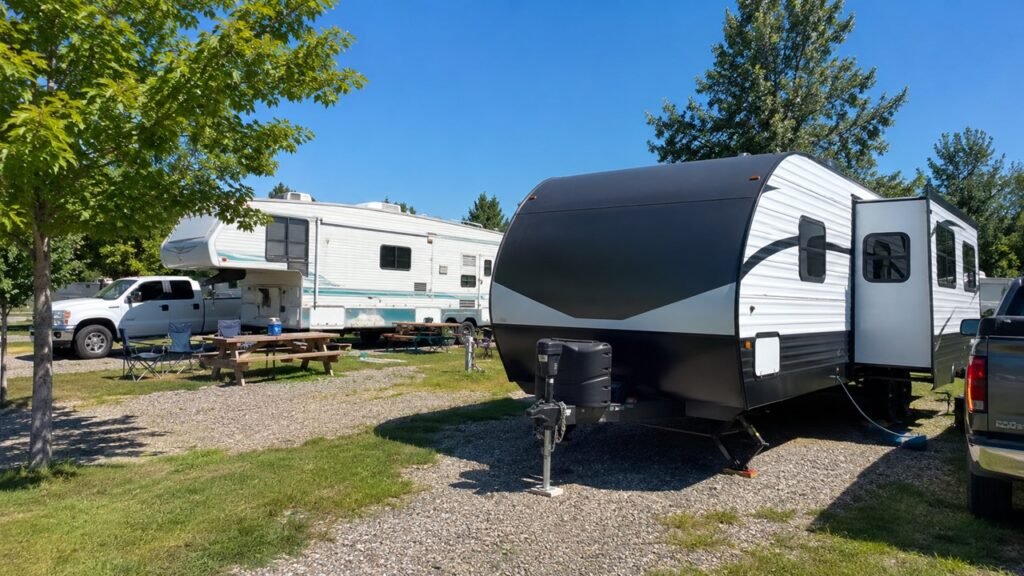
Yes, most electric trailer jacks can be used manually through a built-in override. This backup system lets you raise or lower the trailer tongue when the battery is dead, a fuse has blown, or the electrical system has stopped working.
In this guide, I’ll explain how the manual override works, how to find it, which tools you may need, how to crank the jack safely, and what to do if the mechanism will not turn.
Key Takeaways
- Most electric trailer tongue jacks include a manual override.
- The override is usually beneath a cap on the motor or gearbox housing.
- Use the supplied crank handle or a correctly sized socket and ratchet.
- Isolate power to the jack before attaching the manual crank.
- Cranking direction can vary between brands and models.
- Stop immediately if the jack binds, slips, grinds, or requires excessive force.
- Avoid impact wrenches and high-torque power tools unless the manufacturer specifically approves them.
- Manual operation gets you through an emergency but does not repair the original problem.
Can You Manually Operate an Electric Trailer Jack?
Most electric trailer tongue jacks are designed to work manually when electrical power is unavailable. Manufacturers know that batteries die, fuses blow, switches fail, and wiring can become damaged at inconvenient times.
The manual override provides a mechanical connection to the jack’s gearbox or lifting screw. Instead of using the electric motor, you turn that mechanism with a crank handle or socket wrench.
This allows you to raise the trailer coupler off the hitch ball, lower it onto the ball, or adjust the tongue height enough to move or store the trailer.
However, not every electric jack uses the same design. The override location, socket size, crank direction, and operating procedure can vary.
Your jack’s owner’s manual should always take priority over general instructions.
You should also understand that manual operation only bypasses the electrical side of the jack. It may not help if the jack tube is bent, the gearbox is seized, or the internal screw has been damaged.
When Would You Need to Use the Manual Override?
The manual override is mainly intended for emergencies when the jack cannot operate electrically. It can save you from becoming stranded with a trailer that cannot be hitched or unhitched.
You may need to use it because of:
- A dead or discharged trailer battery
- A disconnected battery
- A blown inline fuse
- A tripped circuit breaker
- Corroded battery terminals
- A weak frame ground
- A loose wiring connection
- A damaged power cable
- A failed up-and-down switch
- A malfunctioning remote control
- A failed electric motor
- A tow vehicle charging problem
- Cold weather reducing battery performance
- An urgent need to hitch or unhitch the trailer
Manual operation can help you move the jack, but it does not solve the underlying electrical problem. You should still inspect the battery, wiring, fuse, switch, motor, and ground connection afterward.
How Does the Manual Override Work?
The manual override allows you to turn the jack’s internal lifting mechanism without energizing the motor.
On many electric tongue jacks, the override connects to the gearbox shaft. When you rotate that shaft, the gears turn the jack’s internal screw. The screw then extends or retracts the inner tube.
Because you are doing the work normally handled by the motor, manual operation is slower and requires some physical effort. You may need dozens of turns to move the tongue a relatively short distance.
The access point is commonly located:
- On top of the motor housing
- On the rear of the gearbox
- Beneath a rubber weather plug
- Under a threaded plastic cap
- Behind a small removable cover
Some models have an exposed override nut, while others require a specialized crank handle.
A manual override should normally turn with firm but consistent resistance. It should not require violent force, a long breaker bar, or repeated impacts.
What Tools Do You Need to Operate an Electric Trailer Jack Manually?
The exact tool depends on the jack manufacturer and model. Your original crank handle is normally the safest option because it was designed to fit the override correctly.
| Tool | Purpose | Important Note |
| Manufacturer-supplied crank handle | Turns the manual override | Usually the safest and best-fitting option |
| Socket and ratchet | Turns an exposed hex override | Confirm the correct socket size first |
| Socket extension | Reaches a recessed override nut | Helpful on enclosed motor housings |
| Flat screwdriver | Removes certain access caps | Use gently to avoid cracking the cap |
| Wheel chocks | Prevent the trailer from rolling | Install before changing tongue height |
| Work gloves | Protect hands and improve grip | Useful around sharp or dirty components |
| Owner’s manual | Confirms tool size and direction | Instructions vary between models |
| Flashlight | Helps locate the access point | Useful at night or inside storage areas |
Some jacks use a ¾-inch or 19 mm socket, but those sizes are not universal. Other models may use a smaller metric socket or a proprietary crank connection.
Do not force a socket that almost fits. A loose socket can round the override nut, making it much harder to operate during a future emergency.
How to Use an Electric Trailer Jack Manually
The following procedure applies to many electric A-frame tongue jacks. Check the manufacturer’s instructions before starting because the access point and crank direction may differ.
Park the Trailer on Stable Ground
Move the trailer onto level, firm ground whenever possible. Soft soil, loose gravel, steep slopes, and uneven pavement can make the trailer unstable while you change the tongue height.
Engage the tow vehicle’s parking brake if the trailer is still connected.
Place wheel chocks securely against the trailer tires. Chock both sides when possible, especially if the trailer is parked on even a slight incline.
Never rely on the tongue jack alone to prevent the trailer from moving.
Keep the Trailer Coupled When Possible
If you are preparing to unhitch, leave the coupler connected to the tow vehicle until the jack foot is firmly planted and beginning to support the tongue.
This keeps the trailer stable while you position the jack.
If you are trying to hitch the trailer, back the tow vehicle close enough that you do not need to move the trailer by hand after raising it.
Do not place your hands, feet, or body beneath the trailer tongue while operating the jack.
Isolate Electrical Power to the Jack
Before attaching the manual crank, prevent the electric motor from activating unexpectedly.
Depending on your setup, you may need to:
- Turn the jack switch to the neutral or off position.
- Disconnect the tow vehicle’s trailer plug.
- Disconnect shore power if the converter is energizing the 12-volt system.
- Remove the jack’s inline fuse.
- Switch off a dedicated battery disconnect, when appropriate.
- Disable the jack’s remote-control system.
Pulling the jack’s dedicated inline fuse is often preferable to disconnecting the entire trailer battery.
Remember that the trailer battery may also power the emergency breakaway system. Restore all required safety systems before towing.
Locate the Manual Override
Look at the top, side, or rear of the jack’s motor housing.
The access point may be covered by:
- A round rubber plug
- A plastic weather cap
- A threaded cover
- A small metal plate
- A removable dust seal
Some caps pull straight out. Others unscrew or require gentle lifting with a flat screwdriver.
Avoid damaging the cap because it protects the gearbox from rain, dust, and road debris.
If you cannot find the override, look for the jack’s model number and consult the manufacturer’s manual.
Attach the Correct Crank or Socket
Insert the supplied crank handle into the override opening or place the correct socket fully over the hex shaft.
Make sure the tool sits straight and securely.
A socket that is angled or only partially seated can slip off and damage the override nut. It can also cause your hand to strike the housing.
Use a standard hand ratchet when the original crank is unavailable. Avoid using an oversized breaker bar because it can apply far more torque than the gearbox can safely handle.
Turn the Override Slowly
Begin cranking with smooth, controlled pressure.
Do not assume that clockwise always raises the tongue or that counterclockwise always lowers it. Gearbox layouts differ between manufacturers.
Check for:
- Directional arrows on the housing
- Raise and lower markings
- Instructions printed near the access point
- Guidance in the owner’s manual
If there are no markings, turn the crank slowly and watch the jack’s movement. Reverse direction if the tongue begins moving the wrong way.
You may need several turns before the movement becomes obvious.
Watch for Binding or Uneven Movement
The jack should move steadily as you crank. Some resistance is normal when lifting the loaded tongue, but the effort should remain reasonably consistent.
Stop immediately if you notice:
- Grinding
- Sudden slipping
- Clicking without movement
- Metal scraping
- A bent inner tube
- Extreme resistance
- The override shaft turning freely without moving the jack
These symptoms may indicate mechanical damage rather than an electrical problem.
Stop at the Correct Height
Raise or lower the tongue only as far as needed to connect or disconnect the coupler.
Avoid extending the jack to its absolute limit. Many jacks can be damaged if the internal screw is forced against the end of its travel.
If your jack has a drop leg, use it correctly to reduce the amount of powered or manual extension required.
Never use the tongue jack to lift more weight than its rated capacity.
Remove the Tool and Replace the Cap
Once the tongue reaches the required height, remove the crank handle or socket.
Do not restore electrical power while a crank, ratchet, or socket is still attached. If the motor activates, the tool could rotate suddenly and cause injury.
Replace the access cap securely to keep water and debris away from the override shaft and gearbox.
Restore the jack’s fuse, wiring, and other electrical connections after the tool has been removed.
Which Direction Should You Turn the Manual Crank?
There is no reliable crank direction that applies to every electric trailer jack. The correct direction depends on the gearbox and screw design used by the manufacturer.
One model may retract the jack when turned clockwise, while another may retract when turned counterclockwise.
Before applying significant force, check:
- Direction arrows on the jack housing
- Raise or retract labels
- Lower or extend labels
- Instructions on the crank handle
- The owner’s manual
- The manufacturer’s support information
When markings are unavailable, make one or two slow turns and watch the jack foot or coupler.
If the jack begins moving in the wrong direction, stop and reverse the crank. Do not keep turning while waiting for it to change direction.
Can You Use a Drill to Manually Operate an Electric Trailer Jack?
A cordless drill may physically fit some trailer jack override shafts, but that does not mean it is safe to use.
Unless the manufacturer specifically approves drill operation, a hand crank or manual ratchet is the safer choice.
A drill can rotate the mechanism too quickly. You may not notice that the jack has reached its travel limit until the gears, shaft, or screw has already been damaged.
A power tool may also cause:
- Stripped internal gears
- A rounded override nut
- Sudden trailer movement
- Damage to mechanical stops
- Overextension or over-retraction
- A broken motor coupling
- Loss of warranty coverage
An impact wrench is especially risky. Its repeated hammering force can crack gears or damage the gearbox before you realize something is wrong.
Some manual trailer jacks are specifically designed for drill operation. Those products normally have a drill-compatible drive and manufacturer instructions explaining acceptable speed and torque.
That is different from using a drill on an emergency override that was designed for hand cranking.
Is It Normal for Manual Cranking to Be Difficult?
Manual cranking normally requires some effort because you are lifting part of the trailer’s weight. However, the resistance should feel smooth and relatively consistent.
Normal Lifting Resistance
A loaded trailer tongue places significant pressure on the jack. You will usually feel more resistance while raising the tongue than while lowering it.
The amount of effort depends on:
- Loaded tongue weight
- Jack capacity
- Crank handle length
- Gear ratio
- Jack condition
- Ground angle
- Amount of extension
Needing many turns is normal. Needing excessive body weight or a long breaker bar is not.
Excessive Tongue Weight
An overloaded jack may become very difficult to crank.
The jack does not lift the trailer’s entire gross weight. It primarily supports and raises the loaded tongue weight. However, that tongue weight still needs to remain below the jack’s rated lifting capacity.
Cargo placed too far forward can increase tongue weight considerably.
Check the trailer’s actual loaded tongue weight rather than estimating it from empty specifications.
A Bent or Side-Loaded Jack
Trailer jacks are designed to handle vertical loads. Side pressure can make the inner and outer tubes bind together.
Side loading can happen when:
- The trailer rolls after the jack foot touches the ground.
- The tow vehicle pulls against the coupler.
- The foot sits on sloped or uneven ground.
- The mounting plate is bent.
- The jack tube was damaged during towing.
- The trailer shifts while being raised.
Do not try to overcome side loading with more force. Secure the trailer and remove the sideways pressure first.
Rust or Poor Lubrication
Water, road salt, dust, and old grease can make the jack screw difficult to turn.
Some electric jacks have manufacturer-approved lubrication points. Others use enclosed gearboxes that should not be opened or filled with grease by the owner.
Follow the maintenance instructions for your specific model.
Spraying lubricant randomly into the motor housing may contaminate electrical components or attract dirt.
Damaged Internal Gears
Cracked, stripped, or seized gears can make the manual override difficult or impossible to operate.
Possible signs include:
- Grinding inside the housing
- The override slipping repeatedly
- The shaft turning without jack movement
- Jerky extension or retraction
- Metal or plastic debris near the gears
- A motor that spins without moving the jack
Manual operation may bypass a failed motor, but it cannot bypass every type of gearbox damage.
The Jack Has Reached Its Travel Limit
A jack that is fully extended or fully retracted may feel locked.
Do not continue forcing the override once the jack reaches the end of its travel. Excessive torque can damage the screw, gears, clutch, or internal stops.
If more height is required, use the drop leg correctly or place a properly rated jack block beneath the foot before applying the load.
What Should You Do If the Manual Override Will Not Turn?
An override that refuses to turn usually indicates binding, overload, incorrect tool placement, or internal mechanical damage. Do not assume that more force will solve the problem.
Try these checks:
- Confirm that you found the actual override shaft.
- Make sure you are using the correct crank or socket.
- Seat the tool fully before turning.
- Check whether the jack is fully extended or retracted.
- Look for direction markings on the housing.
- Make sure the trailer wheels are securely chocked.
- Check whether the trailer is pushing sideways against the jack.
- Inspect the inner tube for bending or impact damage.
- Look for rust around the moving tube.
- Reduce the load using properly rated lifting and support equipment.
- Apply only manufacturer-approved lubricant.
- Stop if you hear grinding, snapping, or repeated slipping.
- Contact a trailer technician if the gearbox appears seized.
Never strike the override with a hammer or use a pipe to extend the crank handle.
You should also never crawl beneath a trailer supported only by the tongue jack. Use properly rated jack stands under approved frame locations whenever under-trailer access is necessary.
Can Manual Operation Damage an Electric Trailer Jack?
The manual override is designed for backup use, so normal hand cranking should not damage a healthy jack. Problems usually occur when the operator uses the wrong tool, excessive force, or an unsafe technique.
Forcing a Seized Mechanism
A seized jack will not become safer simply because you apply more leverage.
Using a long breaker bar can strip the gears, twist the override shaft, or damage the lifting screw. It may also cause the trailer to shift unexpectedly if the mechanism suddenly releases.
Stop when resistance becomes extreme.
Using the Wrong Socket
A socket that is too large can slip and round the override nut.
Once the nut is damaged, the original crank may no longer fit securely. That can leave you without a usable backup during the next power failure.
Use the exact socket size specified by the manufacturer.
Operating Beyond the Travel Limit
Continuing to crank after the jack reaches full extension or retraction can place excessive pressure on the internal stops.
Possible damage includes:
- Stripped gears
- Bent screw components
- Broken pins
- Damaged motor couplings
- Jammed inner tubes
Stop as soon as the jack reaches the needed height or its marked travel limit.
Restoring Power With the Crank Attached
An attached crank or ratchet can rotate suddenly if the motor receives power.
Always remove the tool before reinstalling the fuse, reconnecting the battery, or activating the jack switch.
Check the work area before testing electric operation again.
Exceeding the Jack’s Capacity
The jack’s rated capacity applies whether you operate it electrically or manually.
Manual cranking does not increase the jack’s lifting ability. An overloaded jack can bend, slip, or fail under the trailer tongue.
Choose a jack with adequate capacity for your trailer’s actual loaded tongue weight and a reasonable safety margin.
How Long Can You Use an Electric Trailer Jack Manually?
You can generally use the manual override long enough to raise or lower the trailer for hitching, unhitching, storage, or emergency movement.
The mechanism does not normally have a strict time limit when operated correctly by hand. However, it is intended as a backup rather than a substitute for repairing the electrical system.
Frequent manual use can also reveal a larger problem. The battery may not be charging, the motor may be failing, or the jack may be drawing excessive current because of mechanical resistance.
If the jack works smoothly by hand but repeatedly fails electrically, focus on the battery, fuse, wiring, ground, switch, and motor.
If both manual and electric operation feel difficult, inspect the mechanical components before continuing to use the jack.
Should You Repair the Electrical Problem After Using the Override?
Successful manual operation may confirm that the jack can still move mechanically. It does not prove that the battery, wiring, motor, switch, or gearbox is in good condition.
Check the Trailer Battery
A weak battery is one of the most common reasons an electric tongue jack stops working.
The lights inside the trailer may still work even when the battery cannot supply the high current required by the jack motor.
Inspect the battery for:
- Low state of charge
- Loose terminals
- Corrosion
- Damaged cables
- Swollen casing
- Age-related capacity loss
Battery voltage should also be checked while someone operates the jack. A battery can show reasonable resting voltage and still collapse under load.
Inspect the Inline Fuse or Circuit Breaker
Most electric tongue jacks have an inline fuse or circuit breaker near the battery or along the positive power wire.
Remove the fuse and inspect it carefully. A damaged fuse may not always look obviously burned.
Replace it only with the type and rating specified by the jack manufacturer.
Never install a higher-amperage fuse to prevent repeated blowing. The fuse protects the wiring from overheating and potentially causing a fire.
Examine the Ground Connection
Many electric jack problems come from poor grounding.
Some jacks use a dedicated ground wire. Others ground through the jack’s mounting plate and trailer frame.
Rust, paint, dirt, loose mounting bolts, and corrosion can interrupt that connection.
Clean the approved grounding point and tighten the hardware securely. Do not remove protective coatings from unrelated frame areas.
Inspect the Power Wire and Connectors
Trace the jack’s power wire toward the battery.
Look for:
- Loose ring terminals
- Corroded connectors
- Pinched insulation
- Broken strands
- Heat damage
- Poor crimp connections
- Contact with sharp frame edges
- Water inside the fuse holder
Repair damaged wiring with correctly sized automotive or marine-grade components.
Test the Control Switch
A worn or corroded switch may prevent the motor from operating.
A switch problem can cause the jack to:
- Work only upward
- Work only downward
- Operate intermittently
- Click without moving
- Remain completely silent
Testing the switch may require a multimeter and access to internal wiring. Have a qualified technician perform the diagnosis when you are not comfortable working with 12-volt electrical circuits.
Listen for Motor or Gearbox Problems
The sound the jack makes can help narrow down the failure.
A rapid clicking sound may suggest low voltage or a poor connection. A single click may mean the control is receiving power but the motor cannot turn.
Humming can indicate low voltage, binding, or a stalled motor. Grinding may point to damaged gears.
Complete silence can come from a dead battery, blown fuse, broken wire, failed switch, or failed motor.
Do not repeatedly hold the switch when the motor is stalled. That can overheat the motor and wiring.
Safety Tips for Manually Operating an Electric Trailer Jack
A tongue jack handles a heavy vertical load. A few basic precautions can prevent trailer movement, equipment damage, and serious injury.
- Park on level, stable ground whenever possible.
- Apply the tow vehicle’s parking brake.
- Chock the trailer wheels securely.
- Keep the trailer coupled until the jack is supporting the tongue.
- Isolate electrical power before attaching the crank.
- Use the correct crank handle or socket.
- Keep hands and feet away from the jack foot.
- Do not stand directly beneath the coupler.
- Turn the override slowly.
- Stop if the mechanism binds or grinds.
- Never exceed the jack’s rated capacity.
- Do not use an impact wrench.
- Avoid excessive leverage.
- Never work beneath a trailer supported only by the tongue jack.
- Remove the crank before reconnecting power.
- Replace the weather cap after use.
- Restore the breakaway battery system before towing.
How to Keep the Manual Override Ready for Emergencies
The manual override will not help much if the crank is missing, the access cap is seized, or you do not know which socket fits. Preparing before a breakdown makes roadside operation much easier.
- Store the original crank in a labeled compartment.
- Keep the correct socket and hand ratchet in the trailer toolkit.
- Record the jack brand and model number.
- Save a copy of the owner’s manual.
- Check that the override cap can be removed.
- Keep the cap clean and securely installed.
- Inspect the housing for water intrusion.
- Test the override occasionally when the trailer is safely supported.
- Maintain the trailer battery.
- Inspect the fuse holder and power wire.
- Clean approved ground connections.
- Lubricate only the points specified by the manufacturer.
- Protect the jack head with a suitable weather cover.
- Avoid leaving the jack fully extended during long-term storage.
Do not wait for a dead battery at night to discover that the manual crank is stored somewhere else.
Manual Override Differences Between Trailer Jack Types
Not every powered trailer jack uses the same backup system. The correct manual procedure depends on whether you have a tongue jack, stabilizer, fifth-wheel landing gear, or hydraulic lifting system.
| Trailer Jack Type | Typical Manual Backup | Common Application | Important Limitation |
| Electric A-frame tongue jack | Top or rear crank override | Travel and utility trailers | Socket size and direction vary |
| Electric side-mount jack | Side or top gearbox drive | Boat and utility trailers | May require a special handle |
| Electric stabilizer jack | Manual crank connection | Stabilizing travel trailers | Usually not designed for lifting |
| Fifth-wheel landing gear | Gearbox shaft or manual drive | Fifth-wheel trailers | Both legs may need synchronized movement |
| Hydraulic trailer jack | Manual pump or emergency release | Heavy-duty trailers | Does not usually use a crank override |
| Manual tongue jack | Built-in top-wind or side-wind handle | Light and medium trailers | Requires manual effort during every use |
| Drill-compatible manual jack | Dedicated drill drive and hand crank | Utility and recreational trailers | Must be operated within specified speed limits |
Electric stabilizer jacks deserve special attention. Their purpose is usually to reduce trailer movement after leveling, not to lift the trailer or change its tongue height.
Do not use a stabilizer jack as a lifting jack unless the manufacturer clearly states that it is designed and rated for lifting.
When Should You Stop Using the Jack and Replace It?
Some trailer jack problems can be repaired, but structural or load-holding damage should never be ignored.
Stop using the jack if you notice:
- A bent inner tube
- A cracked outer housing
- Severe corrosion
- A damaged mounting plate
- Cracked welds
- Elongated bolt holes
- Grinding inside the gearbox
- The override spinning without movement
- The jack slipping under load
- Excessive side-to-side movement
- Repeated fuse failure
- Burned wiring
- Water inside the motor housing
- A footplate that will not remain secure
- The jack lowering without being operated
- An inability to support the trailer tongue
A jack that cannot reliably hold its load is unsafe, even if the motor still operates.
Have the jack professionally inspected or replace it with a properly rated model before using the trailer again.
Final Answer
Most electric trailer jacks can be used manually through a built-in override. This feature lets you raise or lower the trailer when the battery dies, the fuse blows, the switch fails, or another electrical problem prevents normal operation.
Before cranking, park on stable ground, chock the wheels, and isolate the jack’s electrical power. Locate the override, attach the correct hand crank or socket, and turn it slowly according to the manufacturer’s directions.
Do not assume that every jack uses the same crank direction or socket size. Avoid impact tools, excessive leverage, and forcing a mechanism that feels seized.
Manual operation can help you finish hitching or unhitching, but it should not replace proper repairs. Diagnose the battery, wiring, fuse, ground, motor, or mechanical problem before your next towing trip.
Related FAQs.
Do All Electric Trailer Jacks Have a Manual Override?
Most electric trailer tongue jacks have a manual override, but the feature is not guaranteed on every model. Check the owner’s manual or manufacturer specifications before relying on manual operation during an emergency.
Where Is the Manual Override on an Electric Trailer Jack?
The manual override is commonly beneath a rubber or plastic cap on the top, side, or rear of the motor housing. Its exact position varies, so look for directional markings or consult the jack’s manual.
What Size Socket Fits an Electric Trailer Jack Override?
The required socket size depends on the jack model. Some use a ¾-inch or 19 mm socket, while others use different sizes or a proprietary handle. Measure the nut or check the manual before applying force.
Can I Manually Lower an Electric Trailer Jack With a Dead Battery?
Yes, you can normally lower an electric trailer jack with a dead battery if the jack has a functional manual override and no internal mechanical damage. Secure the trailer, isolate power, and use the correct crank or socket.
Why Will My Electric Trailer Jack Not Crank Manually?
A jack may not crank manually because it is overloaded, fully extended, side-loaded, rusted, bent, poorly lubricated, or internally seized. Stop rather than forcing it if the override requires extreme pressure.
Can I Use a Ratchet Instead of the Original Crank Handle?
A correctly sized hand ratchet can often replace a missing crank handle when the jack uses a standard hex override. Seat the socket fully, turn slowly, and follow the manufacturer’s instructions.
Can I Use an Impact Wrench on the Manual Override?
You should not use an impact wrench on a trailer jack override unless the manufacturer specifically approves it. Sudden high torque can strip gears, damage mechanical stops, and round the override nut.
Does Manual Operation Bypass a Bad Motor?
Manual operation can bypass a failed motor by turning the jack’s lifting mechanism directly. However, it may not work if the gearbox, screw, shaft, or jack tube is damaged or seized.
Can I Leave the Jack in Manual Mode?
Most electric trailer jacks do not have a permanent manual mode. The jack operates manually only while the crank or socket is attached to the override, and the tool should be removed before power is restored.
Why Does My Trailer Jack Work Manually but Not Electrically?
A jack that works manually but not electrically probably has a problem with the battery, fuse, circuit breaker, wiring, ground, control switch, or motor. The mechanical lifting system may still be functional.
Can Manual Cranking Recharge or Reset the Jack?
Manual cranking does not recharge the battery or electrically reset the jack. It only moves the mechanical lifting system, although changing the jack’s position may temporarily release minor binding.
Can I Use the Manual Override While the Trailer Is Plugged Into My Truck?
It is safer to unplug the trailer connector and isolate the jack’s electrical supply before attaching a crank. This prevents the motor from activating unexpectedly while the manual tool is connected.
How Many Turns Does It Take to Move an Electric Trailer Jack Manually?
The number of turns depends on the jack’s gear ratio, travel length, and required height change. Some jacks may need dozens of turns, so slow movement does not automatically indicate a problem.
Should the Jack Be Harder to Raise Than Lower Manually?
Yes, raising the trailer tongue normally requires more effort because you are lifting its weight. Lowering often feels easier, but both directions should remain smooth without grinding, slipping, or severe binding.

Michael Carter is an experienced RV traveler who focuses on practical outdoor trips across the States. He writes clear, step-by-step guides and realistic reviews based on real travel needs. His aim is to help RV and camper owners plan informed, simpler journeys with confidence.