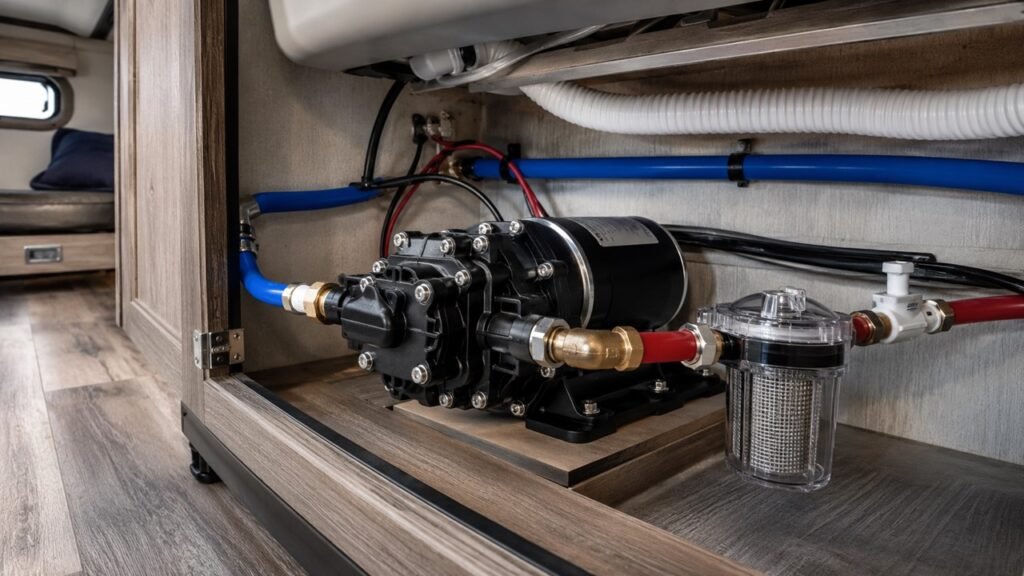
Your RV water pump keeps running because the water system cannot build or hold enough pressure to shut the pump off. In most cases, this happens because of low fresh water, trapped air, a slightly open fixture, a plumbing leak, a cracked pump strainer, a bad check valve, or a faulty pressure switch.
In this guide, I’ll walk you through the common causes in a simple order, so you can find the problem without replacing parts too early. We’ll also cover what different pump sounds mean, how to troubleshoot the system, and when the pump itself may need repair or replacement.
Key Takeaways
- An RV water pump should shut off after the plumbing system reaches pressure.
- If the pump runs nonstop, it usually cannot build enough pressure.
- If the pump cycles on and off, the system is likely losing pressure somewhere.
- Start with the fresh water tank, faucets, toilet, shower, and visible leaks.
- Air in the lines can make the pump sputter, pulse, or run longer than normal.
- A cracked pump strainer can pull in air without showing a water leak.
- Do not leave the pump running constantly because it can overheat or drain your battery.
- Replace the pump only after checking leaks, air, filters, valves, and the pressure switch.
RV Water Pump Keeps Running: Quick Diagnosis Table
Before you start taking anything apart, match your pump’s behavior with the symptom below. This quick table helps you narrow down the problem faster and avoid guessing.
| Pump Symptom | Most Likely Cause | First Thing To Check | DIY Fix? |
| Pump runs nonstop with no water flow | Empty tank, lost prime, or air leak | Fresh water tank level | Usually |
| Pump runs nonstop with water flow | Open fixture or pressure switch issue | Faucets, toilet, and shower | Usually |
| Pump cycles every few seconds | Leak, loose fitting, or valve issue | Visible plumbing fittings | Usually |
| Pump cycles every few minutes | Small leak or bad check valve | Toilet valve and city water inlet | Sometimes |
| Faucet sputters with air bubbles | Suction-side air leak | Pump strainer and inlet hose | Usually |
| Water pressure is weak | Clogged strainer, filter, or worn pump | Strainer and faucet aerators | Usually |
| Pump runs after refilling tank | Trapped air or lost prime | Open faucets and purge air | Usually |
| Pump never shuts off after checks | Faulty pressure switch or pump wear | Pump manual and pressure switch | Sometimes |
How An RV Water Pump Is Supposed To Work
An RV water pump is designed to run only when water pressure drops. When you open a faucet, the pressure in the water lines drops, and the pump turns on. When you close the faucet, pressure builds again, and the pump should shut off automatically.
Most RVs use a 12-volt demand-style water pump. That means the pump reacts to water demand. A short hum after using water is normal, but a pump that keeps humming when every faucet is closed is not normal.
The simple way to understand it is this: your pump is responding to pressure. If it keeps running, your RV either cannot build pressure or cannot hold pressure.
First, Identify What “Keeps Running” Actually Means
Not every running pump problem is the same. A pump that runs continuously is different from a pump that turns on for two seconds every few minutes. Once you know the pattern, the cause becomes much easier to find.
The Pump Runs Continuously
If your RV water pump turns on and never stops, it usually cannot reach shutoff pressure. This often happens when the fresh water tank is empty, the pump has lost prime, a fixture is open, or air is entering the inlet side.
It can also happen when there is a larger leak somewhere in the plumbing. In that case, the pump keeps trying to build pressure, but water is escaping faster than the system can pressurize.
The Pump Cycles On And Off
If the pump runs briefly, stops, and then starts again later, the system is losing pressure slowly. This is often called cycling or short cycling.
A cycling pump usually points to a small leak, a toilet valve that is not sealing, a dripping outdoor shower, a bad city water check valve, or an internal pump valve that lets water move backward.
The Pump Runs But No Water Comes Out
If the pump runs but no water reaches the faucet, check the water supply first. Your fresh water tank may be empty, the pump may have lost prime, the inlet strainer may be clogged, or a winterizing valve may still be in the wrong position.
This does not always mean the pump is bad. Many RV pumps still make noise even when they are only moving air.
Common Reasons Your RV Water Pump Keeps Running
Most RV pump problems come from pressure loss, restricted water flow, or air entering the system. Start with these common causes before assuming the pump needs to be replaced.
Low Or Empty Fresh Water Tank
This is the simplest cause, but it is also one of the easiest to miss. If your fresh water tank is empty or very low, the pump may suck air instead of water. When that happens, it cannot build steady pressure.
Also, RV tank sensors are not always accurate. Your monitor panel may show some water left, but the pump pickup may still be pulling air, especially if the RV is parked on uneven ground.
A Faucet, Shower, Or Toilet Valve Is Slightly Open
A slightly open fixture can make the pump act like something serious is wrong. Check the kitchen faucet, bathroom faucet, shower, outdoor shower, and toilet flush valve.
The outdoor shower is a common trouble spot. Sometimes the shower head is turned off, but the hot and cold knobs are still open. That can stop the plumbing system from holding pressure correctly.
Air Trapped In The Water Lines
Air can get into the lines after refilling the tank, sanitizing the water system, winterizing, replacing a filter, or running the tank dry. When air is trapped inside the plumbing, the pump may run longer than normal.
You may also notice sputtering faucets, pulsing water pressure, or uneven flow. In many cases, you only need to purge the air from the system.
A Leak In The Plumbing System
If water leaks anywhere after the pump, pressure drops. The pump then turns on again to replace that lost pressure.
Look under sinks, near the toilet, around the water heater, behind access panels, and under the RV. Even a tiny drip can make your pump cycle throughout the day.
Cracked Pump Strainer Or Loose Inlet Fitting
Most RV water pumps have a small clear strainer on the inlet side. If that strainer bowl cracks, the O-ring slips, or the fitting loosens, the pump can pull air into the water line.
This type of problem can be confusing because it may not drip water. Since the inlet side is under suction, air gets pulled in instead of water leaking out.
Clogged Strainer, Filter, Or Faucet Aerator
Sediment, minerals, plastic shavings, and small debris can restrict water flow. A clogged pump strainer makes it harder for the pump to pull water from the tank.
A clogged inline filter or faucet aerator can also cause weak pressure. If the pump runs longer than usual and the water flow is poor, clean these parts first.
Bad Check Valve Or City Water Inlet Valve
Check valves stop water from flowing backward. If one fails, your RV may lose pressure even when you cannot see a leak.
One strong clue is water dripping from the city water inlet while you are using the fresh water pump. That usually means the city water check valve is not sealing properly.
Faulty Pressure Switch
The pressure switch tells the pump when to shut off. If it is stuck, misadjusted, or failing, the pump may keep running even when the system has enough pressure.
Some pumps allow pressure switch adjustment. However, check your pump manual first because turning the wrong screw can create more pressure problems.
Worn Pump Diaphragm Or Internal Valve
If your pump is old, noisy, weak, or has run dry many times, the internal parts may be worn. A weak diaphragm or damaged internal valve can stop the pump from building proper pressure.
At this point, replacement may make sense. However, check the easier external causes before buying a new pump.
Step-By-Step Troubleshooting Guide
The best way to fix an RV water pump that keeps running is to work from simple checks to deeper tests. This helps you avoid replacing a good pump by mistake.
Step 1: Turn Off The Pump If It Runs Nonstop
If the pump keeps running and you are not testing it, turn it off. A nonstop pump can overheat, drain your house battery, waste water, and make hidden leaks worse.
This is especially important before sleeping, leaving the RV, or walking away from the water system.
Step 2: Check The Fresh Water Tank Level
Make sure the fresh water tank has enough water. If it is low, refill it and test the pump again. If your RV is not level, add extra water because the pickup tube may pull air before the tank is fully empty.
After refilling, open a cold faucet and let the pump run until the water flows smoothly.
Step 3: Close Every Fixture Completely
Walk through the RV and close every water fixture carefully. One slightly open valve can keep the pump running.
Check these spots:
- Kitchen faucet
- Bathroom faucet
- Shower valve
- Outdoor shower
- Toilet flush valve
- Low-point drains
- Water heater bypass valves
- Washer prep valves, if installed
If the pump stops after closing one fixture, you found the problem.
Step 4: Purge Air From Hot And Cold Lines
Open one faucet at a time and run both hot and cold water until the sputtering stops. Start with the faucet closest to the pump, then move through the RV.
Do not forget the shower, outdoor shower, and toilet. Air can hide in unused water lines and cause the pump to cycle later.
Step 5: Inspect For Leaks
Turn the pump on, keep the RV quiet, and listen closely. Then check every visible water line and fitting.
Look in these areas:
- Under kitchen and bathroom sinks
- Around the toilet base
- Near the toilet water valve
- Around the water heater
- Around the pump and strainer
- Behind access panels
- At the outdoor shower
- At the city water inlet
- Near low-point drain caps
- Under the RV
A dry paper towel works well for finding small leaks. Wrap it around a fitting, wait a moment, and check if it becomes damp.
Step 6: Check The Pump Strainer
Turn off the pump and open a faucet to release pressure. Then inspect the clear strainer on the inlet side of the pump.
Remove the bowl, clean the screen, and check the O-ring. If the bowl has a hairline crack or the O-ring looks flat, replace it.
Step 7: Look For Suction-Side Air Leaks
The suction side is the line between the fresh water tank and the pump. A loose clamp, cracked hose, bad fitting, or misplaced winterizing valve can let air enter.
Because this side pulls water in, it may not drip. Instead, you may see bubbles, sputtering, weak pressure, and a pump that keeps running.
Step 8: Test The City Water Check Valve
Go outside and inspect the city water connection while the pump is running. If water drips from the city water inlet, the check valve may be stuck or damaged.
Sometimes debris keeps the valve from sealing. Other times, the valve needs to be replaced.
Step 9: Consider The Pressure Switch
If the tank is full, all fixtures are closed, air is purged, and no leaks appear, the pressure switch may be the issue.
Before adjusting it, check your pump manual. Different pumps use different settings, and too much pressure can stress older RV plumbing.
Step 10: Test Whether The Pump Itself Is Failing
If every external check looks good, the pump may have internal wear. A worn diaphragm, bad internal valve, weak motor, or cracked housing can stop it from building pressure.
If the pump has water at the inlet but still produces weak output, replacement may be the best fix.
Should You Keep Using The RV Water Pump If It Will Not Shut Off?
A pump that will not shut off should not be ignored. Even if the water still works, constant running can damage the pump and create bigger problems.
Risks include:
- Pump overheating
- Dead house battery
- Burned-out motor
- Wasted fresh water
- Hidden water damage
- Larger leaks from constant pressure
- Extra noise and vibration
Turn the pump off when you are not using water. Then troubleshoot it in short testing sessions instead of letting it run for hours.
RV Water Pump Keeps Running After Filling The Tank
If your RV water pump keeps running right after filling the tank, the most likely cause is trapped air or lost prime. This often happens after draining, sanitizing, winterizing, changing filters, or running the tank dry.
Open a cold faucet and let the pump run briefly until the water flows steadily. Then do the same with the hot side.
If the pump still runs nonstop, check the pump strainer, inlet hose, and winterizing valve. A winterizing valve left in the wrong position can make the pump pull air instead of water.
RV Water Pump Keeps Cycling When No Faucet Is Open
A cycling pump usually means the system builds pressure, shuts off, and then slowly loses pressure again. The cause may be a tiny leak, a valve problem, or an internal pump issue.
Check For A Slow Leak
Tiny leaks can make the pump cycle even when you do not see a puddle. Check fittings, faucets, drain caps, and water heater connections.
Use a paper towel around fittings. If it comes away damp, fix that leak first.
Check The Toilet Valve
The toilet valve is one of the most overlooked causes. If water slowly seeps into the bowl, the pump may cycle every few minutes.
Dry the bowl area, wait, and watch closely. If water slowly appears, the valve may need cleaning or replacement.
Check The City Water Inlet
If the city water check valve fails, the pump may push water backward through the exterior inlet. You may see dripping outside the RV.
This is still a pressure leak, even though it is not coming from a faucet.
Check The Pump’s Internal Check Valve
If you cannot find any external leak, pressure may be leaking backward through the pump into the fresh tank.
Some pump heads can be cleaned or rebuilt. For older pumps, replacement is often the easier long-term fix.
RV Water Pump Runs But There Is No Water Pressure
If the pump runs but water pressure is weak, focus on water supply and restrictions first. The pump may be working, but it may not be getting enough water.
Make Sure The Pump Is Primed
A pump needs water inside to create suction. If it is full of air, it may run loudly without moving much water.
Fill the tank, open the faucet closest to the pump, and let the pump run briefly. Once air leaves the line, pressure should improve.
Clean The Strainer And Filters
A clogged strainer can starve the pump. An old inline filter can also reduce flow, especially after filling from a sediment-heavy source.
Clean the pump strainer and check your filters. If a filter is old or dirty, replace it.
Check For Kinked Or Collapsed Water Lines
Inspect the line from the fresh water tank to the pump. A kinked hose, collapsed soft line, or pinched tube can reduce water flow.
This can happen after storage, repairs, or travel vibration.
Test The Pump Output
If water reaches the pump but output is still weak, the pump may be worn. A failing pump may make noise and vibrate without creating strong pressure.
At that stage, replacement is reasonable.
When To Repair Vs. Replace The RV Water Pump
Not every pump issue means you need a new pump. Many problems are simple external fixes, while others point to internal damage.
| Situation | Repair Or Replace? | Why |
| Cracked strainer bowl | Repair | The part is cheap and easy to replace |
| Loose inlet fitting | Repair | Tightening or resealing usually fixes it |
| Small plumbing leak | Repair | The pump is responding to pressure loss |
| Toilet valve leaking | Repair | The fixture is causing the pressure drop |
| Bad city water check valve | Repair | The valve is leaking, not the pump |
| Clogged filter or aerator | Repair | Cleaning or replacement restores flow |
| Faulty pressure switch | Repair or replace pump head | Depends on the pump model |
| Cracked pump housing | Replace | Damage is usually not reliable to repair |
| Weak output after direct testing | Replace | Internal wear is likely |
| Old pump with repeated issues | Replace | A newer pump may be quieter and more reliable |
How To Prevent Your RV Water Pump From Running Constantly Again
Once you fix the issue, a little maintenance can help keep the pump quiet and reliable. The main goal is to prevent pressure loss, debris buildup, and air leaks.
- Clean the pump strainer regularly.
- Use a drinking-water-safe hose when filling the tank.
- Flush sediment from the fresh water system when needed.
- Sanitize the fresh water tank on a routine schedule.
- Replace old inline filters before they clog badly.
- Use a water pressure regulator on city water.
- Check fittings after long drives.
- Keep the outdoor shower knobs fully closed.
- Turn the pump off when leaving the RV.
- Winterize properly before freezing weather.
- Avoid running the pump dry for long periods.
These small habits help the pump work less, stay quieter, and last longer.
When To Call An RV Technician
You can fix many RV water pump problems yourself, especially loose fittings, trapped air, clogged strainers, and small visible leaks. But some problems are better handled by a technician.
Call for help if you suspect a hidden leak behind walls, water damage under the floor, electrical issues, repeated pressure switch failure, or a cracked pump housing. Also get help if you are not comfortable disconnecting water lines or testing wiring.
The main thing is not to keep using the pump while hoping the problem goes away. A small pressure issue can become a much more expensive repair if the pump keeps running for hours.
Conclusion
An RV water pump that keeps running is usually a pressure problem. That does not always mean the pump itself is bad. Many times, the real cause is low water, trapped air, a slightly open fixture, a small leak, a cracked strainer, or a check valve that is not sealing.
Start with the simple checks first. Fill the fresh tank, close every fixture, purge the air, inspect for leaks, clean the strainer, and check the city water inlet. If all of those look good and the pump still runs, then it makes sense to inspect the pressure switch or replace the pump.
Fixing the problem early protects your pump, battery, plumbing, and RV interior from bigger damage.
Related FAQs
Why Does My RV Water Pump Run When No Water Is On?
Your RV water pump runs when no water is on because the system is losing pressure. Common causes include a small leak, toilet valve seepage, a bad check valve, or an internal pump valve issue.
Is It Bad For An RV Water Pump To Run Continuously?
Yes, it can be bad for the pump. Continuous running can overheat the motor, drain the battery, waste water, and make hidden leaks worse.
Why Does My RV Water Pump Cycle Every Few Seconds?
Rapid cycling usually means pressure is dropping quickly. Check for an open fixture, leaking fitting, dripping toilet valve, or faulty pressure switch.
Can Air In The Lines Make An RV Water Pump Keep Running?
Yes, air in the lines can stop the pump from building steady pressure. It can also cause sputtering faucets, weak flow, and pulsing water pressure.
How Do I Know If My RV Water Pump Pressure Switch Is Bad?
The pressure switch may be bad if the tank is full, no leaks are found, and the pump still will not shut off. Check your pump manual before adjusting it.
Can A Bad Check Valve Make My RV Pump Run?
Yes, a bad check valve can let water flow backward and drop system pressure. This can make the pump cycle even when every faucet is closed.
Should I Turn Off My RV Water Pump At Night?
Yes, it is smart to turn the pump off at night, especially if it cycles or you suspect a leak. Many RVers also turn it off when leaving the RV.
How Long Can An RV Water Pump Run Dry?
Some RV pumps can run dry briefly, but you should not rely on that. Running dry too long can create heat, wear parts, and shorten pump life.
Why Does My RV Water Pump Keep Running After Winterizing?
After winterizing, the pump may keep running because of trapped air, an open drain, a bypass valve in the wrong position, or a pump that has not primed yet.
Do I Need To Replace My RV Water Pump?
You may need to replace it if the pump has weak output, a cracked housing, repeated pressure switch issues, or internal wear. Check leaks, air, filters, and valves first.

Michael Carter is an experienced RV traveler who focuses on practical outdoor trips across the States. He writes clear, step-by-step guides and realistic reviews based on real travel needs. His aim is to help RV and camper owners plan informed, simpler journeys with confidence.