
Your RV battery probably keeps dying because something is draining it, the charging system is not fully recharging it, or the battery can no longer hold enough power. Common causes include parasitic loads, a faulty converter, loose connections, repeated deep discharges, and poor battery maintenance.
Below, I will help you identify when the battery loses power, test the most likely causes, and stop the same problem from happening again.
Key Takeaways
- Propane detectors, control boards, inverters, and USB outlets can drain the battery quietly.
- Connecting your RV to shore power does not guarantee the battery is charging.
- Loose, dirty, or corroded cables can interrupt both charging and power delivery.
- Repeated deep discharges can permanently reduce lead-acid battery capacity.
- A battery may show normal voltage but still fail when placed under a load.
- Flooded batteries need correct electrolyte levels and regular maintenance.
- Lithium batteries provide more usable capacity but require compatible charging equipment.
- Diagnose the charging system and electrical loads before buying another battery.
Why Does My RV Battery Keep Dying?
An RV battery keeps dying when it loses energy faster than the RV replaces it. This may happen because appliances are consuming too much electricity, hidden circuits remain active, or the charging system is not delivering enough power.
The battery itself may also be part of the problem. An old, sulfated, damaged, or repeatedly discharged battery can appear charged after being plugged in but lose voltage quickly once you start using it.
Pay attention to when the problem occurs. The timing often points toward the cause.
For example, a battery that dies overnight may be undersized or powering a furnace blower. A battery that dies during storage probably has a parasitic drain. A battery that dies while connected to shore power may not be receiving power from the converter.
Common Reasons an RV Battery Keeps Dying
Most repeat battery problems can be traced to electrical drain, incomplete charging, damaged connections, or reduced battery capacity. Several problems can also occur at the same time.
Parasitic Power Draw
Your RV contains devices that use electricity even when you believe everything is turned off. These small electrical loads are often called parasitic, phantom, or vampire loads.
Common examples include:
- Propane leak detectors
- Carbon monoxide alarms
- Stereo memory
- Digital clocks
- Refrigerator control boards
- Furnace control boards
- Tank-monitoring systems
- USB charging outlets
- Wi-Fi equipment
- Security systems
- Aftermarket cameras and trackers
One device may use very little electricity. However, several devices running continuously can drain a small battery bank within days or weeks.
Your battery disconnect switch may not isolate every circuit. Safety detectors, solar controllers, emergency brakes, or aftermarket accessories may be wired directly to the battery.
Therefore, switching the disconnect to the off position does not always mean the battery is completely disconnected.
The Battery Is Not Fully Charging
A partially charged battery may appear normal until you begin using appliances. Lights work at first, but the voltage quickly falls as soon as the furnace, water pump, or inverter starts.
Incomplete charging can happen when:
- The generator runs for only a short period.
- The solar panels receive limited sunlight.
- The converter is too small for the battery bank.
- The charger uses the wrong charging profile.
- Driving time is too short to restore the battery.
- The alternator charge line provides limited current.
- The battery cables are too small or too long.
- A large electrical load is operating during charging.
A battery also needs time to complete its charging cycle. Reaching a high charging voltage does not necessarily mean the battery has reached full capacity.
A Faulty RV Converter or Charger
The converter changes 120-volt AC shore power into 12-volt DC power. It supplies the RV’s 12-volt circuits and normally charges the house battery.
If the converter fails, your lights and appliances may continue running from the battery until it becomes completely discharged.
Converter-related problems include:
- A tripped circuit breaker
- A blown converter fuse
- A blown reverse-polarity fuse
- Loose AC input wiring
- Loose DC output wiring
- Internal converter failure
- Low charging voltage
- Excessively high charging voltage
- An incorrect battery profile
Progressive Dynamics recommends checking reverse-battery protection fuses when its converter has no output and the battery is not charging.
Some modern converters use multiple charging stages. For example, certain Progressive Dynamics systems use 14.4 volts for boost charging, approximately 13.6 volts for normal operation, and 13.2 volts for storage maintenance. These figures are examples, not universal specifications for every converter or battery.
Always compare your readings with the specifications for your converter and battery.
An Old or Damaged Battery
Batteries lose capacity as they age. However, age alone does not tell you whether a battery is usable.
A battery can fail early because of:
- Repeated deep discharging
- Long periods at a low charge
- Excessive heat
- Overcharging
- Undercharging
- Vibration
- Low electrolyte
- Internal short circuits
- Poor-quality connections
- Incorrect charging settings
A battery may still reach a normal resting voltage while holding only a small amount of usable energy. This is why voltage testing alone cannot always confirm battery health.
A proper capacity or load test provides a clearer answer.
Repeated Deep Discharging
Every battery has limits on how deeply and frequently it should be discharged.
Traditional lead-acid batteries generally last longer when they are recharged before becoming heavily depleted. Repeatedly draining them until lights dim or appliances shut down can significantly reduce their usable life.
Lithium iron phosphate batteries normally allow deeper discharging than lead-acid batteries. However, lithium batteries can also be damaged by severe over-discharge if the battery management system does not disconnect the load.
Follow the battery manufacturer’s recommended state-of-charge limits rather than relying on one general percentage for every battery.
Battery Sulfation
Sulfation happens in lead-acid batteries when lead sulfate crystals form and harden on the internal plates.
Some sulfate formation is part of normal battery operation. The problem becomes serious when a battery remains partially discharged for an extended period.
Common signs of sulfation include:
- Reduced runtime
- Slow charging
- Rapid voltage loss
- Poor performance under load
- A battery that never appears to reach full capacity
Trojan Battery warns that continually operating or storing a lead-acid battery in a partially discharged condition can cause sulfation.
Light sulfation may sometimes improve with an appropriate charger. Severe sulfation usually causes permanent capacity loss.
Loose or Corroded Battery Connections
A healthy battery cannot work correctly through loose, dirty, or damaged cables.
Corrosion and loose terminals create electrical resistance. That resistance can prevent the battery from receiving a proper charge and restrict power when an appliance starts.
Inspect:
- Positive battery terminals
- Negative battery terminals
- Chassis-ground connections
- Battery disconnect terminals
- Converter connections
- Inline fuses
- Cable lugs
- Battery-bank jumpers
Look for white, green, or blue corrosion around the terminals. Also check for loose lugs, frayed strands, overheated insulation, and cables that feel unusually warm.
A cable may look secure while corrosion is hidden beneath the insulation or inside the crimped terminal.
Low Electrolyte in a Flooded Battery
Flooded lead-acid batteries contain removable caps and liquid electrolyte. Water is gradually lost during charging, especially when the battery is exposed to heat or excessive charging voltage.
If the electrolyte falls below the plates, the exposed section can suffer permanent damage.
Trojan recommends using distilled water when servicing flooded batteries. It also warns owners to add water rather than acid.
Do not add water to sealed AGM, gel, or lithium batteries. These batteries are not designed to be opened.
Follow your battery manufacturer’s procedure because the correct filling time and level can vary.
The Battery Is Being Overcharged
Charging a battery too aggressively can damage it just as easily as leaving it discharged.
Overcharging a flooded battery may cause:
- Excessive bubbling
- Rapid water loss
- Battery heat
- Corrosion
- Strong odors
- Plate damage
- Case swelling
Trojan notes that continuous overcharging can accelerate positive-plate corrosion, increase water consumption, and create damaging temperatures.
Possible causes include an old single-stage converter, a failed voltage regulator, an incorrect battery setting, or a temperature sensor problem.
A battery that becomes unusually hot, swollen, or strongly scented during charging should be disconnected from the charger when it is safe to do so. Have the battery and charging system inspected before using them again.
Extreme Temperatures
Temperature affects how much energy a battery can provide and how quickly it ages.
High temperatures accelerate chemical reactions and self-discharge. They may also increase water loss in flooded batteries.
Cold temperatures temporarily reduce available battery capacity. A battery that worked well in warm weather may feel much weaker during winter camping.
A discharged lead-acid battery is also more vulnerable to freezing because its electrolyte becomes more water-like as its state of charge decreases.
Lithium batteries require special attention during cold-weather charging. Many lithium charging systems reduce or stop charging at low battery temperatures to prevent cell damage.
Check the exact charging-temperature limits for your battery.
The Battery Bank Is Too Small
Sometimes nothing is technically broken. Your battery bank may simply be too small for the amount of electricity you use.
Common overnight loads include:
- Furnace blower
- Ventilation fans
- Refrigerator controls
- Water pump
- Interior lights
- Television
- CPAP machine
- Phone and laptop charging
- Residential refrigerator through an inverter
A single 100Ah battery does not provide unlimited energy. Its usable capacity also depends on battery chemistry, condition, temperature, discharge rate, and manufacturer recommendations.
Calculate your daily watt-hour or amp-hour usage before replacing the battery. You may discover that you need more capacity rather than another battery of the same size.
An Inverter Is Draining the Battery
An inverter changes 12-volt DC battery power into 120-volt AC power. It can consume electricity even when the connected appliance is not actively running.
This standby consumption becomes important during storage or overnight camping.
Large AC appliances can drain an RV battery particularly quickly. A coffee maker, microwave, electric heater, hair dryer, or residential refrigerator may demand far more energy than the lights and water pump.
Turn off the inverter when AC power is not needed. Do not assume that switching off an appliance also switches off the inverter.
The RV Is Not Charging While Driving
Motorhomes and tow vehicles may charge the house battery while traveling. However, the amount of charging can vary greatly.
Charging may be reduced or stopped by:
- A blown fuse
- A disconnected charge wire
- A failed isolator
- A damaged relay
- Voltage drop
- Small factory wiring
- A smart alternator
- A poor ground
- A failed DC-to-DC charger
A seven-pin trailer connector may maintain a battery or provide limited charging, but it may not quickly recharge a heavily discharged battery bank.
Measure the voltage at the house battery with the engine off and again with the engine running. A proper test should also include charging current because a small voltage increase does not confirm meaningful charging.
RV Battery Symptoms and Likely Causes
The way your battery behaves can narrow down the possible problem. Use the following table as a starting point rather than a final diagnosis.
| Battery Symptom | Likely Cause | First Check |
| Battery dies overnight | Furnace use, inverter load, small battery bank, or weak battery | Turn off major loads and monitor overnight consumption |
| Battery dies during storage | Parasitic drain, self-discharge, or improper disconnection | Confirm whether the disconnect switch isolates every circuit |
| Battery dies while plugged in | Converter, fuse, breaker, wiring, or disconnect problem | Measure voltage before and after connecting shore power |
| Battery charges but dies quickly | Sulfation, age, internal damage, or lost capacity | Fully charge the battery and perform a load test |
| Lights dim when a device starts | Weak battery, loose connection, or undersized cable | Inspect terminals, grounds, and cable condition |
| Battery gets hot while charging | Overcharging, internal failure, or incorrect charger setting | Stop charging safely and inspect the charging system |
| Flooded battery frequently needs water | High temperature or excessive charging voltage | Measure charging voltage and inspect the converter |
| Battery works after moving a cable | Loose or corroded connection | Clean and tighten the affected connection |
| New battery keeps dying | Hidden load, incomplete charging, or insufficient capacity | Test charging current and calculate daily consumption |
| Lithium battery suddenly shuts off | BMS protection from low voltage, temperature, or high current | Check battery status and connected load |
How to Diagnose an RV Battery That Keeps Dying
Diagnose the problem in a logical order. Testing random parts can waste time and may lead you to replace a healthy battery.
- Identify the Battery Type: Determine whether you have a flooded lead-acid, AGM, gel, or lithium battery. Check its rated voltage, amp-hour capacity, age, and manufacturer specifications before testing.
- Inspect the Battery Case: Look for cracks, leaks, swelling, impact damage, loose caps, melted terminals, or signs of overheating. A physically damaged battery should not be charged or used.
- Check the Connections: Inspect the positive cable, negative cable, chassis ground, disconnect switch, and battery-bank jumpers. Clean corrosion and tighten loose connections according to the manufacturer’s specifications.
- Check the Flooded-Battery Electrolyte: If you have a serviceable flooded lead-acid battery, check whether the electrolyte properly covers the internal plates. Follow the manufacturer’s instructions and never open a sealed AGM, gel, or lithium battery.
- Fully Charge the Battery: Use a charger that is compatible with the battery chemistry, voltage, and capacity. Allow the charger to complete its full charging cycle before judging the battery’s condition.
- Allow the Battery to Rest: Disconnect charging sources and electrical loads before measuring the resting voltage. The appropriate resting period depends on the battery type and testing method.
- Test the Battery Under Load: Operate a realistic 12-volt appliance and watch how quickly the battery voltage drops. A rapid voltage decline may indicate reduced capacity, sulfation, or internal damage.
- Test the Converter Operation: Measure the battery voltage before connecting shore power and again after the converter begins operating. The voltage should normally increase when the converter is charging correctly.
- Check the Charging Current: Use a DC clamp meter or battery monitor to confirm that electrical current is actually entering the battery. Voltage alone may not reveal whether the battery is receiving a meaningful charge.
- Look for a Parasitic Load: Turn off the RV’s lights, appliances, inverter, and accessories, then measure the current still leaving the battery. An unexplained draw may indicate a device or circuit that remains active.
- Isolate the Circuits: Remove one 12-volt DC fuse at a time while monitoring the current draw. A noticeable decrease after removing a fuse can help identify the circuit responsible for draining the battery.
- Compare Usage With Battery Capacity: Calculate how much electricity your furnace, refrigerator, inverter, lights, fans, and electronics use. The battery may be healthy but too small for your normal power needs.
- Get a Professional Load Test: Have the battery professionally tested if it charges normally but still provides poor runtime. A proper load or capacity test can confirm whether the battery needs replacement.
Do not continue charging a battery that is leaking, swollen, cracked, producing a strong odor, or becoming unusually hot.
How to Test for a Parasitic Battery Drain
A parasitic-drain test helps you find electricity being consumed while the RV appears inactive. Work carefully because incorrect meter use can create a short circuit.
Turn Off Known Electrical Loads
Start by switching off:
- Lights
- Furnace
- Water pump
- Ventilation fans
- Inverter
- Television
- Stereo
- Refrigerator
- USB accessories
Unplug portable devices and allow control boards to enter standby mode.
Some systems remain active for several minutes after being turned off. Wait before taking the final measurement.
Measure the Remaining Current Draw
A DC clamp meter can measure current around a battery cable without disconnecting it. This is often easier and safer for basic troubleshooting.
A standard multimeter can also measure current, but it must be connected in series with the circuit. The meter must be placed in the correct input port and set to an appropriate current range.
Never place a multimeter in amperage mode directly across the positive and negative battery terminals. Doing so can create a direct short, blow the meter fuse, damage the meter, or cause injury.
Ask an RV technician or electrician to perform the test when you are unsure about the procedure.
Isolate the Problem Circuit
Once you confirm an unexplained current draw, remove one 12-volt fuse at a time.
Watch the meter after removing each fuse. A noticeable current decrease indicates that the removed fuse supplies the circuit responsible for at least part of the drain.
Then inspect every device connected to that circuit.
Do not permanently remove power from propane detectors, carbon monoxide alarms, emergency equipment, or other safety systems just to reduce battery use.
Inspect Aftermarket Accessories
Factory wiring is not always the cause. Previous owners and installers may have connected accessories directly to the battery.
Check items such as:
- Backup cameras
- GPS trackers
- Wi-Fi routers
- Cellular boosters
- Additional stereos
- Amplifiers
- USB outlets
- Solar controllers
- Tank heaters
- Security systems
Trace any unfamiliar wire connected to the battery terminal or disconnect-switch input.
How to Check Whether the RV Converter Is Charging the Battery
Your battery voltage should normally change after you connect the RV to shore power and the converter starts charging. However, the correct reading depends on the charging stage, battery chemistry, temperature, and converter model.
Check the following:
- Shore-power pedestal
- RV power cord
- Main AC breaker
- Converter breaker
- Converter fuses
- Reverse-polarity fuses
- Battery disconnect position
- Converter DC output
- Voltage at the battery terminals
- Positive cable condition
- Negative and chassis grounds
- Battery charging profile
Begin by measuring voltage directly across the battery terminals with shore power disconnected.
Next, connect shore power and repeat the measurement. If the voltage does not increase after the converter begins operating, the battery may not be receiving a charge.
Measure voltage at the converter output and then at the battery. A noticeably lower reading at the battery suggests resistance or voltage drop in the wiring.
Remember that a voltage increase does not reveal the full charging current. A nearly full battery may accept little current, while a discharged battery may require much more.
Some converters can power the RV’s 12-volt lights even when the charging connection to the battery is broken. Therefore, working lights do not prove the battery is charging.
Why Does My RV Battery Die While Plugged Into Shore Power?
An RV battery can die while plugged in when the converter is not producing power or the charging path between the converter and battery is interrupted.
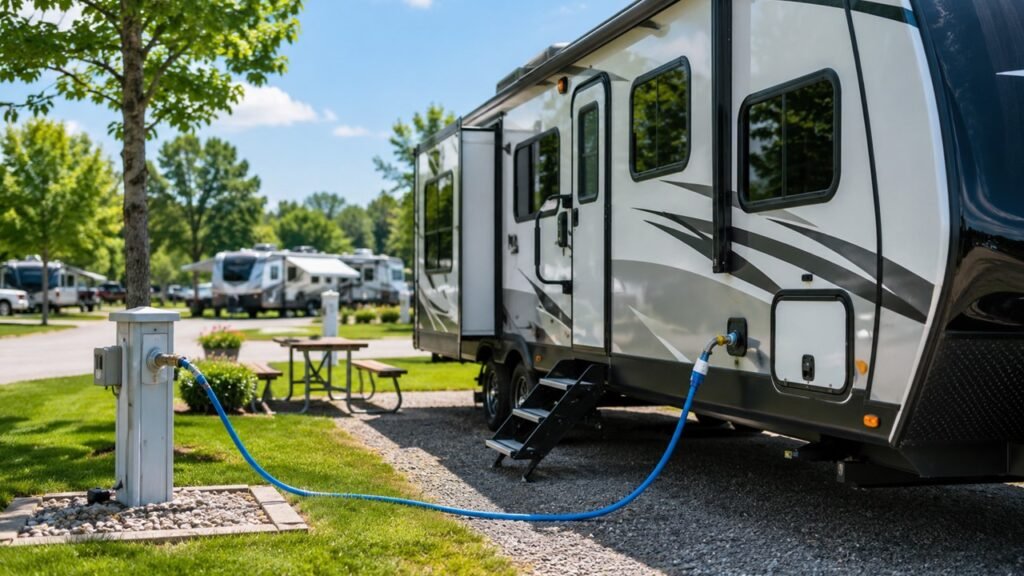
Start by confirming that the RV is actually receiving shore power. A loose plug, tripped pedestal breaker, damaged power cord, or tripped main breaker may leave the RV running from the battery without you noticing.
Next, inspect the converter breaker and fuses. Reverse-polarity fuses can blow after a battery is connected backward, even briefly.
The battery disconnect switch is another common cause. Some RVs allow the converter to power 12-volt appliances while the disconnect prevents charging current from reaching the battery.
Loose positive cables and failed chassis grounds can cause the same problem.
An old or damaged battery may also fail while plugged in. The converter may be supplying the correct voltage, but the battery cannot accept or retain enough energy.
Test both the charging system and the battery before replacing either part.
Why Does My RV Battery Die Overnight?
Overnight battery failure usually means your electrical consumption is higher than expected or the battery has lost usable capacity. Cold weather often makes the problem more noticeable.
Furnace Blower Usage
An RV furnace burns propane to create heat, but the blower motor and control system run on 12-volt electricity.
During cold weather, the blower may cycle repeatedly throughout the night. This can consume a significant portion of a small battery bank.
Heat loss through windows, doors, vents, and uninsulated areas makes the furnace run more frequently.
Reduce consumption by improving insulation, lowering the thermostat slightly, and starting the night with a fully charged battery.
Inverter and AC Appliance Loads
An inverter may continue drawing power even when you are not actively using an AC appliance.
A residential refrigerator cycling overnight can consume substantial energy through an inverter. Televisions, satellite receivers, chargers, and other devices may also remain in standby mode.
Switch off the inverter when AC power is unnecessary.
Limited Battery Capacity
A battery can be healthy but still be too small for your overnight load.
Add together the expected energy used by the furnace, refrigerator, lights, fans, water pump, medical equipment, and electronics.
Compare that figure with the battery bank’s usable capacity. Account for temperature, battery condition, and the manufacturer’s recommended discharge limit.
A Battery That No Longer Holds Capacity
A worn battery may charge to an apparently normal voltage but lose power quickly under load.
This happens because voltage does not tell you how many usable amp-hours remain.
Fully charge the battery and have it capacity-tested or load-tested. Replace it when testing confirms that it can no longer support your needs.
Why Does My RV Battery Die During Storage?
Storage-related battery drain is usually gradual. Hidden loads and natural self-discharge can leave the battery empty before your next trip.
Common storage drains include:
- Propane and carbon monoxide detectors
- Refrigerator control boards
- Furnace controls
- Stereo memory
- Clocks
- USB outlets
- Security systems
- Tracking devices
- Solar-controller standby consumption
- Aftermarket accessories
- Natural battery self-discharge
Trojan states that lead-acid batteries may self-discharge by approximately 5% to 15% per month, depending partly on storage temperature.
Start storage with a fully charged battery. Then verify whether the battery disconnect switch actually isolates every electrical circuit.
For long storage periods, you may need to physically disconnect the negative cable or remove the battery. Follow the RV and battery manufacturers’ storage procedures.
A compatible maintenance charger can keep some batteries charged during storage. However, the charger must support the correct battery chemistry and should not continuously overcharge the battery.
Check stored batteries periodically. Do not assume they will remain charged for an entire season without attention.
How to Stop an RV Battery From Dying
Preventing repeat failure requires more than recharging the battery. You must correct the reason it lost power in the first place.
Fully Recharge the Battery After Each Trip
Recharge the battery as soon as practical after camping.
Do not store a lead-acid battery in a partially discharged state. Extended undercharging encourages sulfation and reduces usable capacity.
Allow the charger enough time to complete its full charging process.
Use the Battery Disconnect Correctly
Find out which circuits your battery disconnect controls.
Switch it off and confirm which devices remain powered. Some safety circuits or accessories may bypass the switch.
A disconnect is helpful during storage, but it should not replace periodic battery monitoring.
Install a Battery Monitor
A simple voltage display provides limited information.
A shunt-based battery monitor measures current entering and leaving the battery bank. It can estimate:
- State of charge
- Current consumption
- Charging current
- Amp-hours used
- Time remaining
- Historical energy use
A monitor makes it easier to identify high electrical loads and verify whether the charging system is replacing the energy you use.
Reduce Unnecessary Electrical Loads
Turn off equipment that does not need to remain active.
Focus on:
- Inverter standby mode
- Unused lights
- Entertainment systems
- USB adapters
- Heating pads
- Wi-Fi equipment
- Exterior lighting
- Aftermarket electronics
Energy savings from several small changes can become significant overnight.
Maintain Clean and Tight Connections
Inspect the battery cables regularly.
Disconnect the appropriate power sources before cleaning. Follow the RV and battery manufacturers’ procedures.
A baking soda and water solution may be used to neutralize corrosion around flooded lead-acid battery terminals, but the solution should not enter the battery cells. Trojan includes this approach in its flooded-battery maintenance guidance.
Tighten connections to the manufacturer’s torque specification. Overtightening can damage battery posts.
Maintain Flooded Lead-Acid Batteries
Check electrolyte levels at the interval recommended by the battery manufacturer.
Use distilled water only. Wear eye protection and gloves, and keep sparks and flames away from the battery area.
Keep the plates covered. Do not overfill the cells because the electrolyte can expand and overflow during charging.
Never attempt to add water to sealed AGM or gel batteries.
Use a Compatible Maintenance Charger
Choose a charger or converter designed for your battery chemistry.
Charging profiles for flooded, AGM, gel, and lithium batteries are not identical. An incorrect profile may leave the battery undercharged or expose it to excessive voltage.
A quality multi-stage charger adjusts its behavior as the battery approaches full charge.
Increase Battery Capacity When Necessary
Calculate your electrical needs before adding batteries.
Estimate how many watt-hours or amp-hours you use during a typical day. Include nighttime furnace use and inverter losses.
Adding capacity may help when the existing battery bank is healthy but insufficient.
Make sure cables, fuses, chargers, battery compartments, and mounting systems can support the larger bank.
Improve the Charging System
Your charging system must be able to restore the energy you consume.
Possible improvements include:
- A higher-output compatible converter
- Additional solar capacity
- A larger solar controller
- A DC-to-DC charger
- Improved battery cables
- Reduced cable length
- Better generator-charging equipment
- Correct battery-temperature sensing
Do not upgrade one charging component without checking the ratings of the complete system.
When Should You Replace an RV Battery?
Replace an RV battery when testing confirms that it is unsafe or can no longer provide practical capacity. Do not rely only on its age or resting voltage.
Replacement may be necessary when:
- The battery fails a load or capacity test.
- Voltage falls rapidly under a modest load.
- Runtime remains poor after a complete charge.
- The battery case is cracked or leaking.
- The battery is swollen.
- A terminal is melted or badly damaged.
- The battery repeatedly overheats.
- Flooded plates have remained exposed.
- Severe sulfation has reduced capacity.
- The battery has suffered repeated deep discharges.
- Internal damage causes abnormal self-discharge.
A battery that is hot, swollen, leaking, or producing a strong unusual odor may present a safety risk. Stop using and charging it when this can be done safely.
Take old batteries to an approved recycling location. Do not place them in household trash.
Should You Upgrade to a Lithium RV Battery?
Lithium iron phosphate batteries can provide more usable energy, lower weight, and longer cycle life than many lead-acid options. However, they are not a universal cure for battery-drain problems.
| Feature | Lead-Acid Battery | LiFePO4 Battery |
| Usable capacity | Usually more limited | Generally higher |
| Weight | Heavier | Lighter for similar usable energy |
| Maintenance | Flooded models need watering | Usually maintenance-free |
| Charging speed | Generally slower | Often accepts faster charging |
| Cycle life | Usually lower | Generally higher |
| Initial cost | Lower | Higher |
| Cold-weather charging | Depends on type and charger | Often restricted without protection |
| Charging compatibility | Common in older RVs | May require equipment changes |
| Battery management system | Usually not built in | Normally included |
| Voltage behavior | Gradually declines | Remains relatively stable before shutdown |
Lithium may be worthwhile when you regularly camp without hookups, want more usable capacity, or need to reduce weight.
Before changing battery chemistry, confirm:
- Converter compatibility
- Solar-controller settings
- Alternator charging method
- DC-to-DC charger requirements
- Battery management system
- Low-temperature charging protection
- Cable size
- Fuse ratings
- Battery compartment suitability
Victron recommends using a charging profile that matches lithium iron phosphate battery chemistry. Its documentation also describes BMS protection against low voltage, high voltage, and temperature-related conditions.
Lithium will not fix loose wiring, excessive appliance use, an undersized charging system, or uncontrolled parasitic loads.
RV Battery Maintenance Schedule
Regular checks can reveal small problems before the battery leaves you without power. Adjust this schedule according to your battery and RV manufacturers’ instructions.
| Maintenance Task | Suggested Frequency |
| Check state of charge | Before and after each trip |
| Inspect cables and terminals | Monthly during regular use |
| Look for swelling, leaks, or damage | Before each trip |
| Check flooded-battery electrolyte | According to manufacturer guidance |
| Measure charging voltage | Every few months or when problems appear |
| Verify converter operation | At the start of the camping season |
| Check for parasitic loads | Before long-term storage |
| Fully recharge before storage | Every storage period |
| Check stored battery condition | Periodically during storage |
| Review battery-monitor history | After trips with unusually high consumption |
| Perform a load or capacity test | Annually or when runtime declines |
The manufacturer’s maintenance instructions should always take priority over a general schedule.
Safety Precautions When Troubleshooting an RV Battery
RV batteries can deliver extremely high current. A dropped tool or incorrect meter connection can cause burns, sparks, fire, or equipment damage.
- Wear eye protection and suitable gloves.
- Remove rings, watches, bracelets, and other metal jewelry.
- Keep cigarettes, sparks, and flames away from batteries.
- Provide ventilation around lead-acid batteries.
- Disconnect shore power before changing battery wiring.
- Disable solar charging before disconnecting applicable components.
- Follow the correct battery-disconnection sequence.
- Never bridge positive and negative terminals with a tool.
- Confirm the multimeter setting before making contact.
- Use correctly rated fuses and circuit protection.
- Do not open sealed AGM, gel, or lithium batteries.
- Stop charging a swollen, leaking, or unusually hot battery.
- Do not work on live 120-volt equipment without proper training.
- Contact a qualified RV technician when the fault is not safely accessible.
Final Thoughts
When your RV battery keeps dying, do not immediately assume you need another battery. First determine whether power is being consumed unexpectedly, the battery is being fully charged, and the connections can carry electricity correctly.
Start with a visual inspection, fully charge the battery, test it under load, verify converter output, and then look for parasitic drains. This step-by-step approach gives you a much better chance of fixing the real problem instead of repeatedly replacing batteries.
Related FAQs
How Long Should an RV Battery Hold a Charge?
How long an RV battery holds a charge depends on its capacity, condition, temperature, charging level, and connected loads. A healthy battery may last days during light use but only hours when powering a furnace, inverter, or residential refrigerator.
Why Does My New RV Battery Keep Dying?
A new RV battery may keep dying because it is not receiving a complete charge, hidden loads remain connected, the charger uses the wrong profile, or the battery bank is too small. Test the charging system and parasitic draw before blaming the battery.
Can a Bad Converter Ruin an RV Battery?
Yes. A converter that undercharges the battery can leave it chronically discharged and encourage sulfation. A converter that overcharges can cause heat, water loss, corrosion, and permanent internal damage.
Will an RV Battery Charge While Plugged Into Shore Power?
An RV battery should charge on shore power when the converter, breakers, fuses, wiring, disconnect switch, and battery are working correctly. Measure voltage and charging current at the battery to confirm that charging is actually occurring.
Should I Disconnect My RV Battery During Storage?
Disconnecting the battery can reduce parasitic drain during storage. However, the battery should still be fully charged, stored under suitable conditions, and checked periodically according to the manufacturer’s instructions.
Can a Completely Dead RV Battery Be Recharged?
Some completely discharged RV batteries can be recharged, but recovery depends on battery chemistry, condition, and how long they remained empty. A severely or repeatedly discharged lead-acid battery may no longer hold useful capacity.
Why Does My RV Battery Show Full but Die Quickly?
A battery can show a high voltage because of surface charge while having very little usable capacity. Sulfation, age, internal damage, or a failed cell may cause the voltage to collapse as soon as a load is applied.
How Do I Know Whether My RV Battery or Converter Is Bad?
Charge and test the battery separately, then measure the converter output at both the converter and battery terminals. A battery that fails a load test is likely damaged, while correct converter output that never reaches the battery points toward wiring, fuse, or connection problems.
Why Does My RV Battery Die When the Furnace Runs?
The furnace uses propane for heat but relies on the battery for the blower and controls. A weak battery, cold temperatures, long furnace cycles, or insufficient battery capacity can cause the voltage to fall overnight.
Does the RV Battery Disconnect Stop Every Power Drain?
Not always. Some safety detectors, solar equipment, emergency circuits, and aftermarket accessories may bypass the disconnect switch. Test for current at the battery after turning the switch off.
Can a Bad Ground Cause an RV Battery to Die?
A poor ground can prevent proper charging and restrict power delivery. It may also create voltage drops, dim lights, intermittent equipment operation, and warm cable connections.
Will Driving Recharge a Dead RV Battery?
Driving may recharge the house battery, but the charging rate depends on the RV wiring, alternator system, fuse protection, voltage drop, and whether a DC-to-DC charger is installed. Factory charge lines may not quickly recover a deeply discharged battery.

Michael Carter is an experienced RV traveler who focuses on practical outdoor trips across the States. He writes clear, step-by-step guides and realistic reviews based on real travel needs. His aim is to help RV and camper owners plan informed, simpler journeys with confidence.