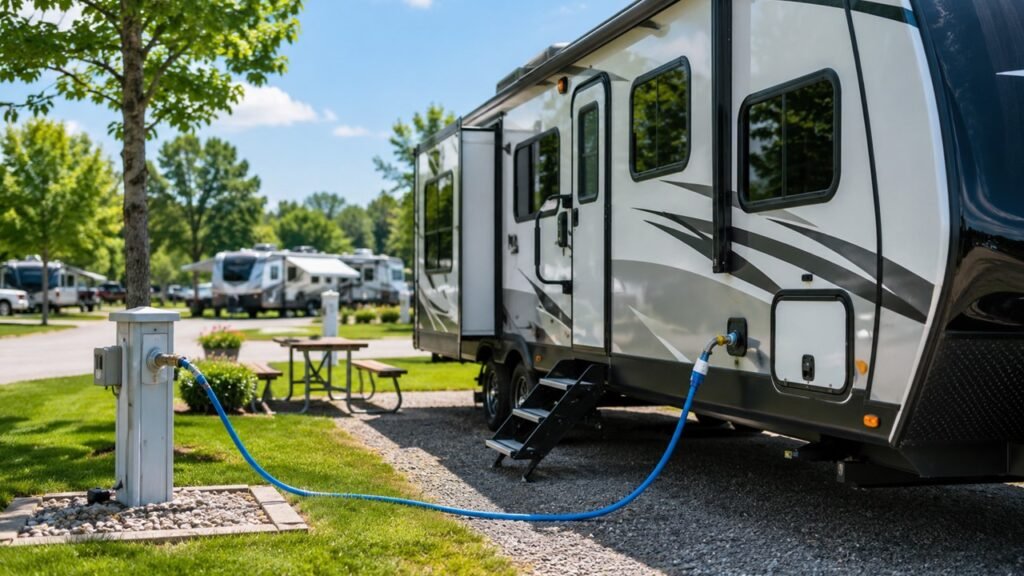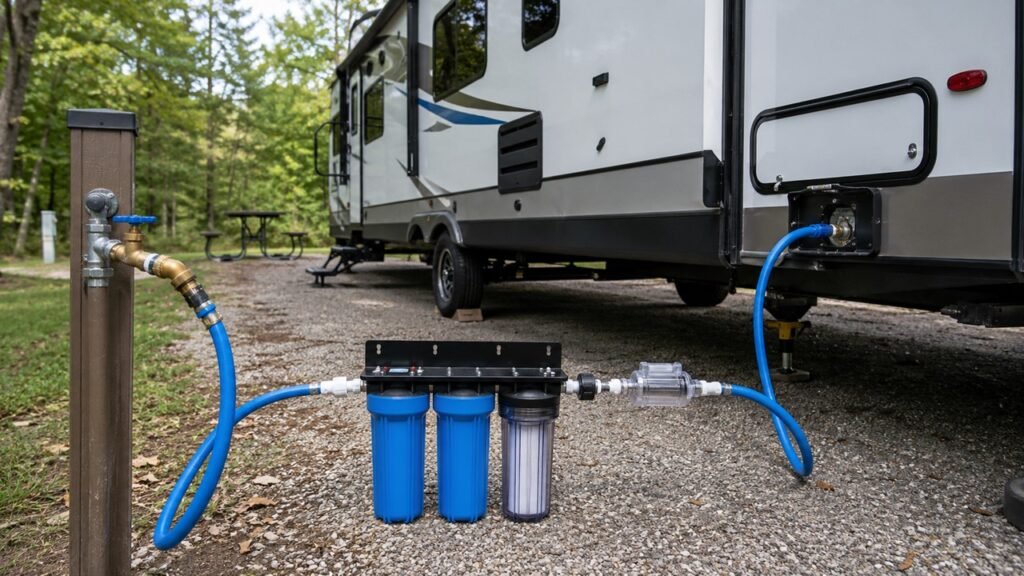
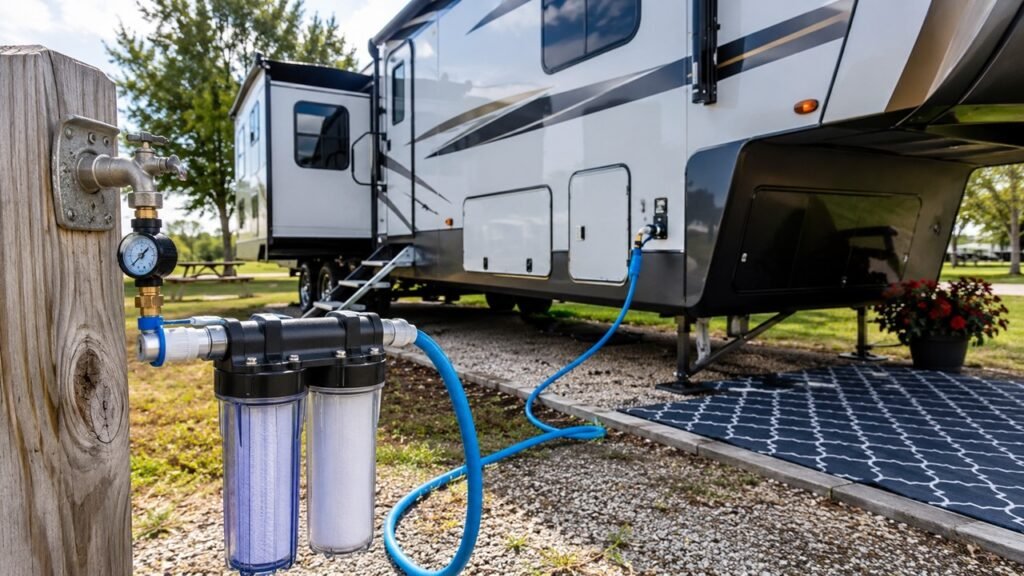
An RV water filter removes sediment, dirt, rust, chlorine taste, bad odors, and some chemicals from the water entering your RV. Depending on the filter type, it may also reduce heavy metals, sulfur smell, cysts, bacteria, hard-water minerals, and dissolved contaminants.
In this guide, we’ll walk through what each RV water filter removes, what basic inline filters miss, and how to choose the right setup for campground water, well water, boondocking, or full-time RV living.
Key Takeaways
- Most RV water filters remove sediment, chlorine taste, and unpleasant odors.
- Sediment filters protect your RV plumbing from sand, dirt, rust, and debris.
- Carbon filters help improve taste and reduce chlorine, VOCs, and some chemicals.
- KDF filters can help reduce chlorine, some metals, sulfur smell, and filter bacteria growth.
- Ceramic, UV, and reverse osmosis systems offer stronger drinking-water protection.
- Basic inline RV filters do not make unsafe or non-potable water safe to drink.
- Hard water usually needs a water softener or reverse osmosis system, not a basic filter.
Quick Answer: What Contaminants Does an RV Water Filter Remove?
The exact contaminants depend on the filter media, micron rating, and system design. A simple hose filter and a full multi-stage RV water filtration system do not remove the same things.
| Contaminant | Basic Inline Filter | Sediment Filter | Carbon Filter | KDF Filter | Ceramic/Sub-Micron Filter | Reverse Osmosis | Water Softener |
| Sand, dirt, and silt | Yes | Yes | Limited | Limited | Yes | Yes | No |
| Rust particles | Yes | Yes | Limited | Limited | Yes | Yes | No |
| Chlorine taste and smell | Yes | No | Yes | Yes | No | Yes | No |
| Chloramines | Sometimes | No | Some types | Limited | No | Yes | No |
| Bad odors | Yes | No | Yes | Yes | Limited | Yes | No |
| VOCs | Limited | No | Yes | Limited | No | Yes | No |
| Pesticides and herbicides | Limited | No | Yes | Limited | No | Yes | No |
| Lead and heavy metals | Sometimes | No | If certified | Some | No | Yes | No |
| Hydrogen sulfide smell | Sometimes | No | Sometimes | Yes | No | Limited | No |
| Cysts | Usually no | Only if fine enough | No | No | Yes, if rated | Yes | No |
| Bacteria | Usually no | No | No | Growth control only | Some, if rated | Yes | No |
| Viruses | No | No | No | No | No | Yes/UV needed | No |
| Hard-water minerals | No | No | No | No | No | Yes | Yes |
| TDS and salts | No | No | No | No | No | Yes | No |
A good way to think about RV filtration is this: basic filters improve water, while advanced systems treat specific problems. So before buying a filter, you need to know what problem you are trying to solve.
Why RV Water Needs Filtering In The First Place
RV water needs filtering because campground water quality can change from one place to another. One RV park may have clean municipal water, while the next may use a private well with iron, sulfur, sand, or hard minerals.
Even when the water is technically potable, it may still taste bad. It may smell like chlorine, look slightly cloudy, or leave grit inside your faucet aerators. That does not always mean the water is dangerous, but it does mean your RV plumbing is dealing with whatever comes through the campground spigot.
Your RV water system is also more compact than a home plumbing system. Small faucet screens, toilet valves, water pumps, water heaters, and showerheads can clog faster when sediment gets inside. Over time, untreated water can leave scale, stains, mineral buildup, and debris throughout the system.
That is why filtering RV water is not only about drinking. It is also about protecting your rig.
A filter can help protect:
- Faucets
- Showerheads
- Toilet valves
- Water pump screens
- Water heater parts
- Tankless water heaters
- Ice makers
- Washing machines
- Freshwater tank plumbing
- Drinking water fixtures
For many RVers, the best filter setup is not complicated. A simple sediment and carbon setup can solve most common campground water problems.
What Sediment Filters Remove From RV Water
Sediment filters are the first line of defense in an RV water system. They catch physical particles before those particles reach your tank, pump, faucets, and water heater.
Sand, Dirt, And Silt
Sand, dirt, and silt are common in campground water, especially when the park uses a well or has older underground pipes. These particles may be tiny, but they can still collect inside your RV plumbing.
A sediment filter traps those particles before they enter your system. This helps keep your water clearer and protects small fixtures from clogging.
Rust And Pipe Scale
Rust flakes can come from old campground pipes, metal fittings, hydrants, or spigots. You may not always see them in a clear glass of water, but they often show up later inside faucet screens or filter housings.
If your sediment cartridge turns brown, orange, or muddy, that usually means it is catching rust, dirt, or other suspended particles.
Small Debris That Can Clog Fixtures
Sediment may seem harmless until your showerhead loses pressure or your toilet valve stops working properly. Small debris can clog narrow passages inside your RV water system.
A sediment filter helps prevent clogs in:
- Faucet aerators
- Showerheads
- Toilet inlet valves
- Water pump screens
- Water heater fittings
- Tankless water heater screens
- Inline appliances
What Sediment Filters Do Not Remove
Sediment filters are useful, but they are not complete water treatment systems. They remove particles, not dissolved chemicals.
A sediment filter usually does not remove:
- Chlorine taste
- Chloramine taste
- VOCs
- Pesticides
- Dissolved minerals
- Salt
- Hard water
- Heavy metals in dissolved form
- Viruses
- Most bacteria
- Bad taste caused by dissolved contaminants
So, a sediment filter is best used as the first stage, not the only stage.
What Carbon RV Water Filters Remove
Carbon filters are mainly used to improve water taste, smell, and chemical quality. They are one of the most common filter types in RV water systems because they make campground water much more pleasant to use.
Chlorine Taste And Smell
Many municipal water systems use chlorine to disinfect water. That is helpful for public safety, but it can leave your RV water tasting like a swimming pool.
Carbon filters reduce chlorine taste and smell, which makes the water better for drinking, cooking, brushing your teeth, and making coffee.
Chloramines
Some cities use chloramines instead of chlorine. Chloramines can be harder to remove than regular chlorine.
Standard carbon may reduce some chloramine taste, but catalytic carbon is usually better for this job. So, if your water still tastes chemically after filtration, chloramines may be part of the problem.
VOCs And Organic Chemicals
VOCs, or volatile organic compounds, are chemicals that can affect water taste, odor, and quality. Carbon filters are commonly used to reduce many organic chemicals.
This is one reason carbon is often included in drinking water filters, RV filters, and household filtration systems.
Pesticides, Herbicides, And Chemical Odors
Rural campgrounds, agricultural areas, and private wells can sometimes have different chemical concerns than city water. Carbon filters may help reduce some pesticides, herbicides, and chemical odors, depending on the filter design.
This is where filter quality matters. A small basic inline filter will not perform the same as a larger carbon block filter.
What Carbon Filters Do Not Reliably Remove
Carbon is great for taste and odor, but it does not solve every water problem.
Carbon filters do not reliably remove:
- Hard-water minerals
- Calcium and magnesium
- High TDS
- Salt
- Most bacteria
- Viruses
- Nitrates, unless specifically rated
- Fluoride, unless specifically rated
- Heavy metals, unless certified for them
For stronger protection, carbon is often paired with sediment filtration, KDF media, UV, or reverse osmosis.
What KDF Filters Remove In RV Water Systems
KDF media is often used in RV water filters because it works well with carbon. It can help reduce chlorine, certain metals, sulfur odors, and bacterial growth inside the filter.
Chlorine
KDF can help reduce chlorine before the water reaches the carbon stage. This can improve filter performance and help the carbon last longer.
That is why many RV inline filters use a combination of carbon and KDF media.
Heavy Metals Like Lead, Iron, And Mercury
Some KDF filters may help reduce certain heavy metals, including lead, iron, mercury, nickel, and copper. However, this depends heavily on the product.
You should not assume every KDF filter removes every metal. Always check the filter’s specific reduction claims before relying on it for heavy-metal concerns.
Hydrogen Sulfide Or Rotten Egg Smell
If your campground water smells like rotten eggs, hydrogen sulfide may be the issue. This is more common with well water than treated city water.
KDF and certain specialty filters can help reduce sulfur smell. Carbon may also help with odor, but sulfur problems often need a more targeted setup.
Bacterial Growth Inside The Filter
You may see the word “bacteriostatic” on some RV filters. This does not mean the filter kills everything in the water.
Bacteriostatic simply means the filter media helps prevent bacteria from growing inside the filter itself. That is useful for RVers because filters can sit wet between trips.
KDF Limitations
The KDF is helpful, but it is not a complete purifier.
KDF usually does not:
- Make non-potable water safe
- Remove all bacteria
- Remove viruses
- Remove hard-water minerals
- Remove high TDS
- Replace UV or reverse osmosis
- Replace regular tank sanitation
Moreover, KDF works best as part of a layered system, especially when paired with carbon.
Do RV Water Filters Remove Bacteria, Cysts, And Viruses?
This is where RV owners need to be careful. A filter that improves taste is not the same as a purifier that makes unsafe water safe to drink.
Cysts Like Giardia And Cryptosporidium
Some fine filters can reduce cysts like Giardia and Cryptosporidium, but only if they are rated for that purpose. The micron rating matters here.
A 100-micron inline filter will not catch the same things as a 1-micron or sub-micron drinking water filter.
If cyst protection matters to you, look for a filter that clearly states cyst reduction. Do not guess based on appearance or marketing words.
Bacteria
Most basic inline RV filters are not designed to reliably remove bacteria. They may improve taste and catch sediment, but that does not mean they disinfect the water.
Some ceramic filters, ultrafiltration systems, and reverse osmosis systems can reduce bacteria. UV purifiers can also inactivate bacteria when properly installed and maintained.
Viruses
Viruses are much smaller than bacteria. Most standard RV filters do not remove them.
For virus concerns, you usually need one of these methods:
- Reverse osmosis
- UV purification
- Ultrafiltration rated for viruses
- Boiling
- Chemical disinfection
- A certified water purifier
This matters most when using questionable sources, remote water, untreated wells, or water affected by a boil-water advisory.
When You Should Not Trust A Basic RV Filter
A basic RV filter is not enough when the water source may be unsafe.
Do not rely on a basic inline filter if:
- The water is labeled non-potable.
- The campground has a boil-water advisory.
- The water looks muddy or cloudy.
- The water smells like sewage.
- You are pulling from a lake, river, or stream.
- You are using an unknown private well.
- Your freshwater tank has not been sanitized.
- Someone in your RV has a weaker immune system.
In those situations, use a true purification method or carry safe drinking water.
Do RV Water Filters Remove Heavy Metals?
Some RV water filters can reduce heavy metals, but not all of them do. This is one area where you should read the label carefully.
A certified carbon block filter may reduce lead. KDF media may help reduce some metals. Reverse osmosis is usually stronger for dissolved metals because it removes a much wider range of contaminants.
Heavy metals RVers may worry about include:
- Lead
- Iron
- Manganese
- Mercury
- Chromium
- Copper
- Arsenic
Iron and manganese often cause staining, discoloration, or metallic taste. Lead and arsenic are more serious health concerns and need filters specifically rated for them.
If you regularly use private well water, testing is the smartest move. A filter can only solve the problem if you know what is actually in the water.
Do RV Water Filters Remove Hard Water Minerals?
Most RV water filters do not remove hard-water minerals because calcium and magnesium are dissolved in the water. These minerals pass through basic sediment and carbon filters.
Why Sediment And Carbon Filters Cannot Fix Hard Water
Hard water is not usually caused by floating particles. It is caused by dissolved minerals, mainly calcium and magnesium.
Think of it like salt in water. Once salt dissolves, you cannot remove it with a basic screen. Calcium and magnesium behave in a similar way.
That is why a sediment filter may catch dirt, but it will not stop white scale from forming in your water heater.
What Removes Hard Water In An RV?
To deal with hard water, you need a system designed for dissolved minerals.
The most common options are:
- Portable RV water softener
- Reverse osmosis system
- Deionization cartridge
- Distillation for small drinking-water amounts
A portable water softener is usually the most practical whole-RV option. Reverse osmosis is better for drinking water, but it can be slower and wastes some water.
Why Hard Water Matters In An RV
Hard water is not just annoying. Over time, it can create real maintenance problems.
Hard water can cause:
- White spots on dishes
- Poor soap lather
- Dry-feeling skin and hair
- Scale inside the water heater
- Clogged faucet aerators
- Mineral buildup in showerheads
- Reduced tankless water heater performance
- Scale flakes inside plumbing lines
If you camp often in hard-water regions, a softener can protect your RV and make daily water use more comfortable.
Do RV Water Filters Remove Bad Taste And Odor?
RV water filters can remove many bad tastes and odors, especially when the problem comes from chlorine, sediment, or organic compounds.
A carbon filter is usually the best first solution for bad taste. It can make campground water taste cleaner and reduce that chemical smell from treated city water.
If your water smells like rotten eggs, the problem may be sulfur or hydrogen sulfide. In that case, a carbon/KDF filter or a specialty sulfur filter may work better.
If your water tastes metallic, the issue could be iron, copper, old pipes, or another metal. A KDF filter, certified carbon filter, or reverse osmosis system may help, but testing is better if the taste is strong or persistent.
If your water tastes stale, the filter may not be the problem at all. Your freshwater tank, hose, or fittings may need cleaning. A dirty freshwater tank can make filtered water taste bad after it enters the RV.
Also, never use a regular garden hose for RV drinking water. A cheap hose can add a plastic or rubber taste, even if your filter is working properly.
What Basic Inline RV Water Filters Usually Remove
Basic inline RV water filters are popular because they are cheap, easy to connect, and simple to use. You attach one between the campground spigot and your drinking-water-safe hose, then let it filter water before it enters the RV.
A basic inline RV filter may remove or reduce:
- Sand
- Dirt
- Silt
- Rust particles
- Larger sediment
- Chlorine taste
- Some odors
- Some organic chemicals
- Some metallic taste
- Some sulfur smell
- Bacterial growth inside the filter, if bacteriostatic
For weekend campers using potable campground water, this may be enough. It improves taste and gives your plumbing some basic protection.
However, an inline filter should not be treated like a full purification system. It is a good first step, not a complete solution for every water problem.
What Basic RV Water Filters Do Not Remove
Basic RV filters have limits. This is important because many new RV owners assume “filtered” means “safe.” That is not always true.
A basic RV water filter usually does not remove:
- Viruses
- Most bacteria
- Unsafe non-potable water risks
- Dissolved salts
- High TDS
- Calcium
- Magnesium
- Hard-water scale
- Nitrates, unless specifically rated
- Fluoride, unless specifically rated
- Arsenic, unless specifically rated
- PFAS, unless specifically rated
- All heavy metals
- Contamination from a dirty freshwater tank
- Contamination from a dirty hose
- Sewage-related contamination
- Water affected by a boil-water advisory
This does not mean basic filters are useless. It just means they should be used for the right job.
For normal potable campground water, they can be very helpful. For questionable water, you need stronger treatment.
RV Water Filter Types And What Each One Removes
Each RV filter type solves a different problem. The best setup usually uses more than one filter instead of expecting one cartridge to do everything.
| Filter Type | Best For | Removes Or Reduces | Does Not Remove Well |
| Inline hose filter | Weekend camping and basic taste improvement | Sediment, chlorine taste, odor | Viruses, hard water, high TDS |
| Sediment canister | Plumbing protection | Sand, rust, dirt, debris | Chemicals, dissolved minerals |
| Carbon block filter | Better taste and odor | Chlorine, VOCs, some chemicals | Hard minerals, viruses |
| KDF + carbon filter | Campground water and intermittent use | Chlorine, some metals, sulfur smell | Full microbial purification |
| Ceramic filter | Drinking water protection | Fine particles, some cysts and bacteria | Viruses and dissolved chemicals |
| UV purifier | Microbial disinfection | Bacteria, viruses, protozoa | Sediment, chemicals, metals |
| Reverse osmosis | Drinking and cooking water | TDS, salts, metals, many chemicals, microbes | Needs pressure, space, and wastewater handling |
| Water softener | Hard water | Calcium and magnesium | Chemicals, bacteria, viruses |
Inline Hose Filters
Inline filters are the easiest RV water filters to use. They connect directly to the hose and filter water before it reaches your RV.
They are best for basic taste, odor, and sediment reduction. Moreover, they are not ideal for serious contamination problems.
Two-Stage RV Filters
A two-stage RV filter usually uses a sediment filter first and a carbon filter second. This is a strong setup for many RVers.
The sediment filter catches dirt and rust. The carbon filter improves taste and odor. Together, they protect your plumbing better than one basic inline filter.
Three-Stage RV Filters
A three-stage system gives you one extra filter slot. This can be used for KDF, carbon block, finer sediment filtration, iron reduction, nitrate reduction, or another specialty cartridge.
This setup makes sense for full-time RVers or people who often camp in areas with questionable water quality.
UV Purifiers
A UV purifier uses ultraviolet light to inactivate bacteria, viruses, and other microorganisms. It does not remove sediment, chemicals, metals, or bad taste.
That means UV works best after sediment and carbon filtration. Clear water allows UV to work more effectively.
Reverse Osmosis Systems
Reverse osmosis is one of the strongest options for RV drinking water. It can reduce dissolved solids, salts, metals, fluoride, arsenic, and many other contaminants.
The downside is that RO systems need space, pressure, maintenance, and wastewater handling. For many RVers, under-sink RO for drinking water is more practical than whole-RV RO.
Portable Water Softeners
A water softener removes calcium and magnesium, which cause hard water. This helps reduce scale in your RV plumbing and water heater.
However, a softener does not remove chlorine, bacteria, viruses, or most chemicals. It should be used with filtration, not instead of filtration.
Which RV Water Filter Setup Should You Use?
The right RV water filter setup depends on your water source, travel style, and main concern. A weekend camper at full-hookup parks does not need the same setup as a full-time RVer using well water.
For Campground City Water
If you usually connect to city-treated campground water, your main problems are likely chlorine taste, sediment, and occasional rusty water.
A good setup includes:
- Water pressure regulator
- Drinking-water-safe hose
- Inline RV filter or two-stage filter
- Sediment filter
- Carbon filter
- Optional water softener in hard-water areas
This setup is simple, affordable, and practical for most RV parks.
For Private Well Water
Well water can vary a lot. It may contain iron, sulfur, sediment, hard minerals, or bacteria. Some wells are excellent. Others need serious treatment.
A better setup includes:
- Sediment pre-filter
- Carbon/KDF filter
- Water test if you drink it often
- Portable water softener if hardness is high
- UV or RO for extra drinking-water protection
If the water smells strongly of sulfur or tastes metallic, do not just guess. Test it or use a filter designed for that specific problem.
For Boondocking Or Filling From Unknown Sources
When boondocking, you may fill your tank from different places. Some are safe potable sources. Some are not.
A safer setup includes:
- Only filling from potable sources when possible
- Filtering water before it enters your freshwater tank
- Sanitizing your freshwater tank regularly
- Using a drinking-water purifier for drinking and cooking
- Carrying emergency backup water
- Avoiding unknown surface water unless properly treated
For boondocking, tank cleanliness matters just as much as the filter.
For Full-Time RV Living
Full-time RVers use more water and visit more locations. So, they benefit from a stronger and more serviceable system.
A good full-time setup includes:
- Adjustable water pressure regulator
- Two-stage or three-stage canister system
- Replaceable sediment cartridge
- Carbon block filter
- Optional KDF or specialty cartridge
- Optional portable water softener
- Optional under-sink RO or UV for drinking water
This setup costs more upfront but gives better control over water quality.
For Weekend RV Camping
Weekend campers usually need something simple and easy to store.
A good basic setup includes:
- Water pressure regulator
- Drinking-water-safe hose
- Inline RV water filter
- Clean hose fittings
- Regular freshwater tank sanitation
If you only camp a few times per year at developed campgrounds, this may be enough.
How Micron Ratings Affect What An RV Filter Removes
A micron rating tells you the size of particles a filter can catch. Smaller micron ratings catch smaller particles, but they may also reduce water flow.
100-Micron Filters
A 100-micron filter catches larger debris. This is useful for basic hose filtration, but it will not catch very fine particles or cysts.
Many simple inline filters focus more on general taste and sediment improvement than fine filtration.
20-Micron Filters
A 20-micron filter catches sand, dirt, and larger suspended particles. This is a common rating for basic sediment control.
It helps protect plumbing, but it is still not a drinking-water purifier.
5-Micron Filters
A 5-micron filter catches finer sediment, rust, and silt. This is a good choice as a first-stage filter in a canister system.
It gives better protection than many basic inline filters.
1-Micron Filters
A 1-micron filter catches very fine sediment. Some 1-micron filters may also reduce cysts if they are rated for that purpose.
This does not automatically mean they remove bacteria or viruses. Always check the filter’s claim.
0.5-Micron And Sub-Micron Filters
A 0.5-micron or sub-micron filter can provide stronger drinking-water protection, especially for cyst reduction.
The tradeoff is water flow. Finer filters can slow flow, especially if the campground water has lots of sediment.
| Micron Rating | What It Usually Catches | Best RV Use |
| 100 micron | Larger debris and visible particles | Basic hose filtration |
| 20 micron | Sand, dirt, and larger sediment | General RV protection |
| 5 micron | Fine sediment and rust | Canister pre-filter |
| 1 micron | Very fine sediment and some cyst-level filtration if rated | Advanced filtration |
| 0.5 micron | Finer cyst-level filtration | Drinking water stage |
| RO membrane | Dissolved contaminants and very small particles | Drinking and cooking water |
Micron rating is important, but it is not the whole story. Filter media matters too. A 1-micron sediment filter and a 1-micron carbon block filter are not designed for the exact same job.
Do RV Water Filters Make Campground Water Safe To Drink?
RV water filters can make potable campground water taste and smell better. They can also reduce sediment and improve everyday water quality.
But a basic RV filter does not automatically make unsafe water safe to drink.
If the campground water is labeled potable, a good RV filter can improve it. If the water is labeled non-potable, under a boil-water advisory, or from an unknown source, a basic filter is not enough.
For questionable water, use one or more of these methods:
- Boiling
- UV purification
- Reverse osmosis
- Certified water purifier
- Chemical disinfection
- Safe bottled water
Also remember this: filtered water can still become contaminated inside your RV if your freshwater tank is dirty. A clean filter cannot fix a dirty tank after the fact.
So, if you drink from your RV system, sanitize your freshwater tank on a regular schedule.
Signs Your RV Water Filter Is Removing Contaminants
You will not always see contaminants leaving the water. But there are signs that your RV filter is doing its job.
Common signs include:
- Water tastes less like chlorine.
- Water smells cleaner.
- Coffee and tea taste better.
- The sediment cartridge turns brown.
- Faucet aerators collect less grit.
- Showerheads clog less often.
- Dishes rinse cleaner.
- Water looks clearer.
- The filter housing shows trapped particles.
- Water flow slows after long use, meaning the filter may be clogged.
A dirty filter is not always a bad sign. It often means the filter protected your RV from whatever was in the water.
Signs Your RV Water Filter Is Not Enough
Sometimes a basic filter will not solve the real problem. If water issues continue after filtering, you may need a different filter type or a stronger system.
Signs your RV filter is not enough include:
- Rotten egg smell remains.
- Water still tastes metallic.
- White scale appears quickly.
- Faucet screens keep clogging.
- Water pressure drops sharply.
- The filter clogs after only a few days.
- Water looks cloudy after filtration.
- Your freshwater tank smells stale.
- Your water heater has scale flakes.
- You are using private well water without testing.
- The campground has a boil-water advisory.
- You are worried about bacteria or viruses.
When this happens, do not just add another random filter. Match the solution to the problem.
For example, hard water needs a softener or RO. Bacteria concerns need UV, RO, boiling, or purification. Sediment problems need better pre-filtration.
How Often Should You Replace An RV Water Filter?
Filter life depends on the water quality, filter size, usage level, and camping style. A weekend camper and a full-time RVer will not replace filters at the same pace.
Inline RV Filters
Inline filters are usually replaced more often than larger canister filters. Replace them based on the manufacturer’s instructions, water taste, odor, and flow rate.
If the water starts tasting bad again, the filter may be exhausted.
Sediment Cartridges
Sediment cartridges should be replaced when they look dirty, water flow drops, or the recommended service period ends.
If you camp somewhere with rusty or sandy water, a sediment filter can clog quickly.
Carbon Filters
Carbon filters can stop adsorbing chemicals before they look dirty. That means appearance alone is not enough.
Replace carbon filters on schedule, especially if you drink the water.
RO Membranes
Reverse osmosis membranes last longer than basic cartridges, but they still need maintenance. Many RVers use a TDS meter to check RO performance.
If TDS starts rising, the membrane may need replacement.
UV Bulbs
UV bulbs should be replaced based on rated hours, even if the bulb still lights up. A glowing bulb does not always mean it is disinfecting properly.
Follow the system’s instructions carefully for safe performance.
How To Get The Best Results From An RV Water Filter
A water filter works best when the whole setup is clean, protected, and installed correctly.
Use these simple tips:
- Use a water pressure regulator before connecting your RV.
- Use a drinking-water-safe hose.
- Flush the spigot before connecting.
- Flush the hose before use.
- Flush a new filter before connecting it to the RV.
- Keep hose fittings off the ground.
- Filter water before it enters the freshwater tank.
- Replace filters on schedule.
- Store filters properly between trips.
- Sanitize your freshwater tank regularly.
- Clean faucet aerators and showerheads.
- Use a separate drinking-water filter if needed.
- Test private well water before relying on it.
- Do not use non-potable water with a basic filter.
- Carry spare cartridges if you travel often.
Small habits make a big difference. Clean hoses, clean fittings, and a sanitized tank help your filter do its job.
RV Water Problems And The Best Filter Solution
Different water problems need different solutions. This table can help you quickly match the symptom to the right filter or treatment.
| Water Problem | Likely Cause | Best Filter Or Solution |
| Chlorine taste | Municipal water treatment | Carbon filter |
| Rotten egg smell | Hydrogen sulfide or sulfur | KDF/carbon or sulfur filter |
| Brown filter cartridge | Sediment, rust, or dirt | Sediment pre-filter |
| White scale | Hard water minerals | Portable softener or RO |
| Metallic taste | Iron, copper, lead, or old pipes | Test water, KDF, certified carbon, or RO |
| Cloudy water | Air, sediment, minerals, or contamination | Sediment filter and testing if persistent |
| Low water flow | Clogged filter or regulator issue | Replace filter and check regulator |
| Stale tank smell | Dirty freshwater tank | Sanitize tank |
| Concern about bacteria | Unsafe source or dirty system | UV, RO, purifier, or boiling |
| High TDS | Dissolved solids | Reverse osmosis |
| Poor soap lather | Hard water | Portable water softener |
| Black specks | Hose, carbon fines, or old fittings | Flush system and inspect filter/hose |
| Musty taste | Carbon exhaustion or dirty tank | Replace carbon filter and sanitize tank |
This is why one filter cannot solve everything. The best RV water setup is built around the actual water problem.
The Best RV Water Filter Setup For Most Campers
For most RV owners, the best setup is simple and layered. You do not need the most expensive system on day one, but you should use the right parts in the right order.
Basic Setup
A basic setup is best for weekend campers and short campground trips.
Use:
- Water pressure regulator
- Drinking-water-safe hose
- Inline RV water filter
This setup helps with taste, odor, and basic sediment. It is easy to install and easy to store.
Better Setup
A better setup is ideal for frequent campers who visit different RV parks.
Use:
- Water pressure regulator
- Sediment canister filter
- Carbon block filter
- Drinking-water-safe hose
- Optional inline pre-filter
This gives better water flow, stronger filtration, and easier cartridge replacement.
Best Setup For Drinking Water
If you drink RV water daily, a stronger drinking-water stage makes sense.
Use:
- Sediment pre-filter
- Carbon block filter
- Optional KDF stage
- Under-sink RO or UV purifier
- Optional water softener before the RV
This setup is especially helpful for full-time RVers, families, and people who use private well water often.
Common Mistakes RV Owners Make With Water Filters
RV water filtration is simple once you understand the basics. Still, many owners make mistakes that reduce filter performance or create water safety risks.
Avoid these common mistakes:
- Assuming every RV filter removes bacteria and viruses.
- Using a garden hose for drinking water.
- Skipping the water pressure regulator.
- Connecting fittings directly to dirty ground.
- Never sanitizing the freshwater tank.
- Reusing wet filters incorrectly.
- Ignoring hard water until scale causes damage.
- Buying a filter without checking the micron rating.
- Trusting vague “removes contaminants” claims.
- Not checking what the filter is actually rated to reduce.
- Using non-potable water because a filter is attached.
- Forgetting to replace carbon filters on time.
- Letting old water sit in the freshwater tank too long.
- Thinking bad taste always means unsafe water.
- Thinking clear water always means safe water.
A filter is only one part of your RV water system. Good habits matter too.
Final Thoughts
An RV water filter removes different contaminants depending on the filter type. A basic inline filter can reduce sediment, chlorine taste, and odors. A better multi-stage system can handle finer sediment, stronger taste problems, some chemicals, and certain metals.
But no single filter removes everything. Hard water needs a softener or RO system. Bacteria and viruses need proper purification. A dirty freshwater tank needs sanitation, not just another filter.
So, the best approach is simple: start with your water source, identify the problem, and choose the filter that actually solves it. For most RVers, a pressure regulator, drinking-water-safe hose, sediment filter, and carbon filter make a strong everyday setup.
Related FAQs
Can You Drink Water From An RV Filter?
Yes, you can drink water from an RV filter if the source water is potable and the filter is suitable for drinking water. However, a basic inline filter does not make unsafe water safe.
Do RV Water Filters Remove Chlorine?
Yes, many RV water filters reduce chlorine taste and smell. Carbon filters are especially good for improving chlorine-treated campground water.
Do RV Water Filters Remove Bacteria?
Most basic inline RV filters do not reliably remove bacteria. Ceramic filters, UV purifiers, reverse osmosis, and certified purifiers are better for bacteria concerns.
Do RV Water Filters Remove Viruses?
Standard RV filters usually do not remove viruses. For virus concerns, you may need reverse osmosis, UV purification, boiling, chemical treatment, or a certified purifier.
Do RV Water Filters Remove Hard Water?
Most RV filters do not remove hard water. You need a portable water softener or reverse osmosis system to reduce calcium and magnesium.
Do RV Water Filters Remove Lead?
Some certified carbon filters, KDF filters, and reverse osmosis systems can reduce lead. Always check the filter’s specific lead reduction claim.
Do RV Water Filters Remove Sulfur Smell?
Some carbon/KDF filters and specialty sulfur filters can reduce rotten egg smell. This problem is more common with well water.
Is An Inline RV Water Filter Enough?
An inline RV filter is enough for basic taste, odor, and sediment improvement from potable water. It is not enough for non-potable water, viruses, or hard water.
Should I Filter Water Before It Goes Into My RV Tank?
Yes, filtering water before it enters your RV tank helps keep sediment, rust, and bad taste out of the freshwater system.
What Is The Best Filter For RV Drinking Water?
The best RV drinking water setup is usually sediment filtration plus carbon block, then UV or reverse osmosis for stronger protection.

Michael Carter is an experienced RV traveler who focuses on practical outdoor trips across the States. He writes clear, step-by-step guides and realistic reviews based on real travel needs. His aim is to help RV and camper owners plan informed, simpler journeys with confidence.