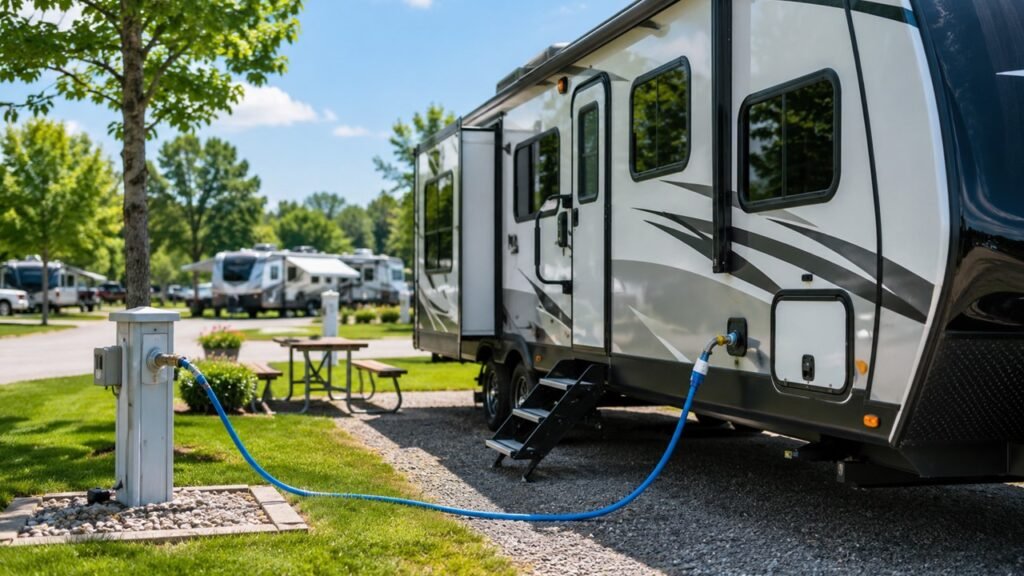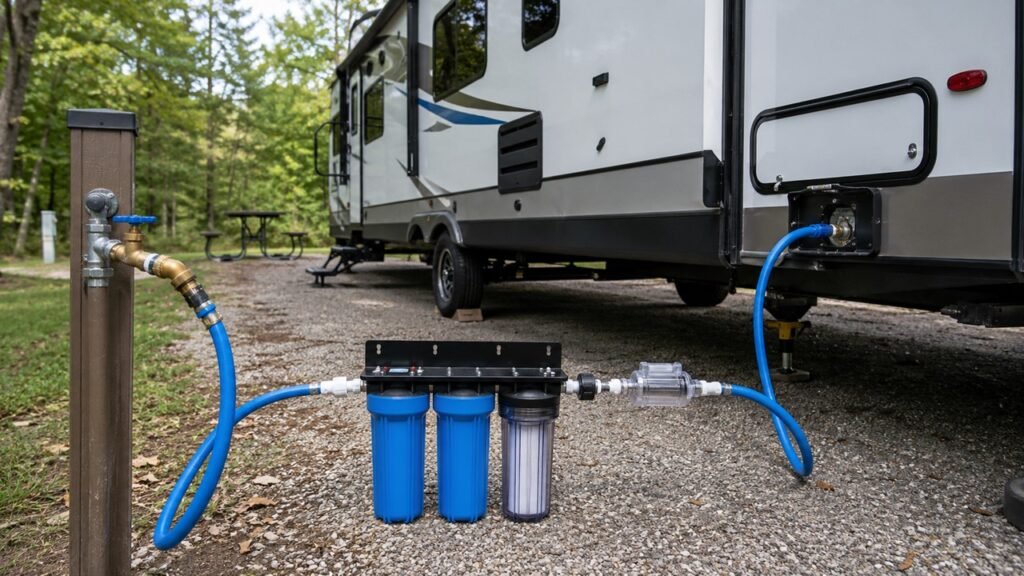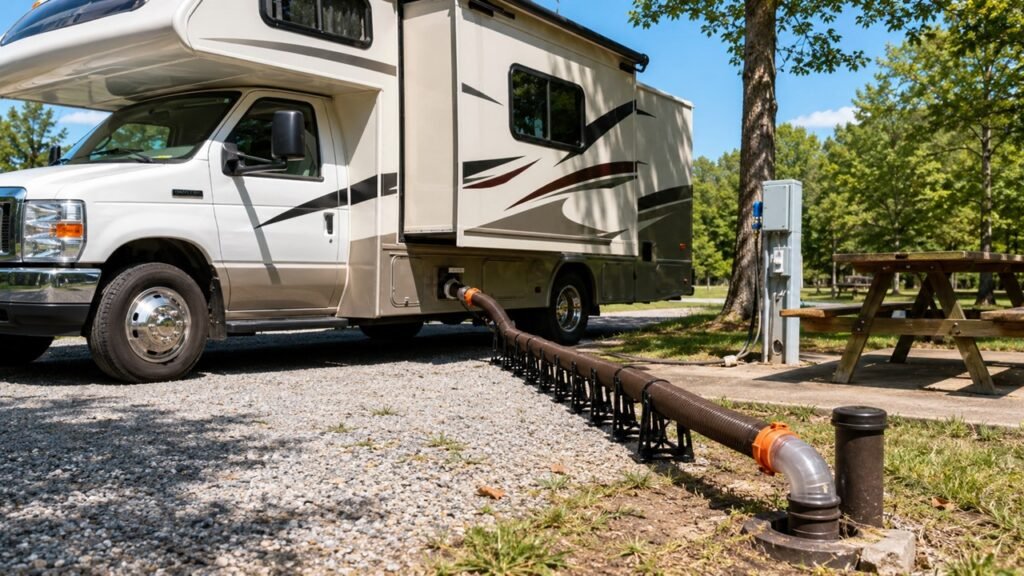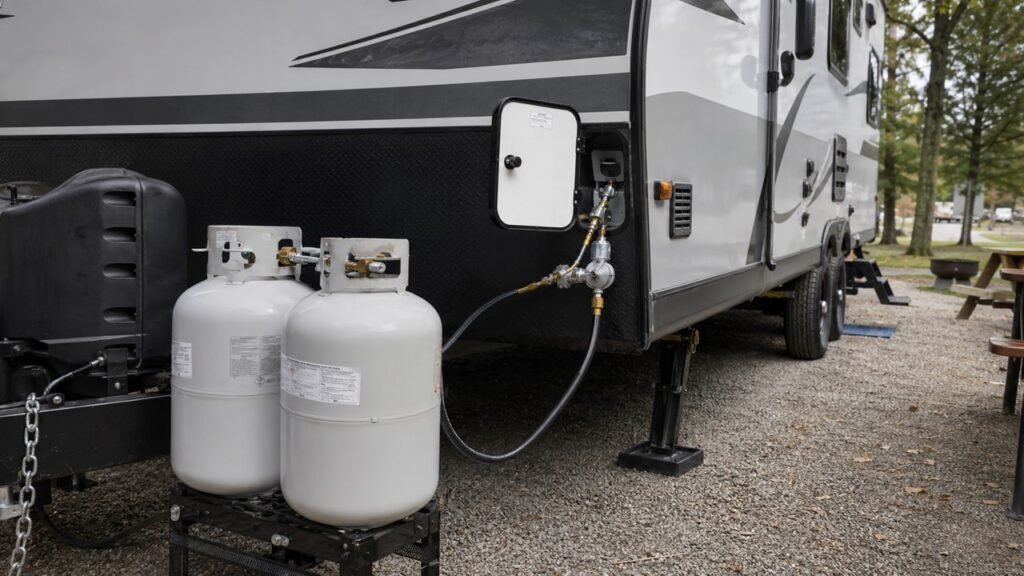
RV battery power works by storing 12-volt DC electricity and sending it to essential RV systems like lights, fans, the water pump, furnace blower, appliance control boards, and safety detectors. When the RV is plugged into shore power or a generator, a converter charges the battery and supplies 12V power. If your RV has an inverter, it can also turn battery power into 120V AC power for household-style devices.
In this article, I’ll walk you through how RV battery power flows, what your battery actually powers, how it gets recharged, how converters and inverters fit in, and how to avoid common battery problems while camping.
Key Takeaways
- RV batteries mainly store and supply 12-volt DC power.
- Battery power runs essential off-grid systems like lights, fans, water pumps, furnace blowers, and appliance controls.
- Shore power and generators supply 120-volt AC power for larger appliances.
- A converter changes 120V AC power into 12V DC power and charges the battery.
- An inverter changes 12V DC battery power into 120V AC power for household devices.
- Battery capacity is usually measured in amp-hours, but real runtime depends on power use.
- Solar panels, generators, shore power, and alternators can recharge RV batteries.
- Lithium batteries offer more usable power than lead-acid batteries, but they cost more upfront.
- Understanding the difference between 12V DC and 120V AC makes RV power much easier to manage.
What Is RV Battery Power?
RV battery power is the stored electricity your RV uses when it is not plugged into a campground pedestal, generator, or other outside power source. In simple words, it is the power that keeps basic RV systems running when you are camping off-grid, stopping overnight, or using your RV away from hookups.
Most RV batteries are called house batteries or coach batteries. These are different from a normal car starting battery. A car battery gives a strong burst of power for a few seconds to start an engine. An RV house battery is designed to deliver smaller amounts of power over a longer period.
That difference matters because RV living loads are steady. Your lights may stay on for hours. Your furnace blower may run through the night. Water pump may turn on and off all day. Your refrigerator, water heater, and propane appliances may still need 12V power for their control boards.
So, the RV battery is not just a backup. It is the heart of the 12V side of your RV electrical system.
How Does RV Battery Power Work In Simple Terms?
RV battery power can feel confusing at first because an RV uses more than one type of electricity. But the basic idea is simple: your battery stores low-voltage power, your RV sends that power to essential systems, and other devices help recharge or convert that power when needed.
Here is the simple flow:
- The RV battery stores 12V DC power.
- The RV fuse panel sends that power to 12V devices.
- Lights, fans, pumps, and control boards use that stored power.
- When plugged in, the converter charges the battery.
- When using solar, the charge controller manages solar charging.
- If you have an inverter, it can turn battery power into 120V AC power.
- The more devices you run, the faster your battery drains.
Think of the battery as a water tank. The appliances are faucets. The converter, solar panels, generator, and alternator are different ways to refill the tank. The bigger the tank and the slower you use it, the longer you can camp without plugging in.
RV Battery Power Flow: From Source To Appliance
Your RV battery does not work alone. It works with panels, fuses, breakers, chargers, and sometimes an inverter. This table gives you a quick view of how power moves through an RV.
| Power Source | Power Type | Main Device Involved | What It Powers |
| RV battery | 12V DC | Fuse panel | Lights, fans, water pump, furnace blower |
| Shore power | 120V AC | Breaker panel | Outlets, microwave, air conditioner |
| Shore power to battery | AC to DC | Converter | Charges battery and runs 12V loads |
| Battery to outlets | DC to AC | Inverter | TV, laptop charger, coffee maker, small appliances |
| Solar panels | DC power | Charge controller | Recharges the battery bank |
| Generator | 120V AC | Converter or inverter-charger | Runs AC loads and charges batteries |
| Tow vehicle or motorhome alternator | DC power | Charge line or DC-to-DC charger | Recharges battery while driving |
This is why two RV owners can have very different experiences. One RV may only run lights and a water pump from the battery. Another may have lithium batteries, solar, and a large inverter that can run many household devices off-grid.
Understanding 12-Volt DC And 120-Volt AC Power
To understand RV battery power, you need to understand the two electrical systems inside most RVs. One side is low-voltage battery power. The other side is household-style power.
12-Volt DC Power In An RV
The 12V DC system is the battery-powered side of your RV. DC stands for direct current, which means the electrical current flows in one direction. This is the same general type of power used by car batteries.
In an RV, 12V DC power usually runs the essentials. These are the things you still want working even when you are not plugged into a campground pedestal.
Common 12V DC items include:
- Interior LED lights
- Exterior lights
- Water pump
- Roof vent fans
- Furnace blower
- Propane refrigerator control board
- Water heater control board
- Propane detector
- Carbon monoxide detector
- USB charging ports
- Tank monitor panel
- Power awning in some RVs
- Slide-outs in some RVs
A helpful thing to remember is this: if the item is small, built into the RV, or needed for basic camping, there is a good chance it uses 12V DC power.
120-Volt AC Power In An RV
The 120V AC system is the household-style side of your RV. AC stands for alternating current. This is the same type of power that comes from regular wall outlets in a house.
In most RVs, 120V AC power comes from shore power, a generator, or an inverter. It powers larger appliances and standard outlets.
Common 120V AC items include:
- Air conditioner
- Microwave
- Standard wall outlets
- Electric fireplace
- Residential refrigerator in some RVs
- Coffee maker
- Toaster
- Hair dryer
- Electric water heater mode
- TV and entertainment devices
- Battery converter or charger
The important difference is that your battery does not naturally provide 120V AC power. Your battery stores 12V DC power. So, to run 120V AC appliances from the battery, you need an inverter.
Why RVs Use Both AC And DC Power
RVs use both systems because they need to work in two different situations. When you are plugged into shore power, you want to use larger appliances just like you would at home. When you are away from hookups, you still need basic systems like lights, water, fans, and safety detectors.
The 12V system gives your RV independence. The 120V system gives your RV comfort. Together, they let you camp at a full-hookup RV park one week and dry camp in a quiet place the next.
What Does An RV Battery Actually Power?
Many new RV owners assume the battery powers everything inside the RV. That is not always true. Some items work directly from the battery, some need shore power, and some need an inverter before battery power can run them.
| RV Item | Runs On Battery? | Notes |
| Interior LED lights | Yes | Usually 12V DC |
| Water pump | Yes | Needed when using the freshwater tank |
| Roof vent fan | Yes | Usually 12V DC |
| Furnace blower | Yes | Propane creates heat, but battery runs the fan |
| Propane refrigerator controls | Yes | The control board still needs 12V power |
| Propane water heater controls | Yes | Ignition and controls usually need 12V |
| Propane detector | Yes | Often always active for safety |
| Wall outlets | Not by battery alone | Need shore power, generator, or inverter |
| Microwave | Only with inverter or AC power | High power draw |
| Air conditioner | Usually no | Needs shore power, generator, or a large battery/inverter system |
| Coffee maker | Only with inverter or AC power | Can drain batteries quickly |
| TV | Depends | Some are 12V, others need 120V AC |
| Slide-outs | Often yes | Battery should be well charged |
| Power awning | Often yes | Uses 12V motor power |
A simple way to remember it is this: the RV battery normally powers camping essentials, not every household appliance. For outlets, microwaves, and air conditioners, you usually need shore power, a generator, or a properly sized inverter system.
House Battery Vs Chassis Battery
Not every battery in an RV does the same job. Motorhomes often have a battery for the vehicle side and another battery bank for the living space. Travel trailers usually focus on the house battery system.
House Battery
The house battery, also called the coach battery, powers the living area of the RV. This is the battery that runs your lights, fans, pump, furnace blower, control boards, and other 12V camping systems.
House batteries are usually deep-cycle batteries. That means they are designed to be discharged and recharged many times. They are built for steady use over time, not just quick engine starting.
If you like dry camping or boondocking, the house battery is one of the most important parts of your setup. A weak or undersized house battery can make even a simple overnight stay frustrating.
Chassis Battery
The chassis battery is found in motorhomes. It starts the engine and powers vehicle-related systems like headlights, wipers, dashboard electronics, and other driving components.
This battery works more like the battery in a car or truck. It is designed to provide a large burst of power to start the engine, then recharge while driving.
In many motorhomes, the chassis battery and house battery are separated so your camping loads do not leave you unable to start the engine.
Why They Are Kept Separate
The house and chassis batteries are kept separate for a very practical reason: you do not want your lights, fans, or furnace blower draining the same battery that starts your engine.
Some RVs use a battery isolator, charge solenoid, battery combiner, or DC-to-DC charger to manage charging between the two systems. These devices can allow charging while driving while still helping protect the starting battery when parked.
In travel trailers, the tow vehicle may send some charge through the trailer wiring connection. However, that charging is often limited. For better charging while driving, many RVers use a DC-to-DC charger.
Types Of RV Batteries
RV batteries come in a few common types. They all store power, but they behave differently when it comes to maintenance, usable capacity, charging speed, weight, and cost.
| Battery Type | Best For | Pros | Cons |
| Flooded lead-acid | Budget RV setups | Affordable and widely available | Heavy, needs water checks, limited usable capacity |
| AGM | Low-maintenance lead-acid setups | Sealed, vibration-resistant, easier to maintain | More expensive than flooded, still heavy |
| Gel | Special charging applications | Sealed and low maintenance | Sensitive to incorrect charging voltage |
| Lithium LiFePO4 | Boondocking and solar setups | Lightweight, more usable power, long cycle life | Higher upfront cost, needs compatible charging |
Flooded Lead-Acid Batteries
Flooded lead-acid batteries are the traditional RV battery choice. They are usually the most affordable option, and you can find them almost anywhere.
The downside is maintenance. Flooded batteries contain liquid electrolyte, so the water level may need to be checked and topped off with distilled water. They also need ventilation because they can release gases while charging.
Another important point is usable capacity. With lead-acid batteries, many RV owners avoid draining them too deeply because repeated deep discharges can shorten battery life. That means a 100Ah flooded battery does not always give you 100Ah of practical everyday use.
AGM Batteries
AGM stands for absorbed glass mat. These are sealed lead-acid batteries where the electrolyte is held in glass mats instead of freely moving liquid.
AGM batteries are popular because they need less maintenance than flooded batteries. You do not have to add water, and they handle vibration well. They are also cleaner to use because they do not vent like flooded batteries under normal conditions.
However, AGM batteries are still heavy, and they usually cost more than flooded batteries. They also do not offer the same usable capacity advantage as lithium batteries.
Lithium LiFePO4 Batteries
Lithium LiFePO4 batteries are becoming more common in RVs, especially for people who camp off-grid often. They cost more upfront, but they offer several major advantages.
Lithium RV batteries are lighter, charge faster, and provide more usable capacity. A 100Ah lithium battery can usually deliver much more practical usable energy than a 100Ah lead-acid battery.
Common lithium benefits include:
- More usable capacity
- Lighter weight
- Faster charging
- Longer cycle life
- Better performance for solar setups
- More stable voltage under load
- Less maintenance
The main downside is cost. Lithium batteries also need compatible charging equipment. If your converter, solar controller, or alternator charging system is not lithium-compatible, you may need upgrades.
RV Battery Capacity Explained: Amp-Hours, Watts, And Runtime
Battery capacity can sound technical, but you do not need to be an electrician to understand the basics. The main terms to know are amp-hours, watts, volts, and usable capacity.
What Amp-Hours Mean
Amp-hours, written as Ah, describe how much current a battery can deliver over time. For example, a 100Ah battery can theoretically provide 5 amps for 20 hours, or 10 amps for 10 hours.
But that is the simple math version. In real RV use, battery type, temperature, age, discharge depth, wiring, inverter losses, and appliance load all affect runtime.
This is why two people with “100Ah batteries” may get very different results. One may have an older flooded lead-acid battery. Another may have a newer lithium battery with better usable capacity.
Why Watts Matter
Watts measure power use. Many appliances list their power draw in watts, especially household-style appliances.
The basic formula is:
Watts = Volts × Amps
For RV battery use, you can also estimate amp-hours like this:
Amp-hours used = Watts ÷ Volts × Hours
For example, if a 60-watt laptop charger runs from a 12V battery for 3 hours:
60 watts ÷ 12 volts × 3 hours = 15Ah
That estimate does not include inverter losses. If you use an inverter, you may need to add extra battery use because some energy is lost during conversion.
Simple RV Battery Runtime Examples
These examples are only estimates, but they show why small 12V devices are easy on batteries while high-wattage appliances drain them quickly.
| Device | Approximate Draw | Time Used | Estimated Battery Use |
| LED light | 5 watts | 5 hours | About 2Ah |
| Water pump | 60 watts | 15 minutes | About 1–2Ah |
| Roof vent fan | 20–40 watts | 8 hours | About 13–27Ah |
| Furnace blower | 70–100 watts | 4 hours total | About 23–33Ah |
| Laptop charger | 60 watts | 3 hours | About 15Ah before inverter losses |
| TV | 50–100 watts | 3 hours | About 13–25Ah before inverter losses |
| Microwave | 1,000+ watts | 10 minutes | High draw; needs inverter and strong battery bank |
This is why your RV lights can run for a long time, but a microwave can pull a serious amount of power in just a few minutes.
How Long Will An RV Battery Last While Camping?
An RV battery can last one night, several days, or even longer depending on your setup and usage. There is no single answer because every RV and camping style is different.
Your battery runtime depends on:
- Battery capacity in amp-hours
- Battery chemistry
- Usable depth of discharge
- Number of batteries in the bank
- How often you use lights and fans
- Furnace fan use in cold weather
- Water pump use
- Inverter use
- Outside temperature
- Solar charging
- Generator charging
- Hidden parasitic loads
A basic single lead-acid battery may be enough for lights and light water pump use during a short trip. But if you run a furnace blower overnight, charge laptops, use an inverter, or camp in cold weather, that same battery may drain much faster.
As a general rule, a 100Ah lead-acid battery may only give you around half of its capacity for regular practical use if you want to protect battery life. A 100Ah lithium battery usually gives you much more usable energy. That difference is one reason lithium is popular with frequent boondockers.
How RV Batteries Are Recharged
RV batteries are not meant to be drained and forgotten. They need to be recharged regularly. The good news is that RVs can recharge batteries in several ways.
Charging From Shore Power
When you plug your RV into a campground pedestal or home outlet, you are using shore power. Shore power brings 120V AC electricity into your RV.
Once that power enters the RV, the converter changes some of it into 12V DC power. That 12V power can run your DC systems and recharge your battery at the same time.
This is why your lights still work when plugged in, even if the battery is low. In many RVs, the converter is supplying the 12V system while also charging the battery.
Charging From A Generator
A generator works like portable shore power. It produces 120V AC electricity that your RV can use when hookups are not available.
When the generator is running, it can power your converter or inverter-charger. That device then charges the RV batteries.
Generators are useful when solar is not enough, when the weather is cloudy, or when you need to recover battery power quickly. The downside is noise, fuel use, and campground generator-hour restrictions.
Charging While Driving
Many motorhomes can charge the house batteries from the engine alternator while driving. This helps replace some battery power between campsites.
Travel trailers may also receive a charge from the tow vehicle through the trailer wiring connection. However, this charge is often slow because of wire length, voltage drop, and limited current.
If you rely heavily on driving to recharge your batteries, a DC-to-DC charger is often a better option. It gives more controlled charging and is especially helpful for lithium batteries.
Charging With Solar Panels
Solar panels create DC electricity from sunlight. That power does not go straight into the battery without control. It first goes through a solar charge controller.
The solar charging process looks like this:
- Solar panels collect sunlight.
- The panels produce DC electricity.
- The charge controller regulates voltage and current.
- The battery stores the energy.
- Your RV uses that stored energy later.
Solar is excellent for extending your battery life, especially if you use modest power. But solar is not magic. Shade, clouds, panel size, battery size, season, and appliance use all affect how well it works.
Charging With A DC-To-DC Charger
A DC-to-DC charger takes power from a vehicle alternator and charges the RV battery in a controlled way. This is especially helpful for motorhomes, campervans, and travel trailers that need better charging while driving.
It can also protect your alternator and battery system by controlling the charge rate. For lithium batteries, this matters because lithium can accept charge quickly and may require a different charging profile than lead-acid batteries.
Converter, Inverter, Inverter-Charger, And Charge Controller Explained
Several RV power devices sound similar, but they do different jobs. Once you understand these parts, RV battery power becomes much easier to follow.
| Device | What It Does | When It Works |
| Converter | Changes 120V AC to 12V DC | When plugged into shore power or generator |
| Inverter | Changes 12V DC to 120V AC | When using battery power for AC devices |
| Inverter-charger | Combines inverter and battery charger | Common in larger RV power systems |
| Solar charge controller | Regulates solar power going into battery | When solar panels are producing power |
| Transfer switch | Switches between power sources | When moving between shore, generator, or inverter |
What An RV Converter Does
An RV converter changes 120V AC power into 12V DC power. It usually works when your RV is connected to shore power or a generator.
The converter has two main jobs. First, it helps power the 12V systems in your RV. Second, it charges the RV battery.
If your converter fails, you may notice dim lights, a battery that does not charge, or 12V systems that stop working after the battery drains.
What An RV Inverter Does
An RV inverter does the opposite of a converter. It takes 12V DC power from your battery and changes it into 120V AC power.
That lets you use some household-style devices when you are not plugged in.
An inverter can help you run:
- Laptop chargers
- TVs
- Small kitchen appliances
- CPAP machines
- Camera chargers
- Small power tools
- Some microwaves with the right setup
But an inverter does not create power. It only converts battery power. So, if you run high-wattage appliances through an inverter, your battery can drain quickly.
What An Inverter-Charger Does
An inverter-charger combines two jobs in one device. When AC power is available, it charges the batteries. When AC power is not available, it can invert battery power into 120V AC power.
These are common in larger RVs, upgraded solar systems, and serious off-grid setups. They simplify the system because one unit can handle charging and inverting.
What A Solar Charge Controller Does
A solar charge controller sits between your solar panels and battery. Its job is to regulate the power going into the battery.
Without a charge controller, solar panels could send unsafe voltage to the battery. A proper controller helps prevent overcharging and supports better battery health.
There are two common types: PWM and MPPT. MPPT controllers are usually more efficient, especially in larger solar setups.
Series Vs Parallel RV Battery Wiring
Battery wiring affects voltage and capacity. This section is important because incorrect wiring can damage equipment or create safety risks. For major battery work, it is best to use a qualified RV technician or electrician.
Parallel Wiring
Parallel wiring keeps the voltage the same but increases amp-hour capacity.
For example, if you connect two 12V 100Ah batteries in parallel, you still have a 12V system, but the capacity becomes 200Ah.
Parallel wiring is common when RV owners want more capacity while keeping a 12V battery system.
Series Wiring
Series wiring increases voltage while capacity stays the same.
For example, two 6V 200Ah batteries wired in series become a 12V 200Ah battery bank.
This is common in RVs that use 6V golf-cart-style batteries. The batteries are paired together to create the 12V power the RV needs.
Series-Parallel Wiring
Series-parallel wiring combines both methods. It is often used in larger battery banks where multiple 6V batteries are connected to create a larger 12V system.
| Wiring Method | Voltage Result | Capacity Result | Common RV Use |
| Parallel | Same voltage | Higher amp-hours | Multiple 12V batteries |
| Series | Higher voltage | Same amp-hours | Two 6V batteries making 12V |
| Series-parallel | Depends on setup | Higher total capacity | Larger RV battery banks |
Always make sure the battery bank voltage matches your RV electrical system. Most RV house systems are 12V, but some upgraded systems may use 24V or 48V equipment.
How Battery Power Reaches Your RV Appliances
Battery power does not jump straight from the battery to every appliance. It travels through cables, fuses, distribution panels, switches, and appliance controls.
The basic path usually looks like this:
- Battery stores 12V DC power.
- Battery cables carry power to the RV distribution system.
- The fuse panel protects individual 12V circuits.
- Switches send power to lights, fans, pumps, and other devices.
- Appliance control boards use 12V power to operate safely.
- Larger AC appliances use breakers instead of fuses.
- Inverters can supply selected 120V circuits if installed.
This is why troubleshooting starts with identifying the power type. If your lights are not working, you usually check the 12V side. If your outlets are not working, you usually check the 120V side.
RV Fuse Panel Vs Breaker Panel
RVs use fuses and breakers because the 12V DC system and 120V AC system need different protection. Knowing which panel controls which system helps you solve problems faster.
| Panel Type | Power Type | Protects | Common Issues |
| Fuse panel | 12V DC | Lights, pump, fans, controls | Blown fuse, loose connection |
| Breaker panel | 120V AC | Outlets, microwave, air conditioner | Tripped breaker, overload |
| GFCI outlet | 120V AC | Wet-area outlets | Needs reset after a fault |
If your RV lights stop working, check the fuse panel and battery voltage. If your outlets stop working, check shore power, breakers, and GFCI outlets.
This one habit can save you a lot of frustration because you will not waste time looking at the wrong side of the system.
Battery Monitoring: How To Know How Much Power You Have Left
Guessing battery level is not a great strategy when camping. A good battery monitor or voltage reading helps you understand when to conserve power and when to recharge.
Voltage Readings
Voltage can give you a rough idea of battery charge, especially with lead-acid batteries. However, voltage readings can be misleading while the battery is under load or actively charging.
| 12V Lead-Acid Voltage | Approximate Charge |
| 12.7V or higher | Full |
| 12.4V | Around 75% |
| 12.2V | Around 50% |
| 12.0V | Around 25% |
| 11.8V or lower | Very low |
For the most useful reading, let the battery rest with no charging or heavy load before checking voltage.
Battery Monitor
A shunt-based battery monitor is more accurate than a simple voltage display. It tracks power going into and out of the battery, then estimates the remaining charge.
This is especially useful with lithium batteries because their voltage stays fairly steady for much of the discharge cycle. With lithium, voltage alone may not show the real state of charge until the battery is already quite low.
Why RV Control Panel Readings Can Be Misleading
Many RVs come with simple battery indicators that show levels like full, two-thirds, one-third, or empty. These panels are easy to read, but they are not very precise.
They often measure voltage, not true capacity. So, the display may look full when plugged in, then drop quickly once the RV is unplugged.
For weekend camping, a basic panel may be enough. For boondocking, a real battery monitor is much more helpful.
Common RV Battery Problems And What They Mean
Most RV battery problems come from a few common causes: low charge, poor charging, bad connections, old batteries, parasitic loads, or confusion between the AC and DC systems.
| Problem | Likely Cause | What To Check First |
| Lights are dim | Low battery or converter issue | Battery voltage and converter output |
| Battery will not charge | Bad converter, loose cable, wrong charger setting | Shore power, fuses, charger settings |
| Outlets do not work | No AC power or tripped breaker | Shore power, breaker, GFCI outlet |
| Battery drains overnight | Parasitic loads or inverter left on | Inverter, detectors, control boards |
| Furnace stops working | Low battery voltage | Battery charge and furnace fuse |
| Solar is not charging | Shade, controller issue, blown fuse, wiring fault | Charge controller display and panel input |
| Battery smells or gets hot | Overcharging or battery failure | Stop using and inspect safely |
| Battery dies in storage | Parasitic draw | Battery disconnect and storage charge |
| Slide-outs move slowly | Low battery or weak connection | Battery charge and cable condition |
A good troubleshooting habit is to ask: “Is this a 12V problem or a 120V problem?” That single question usually points you in the right direction.
Why Your RV Battery Drains Even When Nothing Is On
Your RV battery can drain even when you think everything is turned off. This happens because some devices quietly use power in the background.
These hidden power users are called parasitic loads.
Common parasitic loads include:
- Propane detector
- Carbon monoxide detector
- Stereo memory
- Refrigerator control board
- Water heater control board
- Tank monitor panel
- Inverter standby draw
- Keyless entry system
- Smart control system
- Antenna booster
- Small indicator lights
One small load may not seem like much. But several small loads running day and night can drain a battery during storage or a long off-grid stay.
A battery disconnect switch can help during storage. However, some safety devices may bypass the disconnect, depending on the RV. If you are storing the RV for a long time, check the battery regularly or disconnect it properly according to your RV and battery manufacturer guidance.
RV Battery Maintenance Tips
Different battery types need different care. A flooded lead-acid battery does not need the same maintenance as lithium, and lithium does not behave like AGM.
Lead-Acid Battery Maintenance
Flooded lead-acid batteries need the most regular care.
Use these basic maintenance habits:
- Check electrolyte levels when recommended.
- Add distilled water only when needed.
- Keep battery terminals clean and tight.
- Look for corrosion around terminals.
- Keep the battery compartment ventilated.
- Avoid repeated deep discharges.
- Recharge the battery after use.
- Store the battery fully charged.
- Use a compatible charger.
- Inspect cables for damage or looseness.
If a flooded battery needs water constantly, it may be overcharging. That is a sign to check the charger or converter.
AGM Battery Maintenance
AGM batteries are easier to maintain because they are sealed. You do not add water, and they are less messy than flooded batteries.
Still, they are not maintenance-free in every way. You should keep terminals clean, use the correct charging profile, avoid deep discharging when possible, and store them properly.
AGM batteries can be a good middle ground for RV owners who want less maintenance but do not want to pay for lithium.
Lithium Battery Maintenance
Lithium LiFePO4 batteries need less routine maintenance, but they need the right system setup.
Important lithium care tips include:
- Use lithium-compatible charging profiles.
- Check whether your converter supports lithium.
- Use a compatible solar charge controller.
- Avoid charging below freezing unless the battery supports it.
- Protect the battery from extreme heat.
- Monitor state of charge with a battery monitor.
- Follow manufacturer storage guidance.
- Make sure the battery management system is working properly.
Lithium batteries are excellent for off-grid RV power, but they work best when the full charging system is designed for them.
Safety Tips For RV Battery Power
RV battery power may be low voltage, but it can still be dangerous. Batteries can produce high current, and RVs also have 120V AC circuits that require extra caution.
Follow these safety tips:
- Disconnect shore power before working on the electrical system.
- Turn off generators before inspecting wiring.
- Disconnect battery power before electrical service.
- Use properly sized fuses and breakers.
- Never bypass a fuse.
- Avoid sparks near flooded lead-acid batteries.
- Keep flooded batteries in ventilated compartments.
- Do not mix old and new batteries in the same bank.
- Do not mix battery chemistries in the same bank.
- Use the correct wire gauge for inverters and chargers.
- Secure batteries so they cannot move while driving.
- Use chargers compatible with your battery type.
- Replace damaged cables or swollen batteries.
- Hire a qualified RV technician for major electrical work.
If you are not sure what you are doing, stop and get help. RV electrical mistakes can damage equipment, start fires, or create shock hazards.
How To Get More Battery Power In An RV
If your RV battery runs out too quickly, you have two choices: store more power or use less power. The best setup usually does both.
Add More Battery Capacity
Adding more battery capacity gives you more stored energy. This can mean adding another battery or upgrading to a larger battery bank.
However, batteries should be matched properly. Mixing old and new batteries, or mixing different battery types, can create charging and performance problems.
If you add capacity, also make sure your charger, wiring, fuses, and storage space can safely support the upgrade.
Upgrade To Lithium
Lithium batteries can be a major upgrade for RVers who camp off-grid often. They provide more usable capacity, charge faster, and weigh less than lead-acid batteries.
The higher upfront cost is the main drawback. You may also need a lithium-compatible converter, solar controller, battery monitor, or DC-to-DC charger.
For occasional campground camping, lithium may not be necessary. For regular boondocking, it can make a big difference.
Add Solar Panels
Solar panels help recharge the battery during the day. They are especially useful for campers who use lights, fans, water pumps, laptops, and other moderate loads.
But solar does not replace good power management. A small solar panel will not run an air conditioner all day. Shade, weather, roof space, and battery size all matter.
A good solar system should be sized around your actual power use, not just the biggest panel that fits the roof.
Use A Generator Strategically
A generator can recharge batteries when solar is not enough. It is useful in cloudy weather, heavy shade, winter camping, or high-power situations.
The best approach is to use the generator during efficient charging periods. Many batteries accept the most charge when they are lower, then charge more slowly as they get full.
Always follow campground rules and safe generator practices.
Reduce Power Consumption
Sometimes the easiest way to get more battery life is to waste less power.
Helpful habits include:
- Switch to LED lights.
- Turn lights off when not needed.
- Use propane mode for the fridge when appropriate.
- Turn off the inverter when not using AC devices.
- Avoid running high-wattage appliances from battery power.
- Use roof fans before using air conditioning.
- Charge devices during peak solar hours.
- Keep furnace use reasonable in cold weather.
- Monitor battery level daily.
- Fix bad connections and weak batteries early.
Small changes add up quickly when you are camping on battery power.
What Size RV Battery Bank Do You Need?
The right battery bank depends on how you camp. Someone who stays at full-hookup campgrounds does not need the same setup as someone who boondocks for a week.
| Camping Style | Typical Battery Setup | Best Fit |
| Campgrounds with hookups | One basic deep-cycle battery | Weekend use and backup power |
| Occasional dry camping | 100–200Ah usable capacity | Lights, pump, fans, light charging |
| Regular boondocking | 200–400Ah usable capacity | Solar, fridge controls, fans, devices |
| Heavy off-grid use | 400Ah+ with inverter setup | Laptops, appliances, longer stays |
| AC on battery | Large lithium bank and large inverter | Advanced and expensive setup |
For most casual RVers, a simple battery setup is enough. But if you want to run an inverter, work remotely, use solar, or camp without hookups often, battery capacity becomes much more important.
A good method is to list your daily power use first. Then size the battery bank around real needs instead of guessing.
Can RV Batteries Run An Air Conditioner?
Technically, yes, RV batteries can run an air conditioner if the system is large enough. But most standard RV battery setups cannot do it for long.
An RV air conditioner uses a lot of power. It also needs a large surge of power when starting. To run one from batteries, you usually need a large lithium battery bank, a high-capacity inverter, heavy-duty wiring, proper fusing, and often a soft start device.
For most RV owners, it is more practical to run the air conditioner from shore power or a generator. Battery-powered air conditioning is possible, but it is usually an advanced and expensive setup.
If your RV only has one standard lead-acid battery, do not expect it to run the air conditioner. That battery is meant for lights, fans, pumps, and controls, not heavy cooling loads.
Simple Example: How RV Battery Power Works During A Camping Day
Let’s imagine a normal camping day without hookups.
In the morning, you turn on the lights, use the water pump, and run the roof vent fan. All of those use 12V battery power. If your refrigerator is running on propane, it may still use 12V power for its control board.
Later, the sun comes up and your solar panels begin charging the battery through the charge controller. You plug in a laptop through an inverter, so the inverter changes battery power into 120V AC power. That works, but it uses more energy than a simple 12V light.
At lunch, you want to use the microwave. If you do not have shore power, a generator, or a large inverter and battery bank, the microwave may not work. That is because it needs 120V AC power and draws a lot of watts.
At night, the furnace runs on propane, but the blower fan uses battery power. If it is cold and the furnace cycles often, your battery can drop faster than expected.
By morning, your battery level tells you what to do next. If solar is strong, you may recover during the day. If not, you may need to conserve power, drive, plug in, or run a generator.
That is RV battery power in real life. It is not just about having a battery. It is about knowing what uses power, how fast it drains, and how you plan to recharge it.
Conclusion
RV battery power is easier to understand once you separate the system into two parts: 12V DC power and 120V AC power. Your RV battery stores 12V DC power and runs the essentials, including lights, fans, the water pump, furnace blower, safety detectors, and appliance control boards.
When you plug into shore power or run a generator, your converter recharges the battery and supplies 12V power. When you are off-grid, an inverter can turn battery power into 120V AC power for selected household devices, but it will drain the battery faster.
The main thing to remember is simple: your RV battery is designed to keep the core camping systems working when you are unplugged. Once you know what runs on battery, what needs AC power, and how your battery recharges, managing RV power becomes much less confusing.
Related FAQs
Does An RV Battery Power The Outlets?
Usually, no. Standard RV outlets need shore power, generator power, or inverter power. The battery alone normally powers 12V systems unless an inverter is installed.
Does An RV Battery Charge When Plugged Into Shore Power?
Yes. In most RVs, the converter charges the battery when the RV is connected to shore power.
Can I Use My RV Without A Battery?
Some RV systems may work while plugged in, but many 12V controls, safety devices, and appliances need a battery or stable 12V power.
How Long Does A 12V RV Battery Last?
It depends on battery size, battery type, and power use. A small battery may last one night, while a larger lithium bank can last much longer.
What Is The Difference Between An RV Converter And Inverter?
A converter changes 120V AC power into 12V DC power. An inverter changes 12V DC battery power into 120V AC power.
Why Does My RV Battery Keep Dying?
Common causes include parasitic loads, an inverter left on, an old battery, poor charging, loose connections, or a failing converter.
Do Solar Panels Power The RV Directly?
Not usually. Solar panels charge the battery through a charge controller, and the battery powers the RV systems later.
Should I Leave My RV Plugged In All The Time?
You can if the charger has a proper maintenance or float mode. Still, check battery condition regularly, especially with flooded lead-acid batteries.
Are Lithium RV Batteries Worth It?
Lithium batteries are worth it for frequent boondocking, solar setups, and heavy battery use. For occasional campground camping, lead-acid may be enough.
Can My Tow Vehicle Charge My RV Battery?
Yes, but charging through the tow vehicle is often slow. A DC-to-DC charger gives better and more controlled charging.
Why Do My RV Lights Work But My Outlets Do Not?
Your lights usually run on 12V DC battery power, while outlets need 120V AC power from shore power, a generator, or an inverter.
Can An RV Battery Run A Refrigerator?
It depends on the refrigerator type. A propane RV fridge usually needs 12V power for controls, while a residential fridge needs 120V AC power or an inverter.

Michael Carter is an experienced RV traveler who focuses on practical outdoor trips across the States. He writes clear, step-by-step guides and realistic reviews based on real travel needs. His aim is to help RV and camper owners plan informed, simpler journeys with confidence.